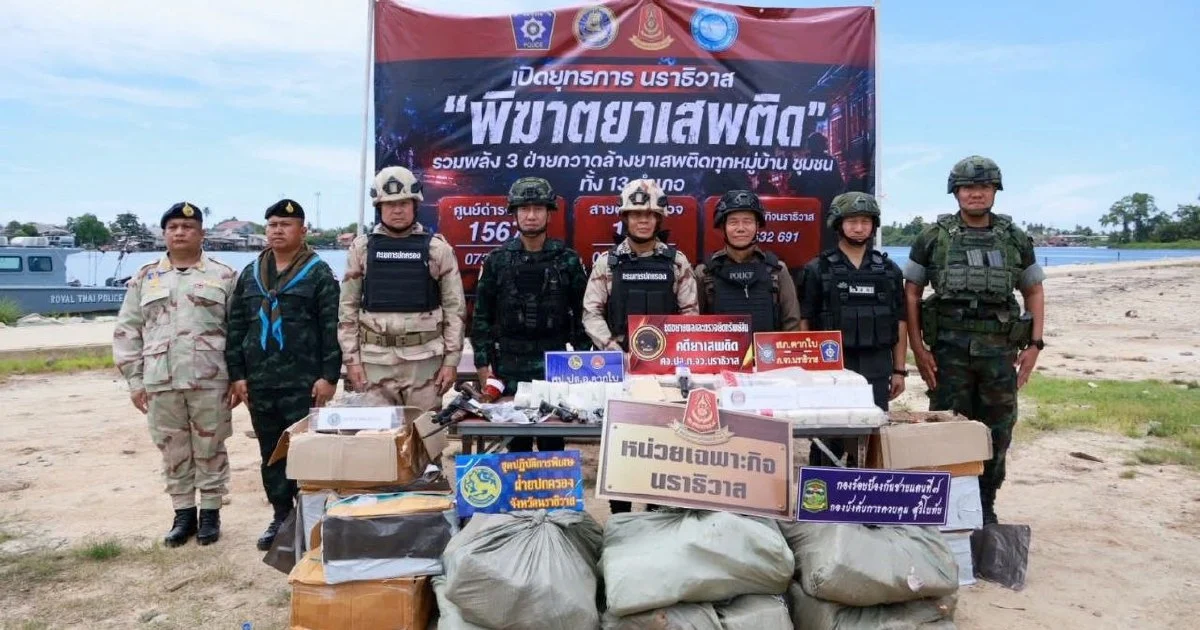
Thai law enforcement has moved decisively against organised drug trafficking by arresting 233 individuals suspected of involvement in narcotics operations, marking a significant escalation in regional counter-narcotics efforts. The intensive month-long operation unfolded in Narathiwat province, Thailand's southernmost domain, where police identified members of multiple criminal syndicates engaged in the illicit trade. Intelligence gathered by Thai authorities indicates that certain arrested individuals maintain operational ties with Malaysian-based drug trafficking organisations, raising serious concerns about the porous nature of the Thailand-Malaysia border and the sophistication of transnational criminal networks operating across Southeast Asia.
The scale of arrests demonstrates Thailand's commitment to dismantling supply chains that feed regional drug markets. Narathiwat province, positioned strategically along the southern frontier, has long been identified as a critical transit point for narcotics moving between Thailand and Malaysia. Criminal groups utilise the region's geography and established smuggling routes to move contraband with relative impunity, exploiting border vulnerabilities and corrupt officials. The police operation successfully disrupted at least one such network attempting to transport approximately RM1.2 million worth of controlled substances through Malaysian territory, intercepting shipments that would have destabilised communities downstream.
The arrest operation reveals the interconnected nature of Southeast Asian drug trafficking. Thai authorities determined that numerous detained suspects maintained direct operational relationships with Malaysian counterparts, indicating coordinated supply and distribution arrangements across national lines. Such links suggest sophisticated organisational structures capable of managing complex logistics, money laundering, and personnel coordination across borders. The existence of these networks underscores how individual national crackdowns, while valuable, remain insufficient without genuine regional cooperation and intelligence-sharing mechanisms that can track suspects and shipments moving between jurisdictions.
Narathiwat's significance in regional trafficking cannot be overstated. The province borders Malaysia's Kelantan state, creating a natural corridor for illicit commerce. Local communities throughout the border region have long reported increased drug availability, with organised syndicates establishing distribution networks in both nations. Thai police efforts in Narathiwat thus carry implications extending well beyond Thailand's borders, directly affecting drug availability and associated crime in Malaysian towns and cities. The crackdown represents a proactive measure that indirectly protects Malaysian populations from addiction, overdose-related deaths, and drug-fuelled property crime.
The investigation uncovered evidence of sophisticated operational planning among the detained syndicate members. Beyond simple trafficking, authorities identified money laundering infrastructure, communication networks, and supply chain management systems designed to insulate leadership from direct involvement in street-level activity. This operational complexity suggests that the 233 arrests, whilst substantial, likely represent foot soldiers and mid-level managers rather than the networks' true architects. Senior figures probably remain at large, potentially in either Thailand or Malaysia, continuing to direct operations despite the disruption caused by mass arrests.
The RM1.2 million drug seizure represents significant contraband by local standards, though it reflects merely a fraction of regional trafficking volumes. Authorities captured sufficient material to supply regional markets for weeks or months, preventing this particular consignment from reaching end users. However, such individual successes must be contextualised within broader trafficking patterns. Law enforcement agencies consistently report that even major seizures represent only a small percentage of actual flows, suggesting that successfully interdicted shipments are merely the visible component of much larger criminal commerce.
Cooperation between Thai and Malaysian authorities appears to have been instrumental in preventing the RM1.2 million shipment from crossing the border successfully. Intelligence sharing between national police forces likely identified the trafficking attempt before goods reached Malaysian territory. This successful bilateral coordination demonstrates the potential for effective transnational law enforcement when neighbouring nations prioritise information exchange and joint operations. The region would benefit substantially from institutionalising such cooperation through formal mechanisms, task forces, and standardised protocols that facilitate rapid response to identified threats.
The prosecution of 233 suspects will require substantial judicial resources across Thai courts. Narcotics cases typically involve complex evidence presentation, witness testimony from law enforcement, and expert analysis of chemical compositions. Thailand's legal system, whilst experienced in handling large-scale drug cases, faces resource constraints common across Southeast Asia. Lengthy court processes risk allowing skilled defence advocates to challenge evidence integrity or procedural compliance, potentially resulting in acquittals or reduced sentences. Malaysian authorities monitoring these trials will gain valuable insights into evidentiary standards and prosecution strategies applicable to their own cross-border trafficking cases.
The operation carries implications for Malaysian law enforcement strategy. The identification of Malaysian-linked suspects operating in Thailand suggests that criminal networks recruiting in Malaysia extend operations regionally rather than confining activities to domestic territory. This internationalisation of Malaysian trafficking organisations indicates their growing ambition and resources. Malaysian police and the authorities must correspondingly develop international investigation capabilities, including overseas liaison officers and joint task forces capable of pursuing suspects across borders. The Narathiwat arrests provide both opportunity and impetus for enhanced Malaysian-Thai intelligence sharing and coordinated enforcement initiatives.
Community-level implications deserve consideration as well. Residents throughout border regions in both Thailand and Malaysia have experienced rising drug availability, gang violence associated with territorial disputes, and addiction-related social consequences. The crackdown offers prospects for reduced availability in the short term, potentially diminishing street-level trafficking activity and associated social harms. However, sustained success requires follow-up enforcement operations targeting replacement networks that inevitably emerge when established trafficking organisations face disruption. Long-term community protection depends on comprehensive approaches combining enforcement, prevention, and treatment services.
The incident underscores enduring vulnerabilities in regional border security and transnational crime prevention. Despite improvements in police capability and international cooperation, sophisticated trafficking organisations continue operating successfully across Southeast Asian frontiers. The arrested suspects likely represent replaceable components within larger criminal systems rather than irreplaceable leadership. Unless underlying factors driving trafficking demand—including lucrative profit margins, porous borders, and incomplete international coordination—are addressed systematically, fresh networks will establish themselves to fill market vacuums created by enforcement successes. The Narathiwat operation thus represents tactical victory within an ongoing strategic struggle against organised narcotics trafficking.

