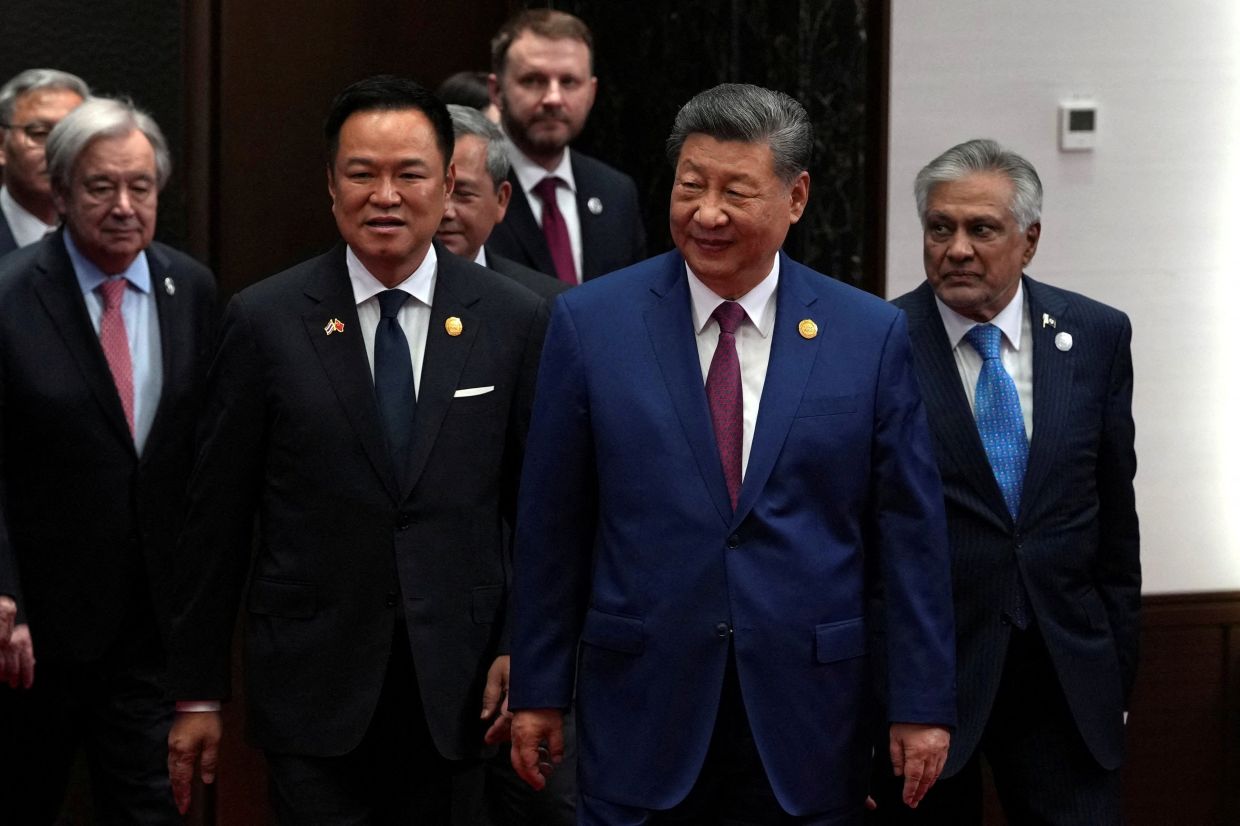
Thai Prime Minister Anutin Charnvirakul has added another chapter to his unconventional diplomatic playbook, performing a rendition of a Teresa Teng classic during a formal state lunch with Chinese Premier Li Qiang in Beijing this week. The performance, documented and distributed by Anutin's office, revealed the Thai leader seated alongside Li at a lengthy banquet table, microphone in hand, as a piano accompaniment supported his vocals. The setting itself—flanked by Thai and Chinese flags with an audience of assembled dignitaries—underscored the formal nature of the occasion, yet the spontaneous musical gesture introduced an element of personal warmth to the bilateral engagement that transcends traditional state protocol.
This latest musical performance represents part of a deliberate strategy that Anutin has cultivated since assuming office in September 2025, particularly intensifying after his election victory in February 2026. Over recent weeks, the Thai leader has systematically performed with heads of state and government across the region, transforming musical expression into a vehicle for deepening diplomatic relationships. The approach demonstrates sophistication beyond mere entertainment; by incorporating music into high-level meetings, Anutin creates moments of shared cultural experience that humanise international relations and generate positive media coverage domestically.
Just weeks before his Beijing performance, Anutin showcased his instrumental prowess alongside Malaysian Prime Minister Anwar Ibrahim, where the Thai leader switched to the saxophone while Ibrahim provided vocals for "My Way," the Frank Sinatra standard. This particular choice of song carries symbolic weight—the anthem of individualism and perseverance resonates across cultures and generations, making it an astute selection for a bilateral meeting between two Southeast Asian nations navigating complex regional dynamics. The collaborative nature of the performance, with each leader contributing different instrumental roles, subtly communicated themes of partnership and complementary strengths.
His visit to Hanoi the previous month followed a similar pattern, where Anutin performed alongside Vietnamese musicians using traditional local instruments in front of Prime Minister Le Minh Hung. This nuanced approach—adapting his performances to incorporate local musical traditions rather than imposing Thai or Western musical preferences—reveals calculated diplomatic awareness. By demonstrating respect for Vietnamese cultural heritage and involving local musicians in the performance, Anutin signalled genuine engagement with Vietnam's identity rather than treating the interaction as a platform for his own talents.
Anutin's background provides interesting context for understanding his unconventional diplomatic style. The heir to a substantial construction fortune, he represents Thailand's establishment business class, yet consciously cultivates an image as a figure connected to ordinary Thais. This carefully calibrated public persona serves multiple domestic political functions: it distinguishes him from predecessors perceived as aloof, generates positive coverage in traditional and social media, and reinforces his political brand among voters who appreciate leaders demonstrating personality and accessibility. His musical performances fit seamlessly into this broader narrative of a leader who transcends rigid formality.
Beyond his diplomatic performances, Anutin maintains diverse recreational pursuits that reinforce his image as a rounded, dynamic figure. He holds a commercial pilot's license and regularly jets across the region, a pursuit that simultaneously serves practical governmental functions while projecting vitality and modernity. His instrumental proficiency extends across multiple genres and cultural traditions—he plays both Western instruments like the piano and distinctly Thai instruments such as the traditional Thai flute. This musical range itself becomes a diplomatic asset, allowing him to connect authentically with different cultural contexts.
An additional dimension to Anutin's musical diplomacy emerged recently through his collaboration with a Thai teenager whose electrifying performance on the international televised competition America's Got Talent achieved viral status. By associating himself with this rising talent and contemporary popular culture, Anutin bridges generational divides and reinforces his positioning as a leader attuned to modern Thailand rather than exclusively to establishment interests. This move also serves domestic political purposes, creating content that resonates with younger voters who comprise an increasingly significant electoral bloc.
The political context underpinning these performances warrants consideration. Anutin's government has maintained a fundamentally conservative posture regarding Thailand's institutional framework, including deference toward traditional power structures and the monarchy—a position that has secured support among Thailand's more traditionally-minded demographic segments. His musical diplomacy, therefore, operates not in contradiction to this conservatism but rather as a complementary approach, suggesting that respecting tradition and engaging with modernity are not mutually exclusive. This reconciliation appeals across Thailand's fractious political spectrum.
From a regional perspective, Anutin's musical diplomacy reflects Thailand's broader strategic interest in maintaining and strengthening relationships with multiple powers simultaneously. Thailand's geopolitical position requires careful navigation between major power interests, and personalised diplomatic engagements through cultural channels help reinforce bilateral relationships while avoiding the perception of exclusive alignment. China values the Bangkok-Beijing relationship, Malaysia and Vietnam see their respective connections with Thailand as central to ASEAN cohesion, and Anutin's willingness to engage personally with each leader signals the importance Thailand places on these partnerships.
The effectiveness of this diplomatic approach ultimately hinges on international reception and domestic political sustainability. While some observers might dismiss musical performances as superficial gestures, others recognise their value in creating positive atmospheres for substantive negotiations and demonstrating authentic interpersonal connections between leaders. In contemporary politics increasingly characterised by polarisation and nationalist posturing, moments of shared cultural participation offer subtle counterweights toward multilateral cooperation. For Malaysia specifically, Anutin's approach with Anwar Ibrahim created a notable diplomatic moment that media outlets across both nations highlighted extensively.

