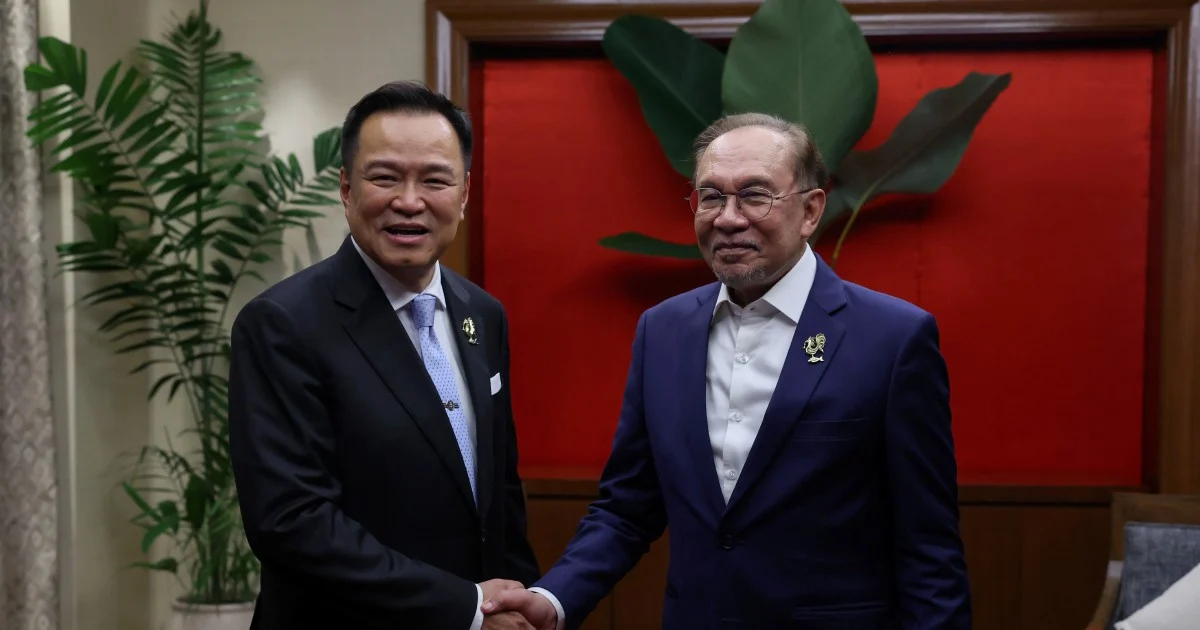
Thai Prime Minister Anutin Charnvirakul is scheduled to arrive in Malaysia on July 9 and 10 for substantive talks with Prime Minister Datuk Seri Anwar Ibrahim, marking a significant diplomatic engagement between two major Southeast Asian economies. The bilateral visit signals renewed commitment to addressing longstanding regional concerns while exploring avenues for enhanced commercial cooperation.
Border security stands as a critical priority for both nations, reflecting the complex challenges that have long characterised the Thailand-Malaysia frontier. The two countries share a 595-kilometre land boundary that has historically grappled with cross-border trafficking, illegal smuggling operations, and sporadic security incidents. These issues extend beyond simple law enforcement concerns; they touch upon national sovereignty, community safety along borderland areas, and the broader stability of the region. Malaysian authorities have consistently reported the movement of contraband goods, including narcotics and arms, through porous border points, while Thai officials face similar pressures from their side.
The security discussions will likely encompass intelligence sharing protocols and joint operational frameworks designed to combat transnational criminal networks. Both governments have recognised that unilateral approaches prove insufficient when confronting smuggling rings and organised crime syndicates that exploit geographic proximity and porous checkpoints. Enhanced coordination between Malaysian and Thai law enforcement agencies could yield tangible improvements in interdiction efforts and intelligence gathering. Such collaboration represents a pragmatic acknowledgment that security threats transcend national borders and demand integrated responses.
Beyond immediate security concerns, the bilateral agenda extends into economic partnerships that offer mutual benefit. Thailand remains a significant trading partner for Malaysia, with bilateral commerce encompassing agricultural products, manufacturing goods, and increasingly, services and technology. The region's broader economic recovery following pandemic disruptions has rekindled interest in deepening supply chain integration and expanding market access. Both nations stand to gain from streamlined trade procedures and reduced tariff barriers that facilitate legitimate commerce whilst maintaining security vigilance.
Investment flows represent another dimension worthy of attention during these high-level talks. Malaysian companies have established substantial operations in Thailand across sectors ranging from automotive manufacturing to retail and hospitality, whilst Thai investors maintain growing presence in Malaysia. Anutin's visit provides opportunity to identify regulatory bottlenecks and discuss mechanisms for attracting fresh capital investment. Infrastructure connectivity, particularly transport corridors linking the two nations, could enhance regional competitiveness and integrate supply chains more effectively.
The timing of this diplomatic visit reflects broader regional dynamics within the Association of Southeast Asian Nations framework. Malaysia and Thailand, as founding members of ASEAN, carry responsibility for maintaining stability and fostering collective prosperity. Their bilateral relations increasingly influence regional positioning on trade agreements, security arrangements, and political developments. Stronger Malaysia-Thailand engagement demonstrates commitment to addressing shared challenges through dialogue rather than allowing disputes to fester.
Border communities deserve particular consideration in these negotiations. Residents living adjacent to the Thailand-Malaysia frontier often suffer disproportionately from security disruptions and illegal activities. Enhanced cross-border cooperation could yield dividends for local populations through improved stability, reduced criminal activity, and potentially facilitated people-to-people exchanges. The health and welfare of communities dependent on cross-border commerce and movement require sustained attention from policymakers in both capitals.
Tourist and cultural exchanges constitute overlooked dimensions of bilateral relations that merit discussion during such visits. The traditional ties binding Thai and Malaysian societies—evident in shared Buddhist heritage, culinary traditions, and historical connections—offer foundations for people-to-people diplomacy. Streamlining visa procedures and promoting tourist flows could generate economic benefits whilst strengthening social bonds between populations.
The visit underscores recognition that regional security and prosperity remain indivisible. Threats emerging in one part of the Malaysia-Thailand borderland inevitably affect the broader region, whilst economic growth in one nation creates positive spillovers for its neighbour. Anutin Charnvirakul's engagement with Anwar Ibrahim signals willingness to invest diplomatic energy in practical problem-solving and relationship-building.
For Malaysia specifically, strengthening ties with Thailand carries strategic value within the broader Southeast Asian context. As the region navigates geopolitical complexities and economic transitions, cohesion among major Southeast Asian players becomes increasingly valuable. Malaysia's role as bridge-builder and consensus-builder within ASEAN depends partly on maintaining robust bilateral relations with key partners including Thailand.
The outcome of these July discussions will likely shape regional cooperation patterns for months ahead. Concrete agreements on border security protocols, trade facilitation measures, or joint developmental initiatives could establish templates for addressing similar challenges elsewhere in ASEAN. Conversely, any unresolved tensions or missed opportunities may require additional diplomatic effort to prevent deterioration.

