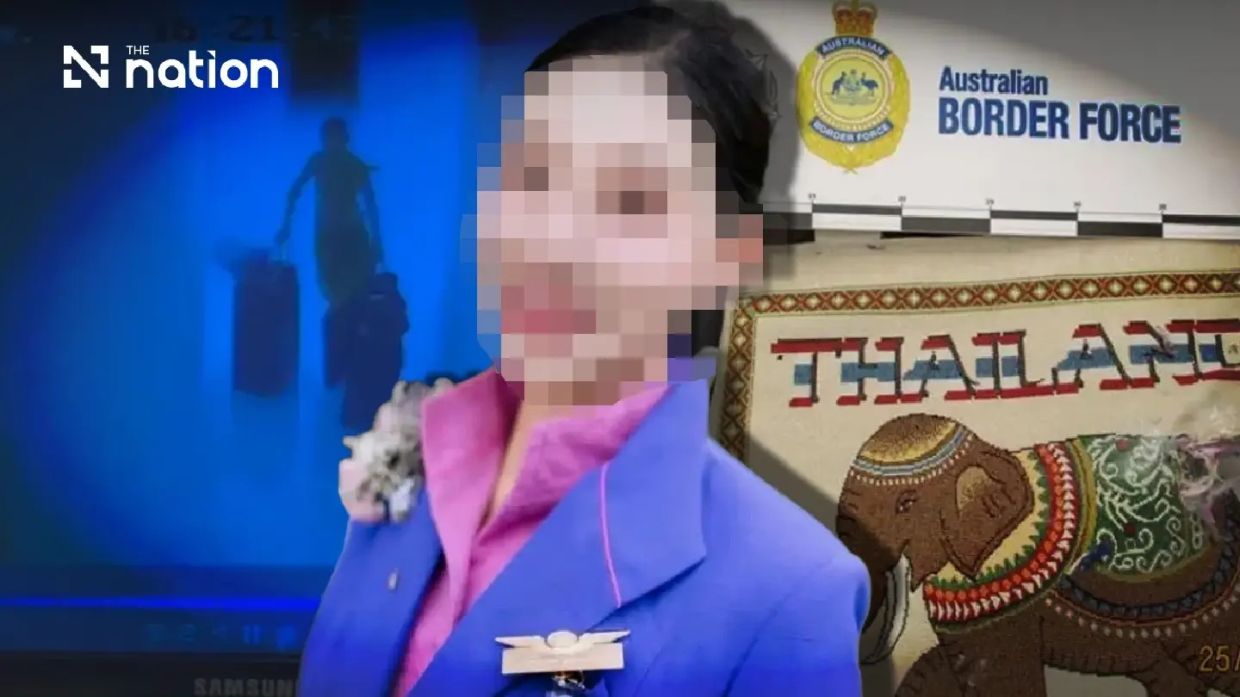
A Thai flight attendant detained in Melbourne for carrying nearly a kilogramme of heroin remains under investigation as the country's narcotics authorities piece together evidence of an expansive transnational smuggling operation. The woman, arrested at Melbourne Airport with 900 grammes of the drug, has not yet been formally charged but continues to be held as police coordinate with Australian counterparts and Thai diplomatic officials to assess her legal position and potential culpability.
The Office of the Narcotics Control Board, working alongside Thailand's Department of Special Investigation, has broadened its probe to encompass what officials believe is a sophisticated international crime network originating from syndicates operating in the Golden Triangle, the notorious narcotics hub straddling the borders of Thailand, Laos, and Myanmar. Deputy ONCB Secretary-General Areepak Ngernbamroong outlined on Monday how the case has evolved from the initial airport arrest into a multi-agency investigation targeting what appears to be an organised criminal enterprise with operations spanning continents. The expansion followed the seizure of more than 26 kilogrammes of heroin in Bangkok linked to related arrests, shifting jurisdiction to the DSI owing to the complexity and scale of the suspected organisation.
Investigators have identified a worrying pattern in which scammers create fake social media accounts to target flight attendants and other frequent international travellers, offering substantial payments in exchange for smuggling packages across borders. The scheme capitalises on the mobility and reduced scrutiny that airline staff typically experience at airports, transforming their professional status into a vulnerability. The messages, distributed to hundreds of potential targets, promise payments that appear attractive to workers in lower-income brackets, with the initial offer often obscuring the dangerous and illegal nature of the endeavour. This exploitation of vulnerable workers suggests the network operates with sophisticated knowledge of how to recruit participants through psychological manipulation rather than overt coercion.
On the Australian end of the operation, authorities have identified a Thai national known by the alias "Dear" who has resided in Australia for approximately ten years as a key figure in receiving narcotics shipments. While Thai officials are uncertain whether this individual holds Australian citizenship or operates under another legal status, they have confirmed that Dear's involvement in smuggling operations extends beyond this single incident. Multiple previous deliveries coordinated through the same recipient indicate a well-established supply chain rather than an opportunistic one-off scheme. The Australian Federal Police are now tasked with investigating who the ultimate recipients of these drugs were and the full extent of Dear's network in the country, a critical line of inquiry for understanding the distribution mechanisms within Australia.
The journey of the drugs themselves reveals sophisticated compartmentalisation within the network. Investigation of the flight attendant's account indicates that parcel boxes containing elephant-patterned bags were delivered by a rider to her residence. According to her boyfriend's statement, the bags were unpacked and inspected before being placed into her luggage, yet Thai airport security's X-ray screening detected nothing unusual. The drugs, it appears, were inserted into the bags only after the boyfriend's examination, suggesting the flight attendant may have been deliberately kept unaware of the contents until after the package was already in her possession and en route to the airport. This timeline complicates assessments of her knowledge and intent, potentially supporting a narrative of victimisation rather than willing participation in drug trafficking.
Payment arrangements remain murky, further complicating the investigation into whether the flight attendant was knowingly compensated for her involvement. Australian police discovered a reference to 8,800 baht (approximately US$264) on a mobile device, yet Thai investigators found no matching transactions in the woman's bank account. Reports suggest two separate transfers of 1,700 baht each, allegedly corresponding to receipt of goods and availability of an air ticket, totalling 3,400 baht. The absence of these payments in her banking records and the relatively modest amount involved raise questions about whether she received compensation at all or whether she was set up without her knowledge or agreement. The payment discrepancies underscore the complications in determining her role and intentions in the scheme.
The delivery rider who transported the parcel has provided statements indicating he had conducted similar deliveries three to four times previously, though this was his first delivery to the flight attendant in question. This detail carries significant implications for understanding whether the woman was a deliberate repeat participant or a one-time target of opportunity. Multiple prior successful deliveries by the same rider suggest the network had established reliable courier channels and recipient infrastructure well before approaching the Thai attendant. The rider's cooperation with investigators has been noted, though authorities remain cautious about accepting his account at face value given the obvious incentives for minimising his own culpability.
The Golden Triangle connection illuminates how regional drug production networks have adapted to intensified border enforcement in northern Thailand. Traditionally, syndicates moved narcotics southward from production areas in Myanmar and Laos through Thailand's mountainous northern provinces, but mounting interdiction efforts have forced traffickers to reroute through Thailand's north-eastern frontier with Laos. Specific crossing points including Nakhon Phanom, Bueng Kan, Loei, and Nong Khai have emerged as critical vulnerability zones, where the Mekong River's narrower width and Thailand's logistical challenges in maintaining continuous border surveillance have created gaps in law enforcement coverage. The vast geography of these border regions makes comprehensive monitoring nearly impossible, allowing smugglers to exploit seasonal variations in river levels and exploit inadequately staffed checkpoint coverage.
Thai and Laotian authorities maintain they collaborate continuously on narcotics interdiction, yet the evidence of drugs moving through the north-east border suggests the partnership faces significant operational challenges. Most seized narcotics arrive already packaged, indicating that drugs are prepared at source rather than in transit, before being transferred through multiple intermediaries who compartmentalise their involvement to minimise exposure. The network's structure creates resilience against law enforcement pressure; the arrest of any single participant or discovery of any single shipment disrupts only one link in a much longer chain. This decentralised approach protects the core operation and the highest-level traffickers from direct exposure, a hallmark of sophisticated criminal enterprises.
Thailand's narcotics officials stress that the flight attendant case likely represents merely one operational strand within a much larger international organisation. The coordination between Golden Triangle production areas, transit routes through multiple countries, recruitment of international airline staff, and distribution networks in destination countries like Australia suggests an enterprise operating at a level of sophistication requiring substantial capital investment and careful operational planning. The woman detained in Melbourne may ultimately prove to be a victim of targeted exploitation rather than a knowing conspirator, yet establishing this conclusively will require Thai authorities to send compiled evidence to the Australian Federal Police, the Thai embassy, and Thai consular officials to support her legal defence. As investigations proceed, the case illuminates the persistent and evolving challenge of drug trafficking networks that continuously adapt their methods to circumvent border controls and exploit vulnerable populations across Southeast Asia and beyond.

