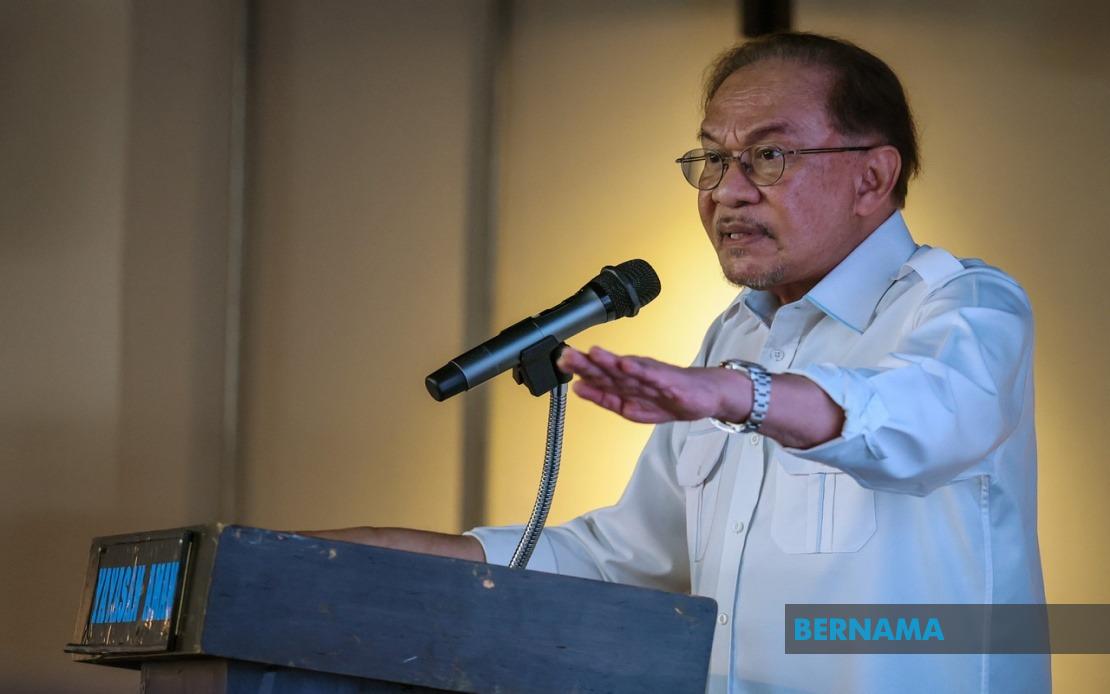
Prime Minister Datuk Seri Anwar Ibrahim has defended the ongoing investigation into findings from the Royal Commission of Inquiry report on Lembaga Tabung Haji, stating that the probe is essential to shield Malaysia from sustaining additional financial damage. Speaking at an event in Bukit Mertajam, Anwar outlined his administration's determination to pursue the matter rigorously while maintaining strict adherence to legal standards and evidentiary requirements.
The government faces a delicate balancing act in addressing the Tabung Haji crisis. Anwar acknowledged the political difficulty of his position, noting that criticism emerges regardless of whether his administration takes action or holds back. He highlighted the apparent contradiction: inaction risks allowing further state funds to drain away, yet pursuing accountability invites accusations of political motivation. This tension underscores the challenge facing any government attempting to recover misappropriated public funds while preserving institutional credibility.
Anwar placed particular emphasis on the need for transparency in determining how the reported RM12 billion in losses occurred at Tabung Haji. He called for clarity on the timing and mechanisms of the losses, stressing that investigators must identify those responsible through thorough examination. His framing suggests the government intends to move beyond preliminary findings and establish a clear causal chain linking specific actors to financial mismanagement.
The Prime Minister outlined his administration's approach to accountability: investigations conducted fairly, followed by prosecution based on solid evidence, with final judgement rendered by the courts. This methodical process reflects Malaysia's commitment to rule of law principles, distinguishing it from arbitrary or politically motivated action. By emphasizing judicial review rather than executive decree, Anwar positioned the government as a neutral arbiter rather than a partisan actor seeking revenge against predecessors.
However, the scale of losses at Tabung Haji—a fund serving Muslim pilgrims nationwide—carries profound implications beyond mere financial accounting. The institution manages savings for millions of Malaysians planning to perform the hajj pilgrimage, a religiously significant undertaking. Any misappropriation strikes at the heart of public trust in religious institutions and government stewardship of faith-based financial vehicles. The RCI investigation therefore addresses not only fiscal rectitude but also the integrity of systems designed specifically to serve devotional purposes.
For Malaysian investors and pilgrims, the investigation holds practical significance. Tabung Haji has faced questions about the security and accessibility of deposited funds, affecting confidence in contributing further amounts. Demonstrating that wrongdoers face consequences through legitimate legal channels could help restore institutional credibility. Conversely, perceived weakness in pursuing accountability might deepen skepticism about whether future deposits remain adequately protected.
Regionally, Malaysia's handling of the Tabung Haji matter reflects broader concerns across Southeast Asia about transparency in public institutions. Nations throughout the region manage similar faith-based financial schemes, making Malaysia's approach instructive. A robust, evidence-based investigation coupled with successful prosecution could set a precedent for other governments seeking to strengthen institutional governance without sacrificing due process.
Anwar's emphasis on court-led resolution rather than administrative action also addresses concerns about executive overreach. By delegating final judgement to judges rather than determining guilt through ministerial decree, the government preserves separation of powers and institutional checks. This approach, while potentially slower and less immediately satisfying, builds the legal foundations necessary for sustainable governance reforms.
The timeframe for the investigation remains unclear, though Anwar's comments suggest it will proceed deliberately rather than hastily. Given the complexity of financial transactions potentially spanning years and involving multiple actors, thorough examination necessarily requires time. Public patience will depend partly on visible progress and interim findings demonstrating that serious forensic work is underway.
Moving forward, the government must navigate presenting investigations as rigorous and non-partisan while simultaneously maintaining political viability. The criticisms Anwar referenced suggest opposition figures and segments of the public remain skeptical of his administration's motives, regardless of its procedural commitments. Building confidence may ultimately depend less on rhetorical reassurance than on tangible outcomes: indictments supported by compelling evidence, trials conducted transparently, and verdicts that persuade observers of their fairness.
The Tabung Haji investigation also reflects Malaysia's evolving standards for institutional accountability. Previous administrations faced accusations of overlooking financial misconduct by connected parties. The current government's willingness to pursue the matter, despite political costs, signals changing expectations about governance standards. Whether this represents a sustainable shift toward institutional reform or a temporary political realignment will become clearer as investigations conclude and prosecutions proceed through the courts.
For Malaysians monitoring this issue, the RCI investigation embodies fundamental questions about national governance: whether public institutions can be held accountable, whether evidence and law genuinely guide official action, and whether public funds stolen or misappropriated can realistically be recovered. Anwar's reiterated commitment suggests his administration recognizes these stakes, even as political pressures complicate implementation of seemingly straightforward principles of justice and fiscal stewardship.

