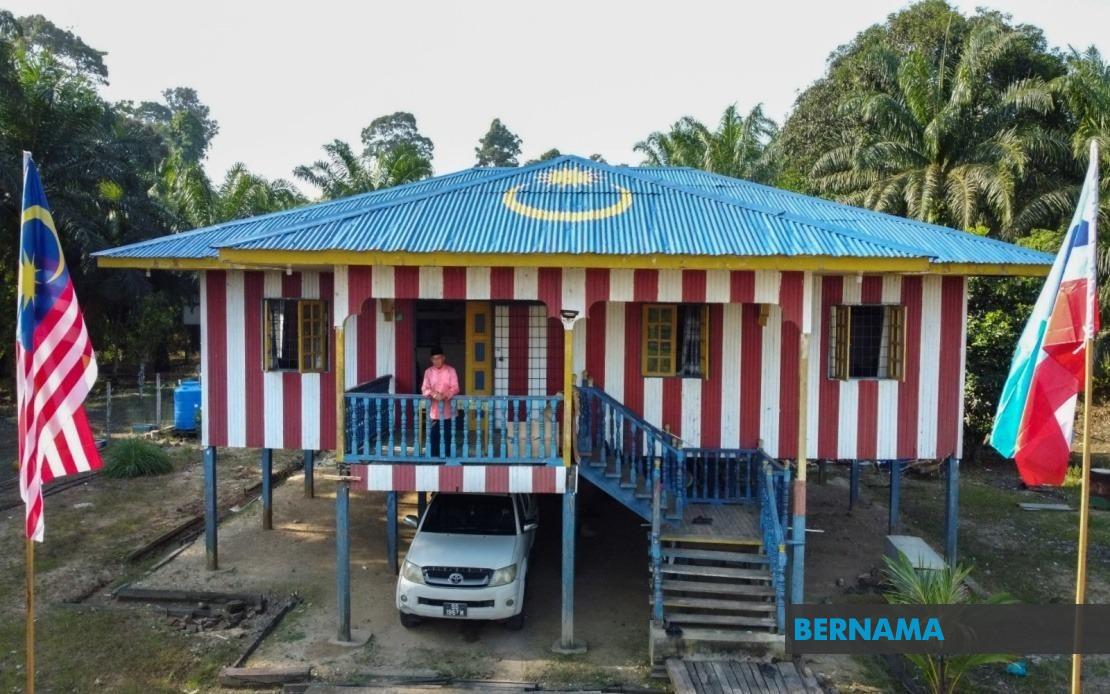
In the heart of Sandakan at Batu 15, Jalan Labuk, a house has become far more than just residential space—it has evolved into a living statement of national devotion. Teratak Gemilang, the home of 68-year-old entrepreneur Mohd Halikin Angga, stands out dramatically against the surrounding landscape with its bold red and white striped walls, deep-blue roof crowned with a golden-yellow crescent moon and 14-pointed star, and fluttering Jalur Gemilang flags throughout the compound. The residence represents two decades of unwavering commitment to expressing love for Malaysia, transforming a simple wooden dwelling into what has become a well-known landmark that draws visitors throughout the year, particularly during National Month and patriotic occasions.
Mohd Halikin's vision for Teratak Gemilang originated from a deeply personal place. The idea emerged in 2004, born from his profound affection for his country and a desire to honour his parents' generation, who endured the challenges of colonial rule. He describes the moment of inspiration with genuine emotion, explaining that he felt a persistent sadness whenever National Day flags had to come down after celebrations concluded. More poignantly, witnessing flags damaged by wind or discarded from vehicles struck him with an acute sense of loss—as if the nation's symbols themselves were being disrespected. This emotional response catalysed his decision to create a permanent, unmissable tribute to Malaysia that would outlast temporary displays and seasonal commemorations.
The physical transformation of his home required considerable personal investment and artistic effort. Armed with brushes and using his own financial resources, Mohd Halikin methodically painted every surface to embody the Jalur Gemilang's iconic colours: red, white, blue, and yellow. The architectural choices were deliberate and symbolically significant. The deep-blue roof with its crescent moon and stars mirrors the flag's celestial elements, while the striped walls create an almost defiant visual statement that cannot be ignored by those passing by. Around the perimeter, multiple Jalur Gemilang flags wave continuously, ensuring that Malaysia's symbol remains prominent throughout every season and weather condition—a stark contrast to the temporary installations that prompted Mohd Halikin's original sadness.
Beyond its exterior aesthetics, Teratak Gemilang functions as an informal museum of Malaysian leadership and constitutional history. Step inside, and visitors encounter a carefully curated mini-gallery that traces the nation's political journey. The living room displays portraits of the Yang di-Pertuan Agong, the Yang di-Pertua Negeri Sabah, and a complete succession of Malaysian prime ministers stretching from Tunku Abdul Rahman Putra Al-Haj to the incumbent leader. This chronological arrangement serves an educational purpose, allowing visitors to visualise the continuity and progression of national governance across decades. Mohd Halikin has assembled this collection with meticulous care, treating each portrait as part of a larger narrative about Malaysia's development.
Among his most treasured possessions is a historic photograph capturing a pivotal moment in Malaysian history: Tunku Abdul Rahman in 1961 meeting with 20 North Borneo leaders to discuss the formation of Malaysia. The story of how this photograph entered his collection reveals Mohd Halikin's dedication to his cause. In 2005, while flying to perform Umrah, he discovered the image in a newspaper. Rather than simply reading about it and discarding the publication, he sought permission from the cabin crew to preserve the newspaper and subsequently had the photograph professionally framed. This anecdote demonstrates how his patriotism extends beyond surface-level decoration into genuine scholarly interest in Malaysia's founding narrative and its significance for Sabah's role in the federation.
Mohd Halikin's commitment to Malaysian identity permeates even his most intimate family decisions. Three of his seven children bear names honouring prominent national figures and statesmen. His eldest was named after Tun Dr Mahathir Mohamad, the second after Tun Abdullah Ahmad Badawi, while his sixth child, Nur Zahirah, received a name honouring the 13th Raja Permaisuri Agong. These naming choices reflect a philosophical belief that names carry meaning beyond mere identification—they represent hopes and aspirations for the next generation. By naming his children after leaders who shaped Malaysia's trajectory, Mohd Halikin has created an intentional family connection to national history, ensuring that his descendants grow up conscious of the contributions made by previous generations to building the nation.
Teratak Gemilang has transcended its original purpose as a personal residence to become a recognised community landmark. Over more than twenty years, the house has attracted steady streams of visitors who stop to photograph its distinctive appearance, particularly during National Month when patriotic sentiments run highest. The structure has inadvertently become a pilgrimage site for Malaysians seeking tangible expressions of national pride and unity. What began as one man's individual response to seasonal flag removals has evolved into a shared cultural reference point, suggesting that Mohd Halikin tapped into a broader hunger for permanent, visible symbols of national identity.
Mohd Halikin remains steadfast in his determination to maintain Teratak Gemilang in its current patriotic state indefinitely. He views the house not as a temporary artistic project but as a permanent institutional commitment to sustaining Malaysia's patriotic spirit across generations. He envisions the structure continuing to serve as inspiration for strengthening unity among Sabah's diverse multiracial community, particularly as Malaysia approaches major commemorative occasions including National Day and Malaysia Day celebrations in 2026. For a state where demographics encompass numerous ethnic groups and religions, Teratak Gemilang symbolises the possibility of shared national identity transcending particular community boundaries.
The significance of Teratak Gemilang extends beyond Sandakan's municipal boundaries to offer broader commentary on how individual citizens can contribute to national narratives. In an era when patriotism is sometimes dismissed as performative or superficial, Mohd Halikin's two-decade commitment demonstrates sustained, material investment in expressing love for country. His willingness to permanently alter his private residence—a significant financial and aesthetic commitment—reflects conviction that goes deeper than convenient gestures. Moreover, his creation raises questions about whether Malaysian society adequately celebrates such grassroots expressions of civic pride, or whether prominent national monuments and government-sponsored displays overshadow individual contributions to cultural life.
The existence of Teratak Gemilang also reflects particular resonance within Sabah's historical context. As a state that joined Malaysia relatively recently compared to Peninsular territories, and as a region with distinct demographic and political characteristics, Sabah has navigated its relationship with national identity across multiple decades. An individual resident choosing to transform his home into a permanent Jalur Gemilang monument carries additional symbolic weight in this setting. It suggests genuine embrace of Malaysian identity by a Sabahan whose generational memory includes the pre-1963 era and the negotiations that brought North Borneo into the federation. In this sense, Teratak Gemilang functions as a personal testimony to Malaysia's successful integration of diverse regions and peoples.
Looking forward, Teratak Gemilang's longevity will depend on circumstances beyond Mohd Halikin's control. The wooden structure's durability poses practical challenges, particularly in Sandakan's tropical climate with its intense rainfall and salt air. The vibrant paint will eventually require maintenance and repainting. Succession planning becomes relevant—will subsequent owners maintain the house's patriotic character, or will market pressures eventually force transformation into conventional residential architecture? These questions suggest that while Mohd Halikin's personal commitment remains steadfast, institutional recognition and support might be necessary to ensure Teratak Gemilang survives as a lasting monument rather than fading as a quirk of individual endeavour.

