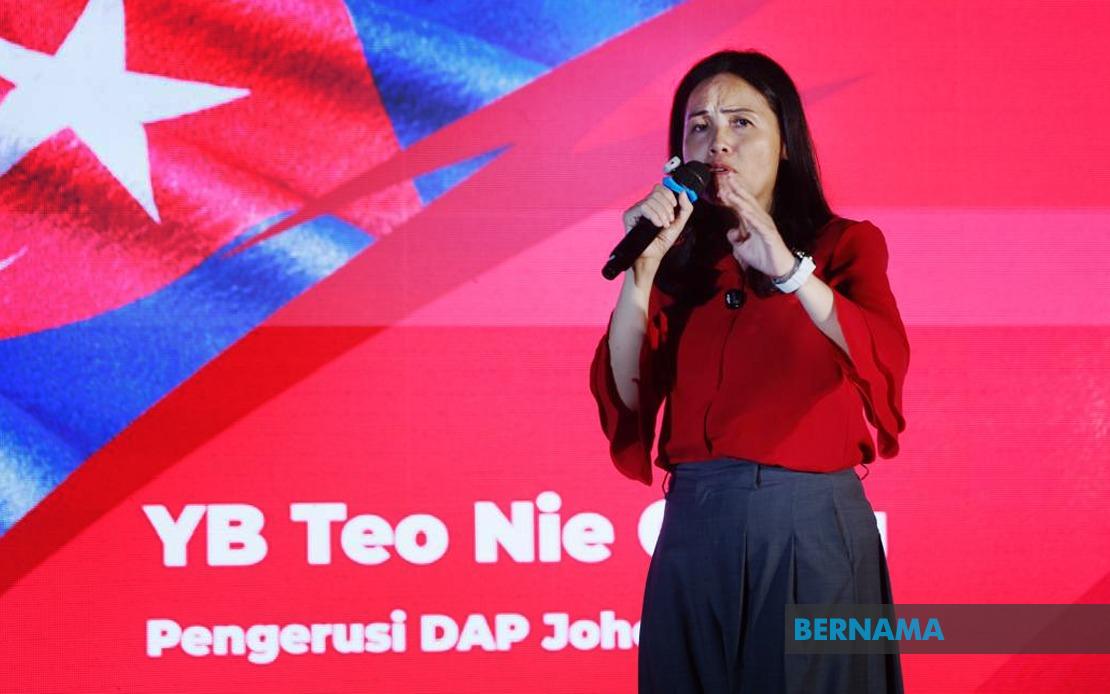
Johor's plan to allow appointed state assemblymen positions has drawn scrutiny from opposition voices, with DAP chairman Teo Nie Ching raising pointed questions about the true intentions behind the controversial mechanism ahead of this Saturday's state election. Speaking at a Pakatan Harapan rally in Paloh on July 9, Teo highlighted the potential risks to democratic principles, arguing that individuals appointed without voter consent lack the legitimacy that comes from standing before the electorate at the ballot box.
The Johor State Legislative Assembly passed legislation in May that permits the appointment of up to five assemblymen, a decision justified by the state government as necessary to strengthen the assembly's overall function and composition. However, Teo's intervention signals growing unease within opposition circles about how such appointments might be deployed. Her questioning was direct: if these positions were not designed to accommodate election losers, then precisely who would fill them, and on what criteria would selections be made?
The timing of Teo's criticism carries particular weight given Johor's recent electoral dynamics. The state government has relied substantially on support from PAS in the run-up to elections, and Teo's rhetorical query about potential appointees appears calculated to raise public concern about backroom political arrangements. By framing the issue around accountability and transparency, she positioned the debate not as partisan squabbling but as a matter of fundamental democratic governance that should concern all voters regardless of political affiliation.
The Deputy Communications Minister's concerns touch on a real tension in Malaysia's constitutional framework. While appointing members to legislative bodies is technically permissible under state enactments, the practice sits uneasily with democratic principles emphasizing popular representation. Appointed assemblymen would wield legislative power without having convinced voters of their merit or policy positions. This creates a democratic deficit that critics argue undermines the legitimacy of legislation they help pass, particularly on contentious matters affecting ordinary citizens.
Beyond the immediate controversy over appointed positions, Teo sought to redirect focus toward the Unity Government's broader reform agenda. She defended the MADANI administration's performance while acknowledging imperfection, framing government achievements as step-by-step systemic improvements delivered across multiple policy areas. By coupling criticism of Johor's appointing mechanism with a positive narrative about federal reforms, she attempted to position DAP and Pakatan Harapan as advocates for substantive, measurable change rather than mere opposition figures.
The specific reforms Teo highlighted reveal her strategic emphasis on bread-and-butter issues affecting ordinary Malaysians. The guaranteed matriculation placement for all SPM students achieving 10A, irrespective of socioeconomic background, represents a tangible policy shift addressing educational access. Similarly, expanded provision for Unified Examination Certificate holders addresses concerns from Chinese-educated communities historically underrepresented in higher education. These examples ground abstract reform rhetoric in concrete policy outcomes.
Education funding increases provided another concrete metric for measuring government performance. The allocation rise to RM20.16 million for Chinese independent schools from RM12 million in 2019 represents a 68 percent increase over four years, a substantial commitment addressing long-standing community demands. For Malaysian voters evaluating government effectiveness, such figures offer clearer judgement criteria than general claims about administrative improvement or democratic credentials.
Yet the contradiction embedded in Teo's message deserves examination. While she criticized Johor's appointed assemblymen mechanism as democratically problematic, the federal government she defends operates within a broader constitutional system that also permits appointed positions in various institutional contexts. Her argument thus rests less on categorical opposition to appointment mechanisms than on questioning their specific deployment in Johor and the motives underlying that deployment—a more nuanced but also more politically vulnerable position.
The 2.7 million voters preparing to cast ballots across 56 state seats this weekend face genuine choices about Johor's political direction. Teo's intervention injects institutional governance questions into a campaign that might otherwise focus primarily on personality, ethnicity, and which coalition should lead the state. Whether voters weigh concerns about appointed assemblymen as heavily as education policy or economic performance remains uncertain, but her intervention ensures the democratic legitimacy question will be part of the electoral conversation.
From a broader Southeast Asian perspective, Malaysia's ongoing negotiation of these democratic tensions reflects challenges facing established democracies attempting to balance various governance mechanisms. The debate surrounding Johor's appointed positions touches fundamental questions about representation, accountability, and the proper relationship between elected and appointed officials in legislative institutions. How Malaysia resolves these tensions will likely influence regional discussions about democratic governance and institutional design.
Looking ahead to 2026, as Teo noted in her rally speech, these immediate electoral choices will shape longer-term governance frameworks. Voters selecting state representatives this weekend simultaneously cast judgement on how their preferred representatives should approach appointed positions, institutional reform, and the pace of systemic change. The appointed assemblymen debate, while technical in appearance, ultimately reflects competing visions for Malaysian democracy's future direction and the mechanisms through which power should be exercised.

