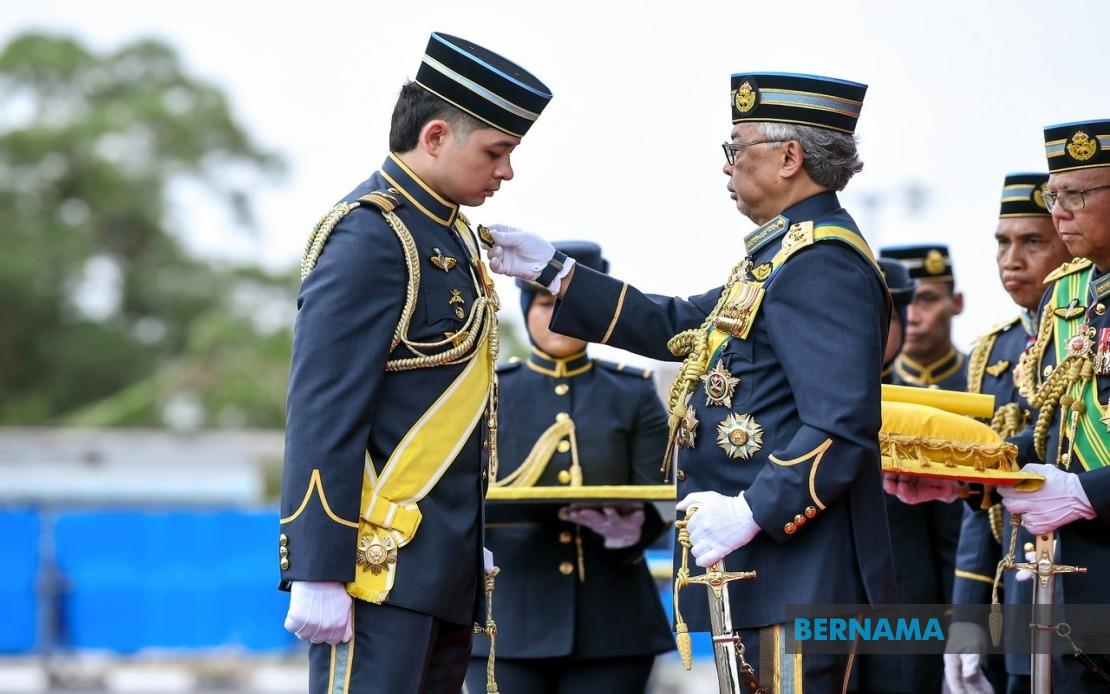
The Tengku Mahkota of Pahang, Tengku Hassanal Ibrahim Alam Shah Ibni Al-Sultan Abdullah Ri'ayatuddin Al-Mustafa Billah Shah, has set a significant precedent within Malaysia's royal institution by completing the Royal Malaysian Air Force's Basic Helicopter Flying Course. The milestone achievement marks the first instance of a royal family member formally undergoing and graduating from this rigorous military aviation training programme at the RMAF Air College in Alor Setar. His completion of the course reflects both personal commitment to aviation expertise and a symbolic gesture toward deepening the royal family's engagement with the nation's defence establishment.
The distinguished pilot received his RMAF Flying Wings during the 2026 Flying Wings Presentation Parade held at the Air College's parade ground, where he joined 39 other military graduates in being formally recognised for their achievement. The ceremony, conducted by Al-Sultan Abdullah Ri'ayatuddin Al-Mustafa Billah Shah in his capacity as Sultan of Pahang and Colonel-in-Chief of the RMAF, represented a significant institutional occasion that underscored the importance placed on aviation training excellence within the armed forces. The presence of the Sultan at the formal presentation ceremony elevated the recognition given to all graduates, emphasising the strategic value of developing skilled pilots and weapons specialists across Malaysia's three military services.
The Tengku Mahkota's participation was specifically part of the 67(A)/26 Basic Helicopter Flying Course, which ran from early June through the end of July and utilised the EC120B Colibri helicopter for practical training. Throughout the course, he demonstrated notable competency by successfully navigating multiple demanding assessment phases, including the Basic Handling Test, Instrument Flying Test, Final Navigation Test, and Final Handling Test. His performance across these varied evaluations indicates not merely completion of mandatory requirements but proficiency in the technical and decision-making dimensions essential to helicopter operations. The breadth of assessments reflects the comprehensive nature of modern pilot training, demanding skills across basic aircraft control, emergency procedures, navigation in varied conditions, and instrument-based flying.
Alongside Tengku Hassanal's achievement, the parade ceremony recognised 39 additional graduates drawn from the Malaysian Armed Forces. This cohort comprised 37 newly qualified pilots and two weapons systems officers spanning representation from all three military branches: the Royal Malaysian Air Force, Royal Malaysian Navy, and Malaysian Army. The diversity of the graduating class underscores the multi-service nature of aviation operations within Malaysia's defence infrastructure, with both fixed-wing and rotary-wing pilots requiring similar foundational training and discipline. The inclusion of weapons systems officers acknowledges the increasingly technical character of modern military aviation, where pilots must coordinate with specialist operators managing complex sensor and weapons integration systems.
The flying wings presentation encompassed graduates from four distinct training courses operating in parallel within the Air College system. Beyond the Tengku Mahkota's helicopter course, the ceremony recognised completers of the 67/25 Basic Helicopter Flying Course, the 87/25 Basic Flying Course for fixed-wing aircraft, and the 01/25 Basic Weapons Systems Officer Course. This structured approach to military aviation training allows the RMAF to develop specialists across different aircraft types and operational roles, ensuring that Malaysia maintains capability across transport, combat, and utility helicopter operations as well as fighter and surveillance aircraft. The parallel operation of these programmes demonstrates substantial institutional investment in building aviation capacity across the service.
Beyond the formal presentation of flying wings, the ceremony distributed six awards acknowledging exceptional performance among the graduating cohort. These recognitions spanned multiple dimensions of military excellence, including flying proficiency, academic achievement, disciplinary conduct, and leadership demonstration. The multi-criteria approach to awards reflects the holistic nature of military officer development, where technical competence must be paired with intellectual capability, reliability, and the capacity to guide and motivate subordinates. Young officers identified as excellence achievers in these early career assessments frequently progress to senior command positions, making these formative evaluations significant predictors of future institutional leadership.
The Air Force Chief, General Tan Sri Muhamad Norazlan Aris, addressed the graduates with remarks centring on the personal qualities that enabled their successful completion of training. He highlighted perseverance, fighting spirit, mental resilience, and stringent self-discipline as the foundational attributes that transformed motivated individuals into capable pilots. His remarks acknowledged that military aviation training represents a significant physical and psychological ordeal, with candidates facing demanding flight schedules, complex technical content, and situations that test composure and decision-making under pressure. The completion of such training therefore signals not simply knowledge acquisition but psychological and physical maturation within a military context.
General Tan Sri Muhamad Norazlan emphasised the role of family and personal relationships in sustaining graduates through the training process. This acknowledgment reflects the reality that intensive military training programmes create stress extending beyond the individual trainee to family members who provide emotional support during extended periods of separation and uncertainty. Recognition of this support network within official military ceremonies serves to strengthen community investment in defence institution success, as families understand their contributions to national security capability.
The Air Force Chief further reframed the significance of receiving flying wings, cautioning graduates against interpreting the achievement as a culmination point. Rather, he characterised the wings as an entry marker into a substantially larger responsibility, with the symbolism of the wings representing institutional trust and national expectations. This perspective reflects military culture's emphasis on continuous development and the recognition that initial qualification represents only the foundation for a career-long process of accumulating experience, specialisation, and increasing operational responsibility. The metaphor of wings marking a beginning rather than an ending reinforces the institution's commitment to ongoing professional development.
The significance of Tengku Hassanal's participation extends beyond his individual achievement to represent institutional evolution within Malaysia's royal framework. Traditionally, royal family members have maintained ceremonial roles within the armed forces without necessarily undergoing the same rigorous training regimens as professional military officers. His completion of formal aviation training signals a shift toward greater alignment between ceremonial roles and operational capability, potentially establishing precedent for increased substantive military engagement among younger members of the royal family. This development may contribute to strengthening the practical connection between the monarchy and the defence establishment, as the Sultan and senior royals develop direct operational familiarity with military capability and personnel.
For the broader Malaysian defence sector, the ceremony reflected institutional capacity to develop specialised aviation expertise across multiple aircraft platforms and operational roles. The RMAF's success in graduating multiple cohorts of pilots and weapons officers simultaneously demonstrates substantial training infrastructure and instructional resources. The geographic location of the Air College in Alor Setar, Kedah, positions aviation training within a state that has increasingly become a centre for defence-related activities, contributing to regional economic diversification and technical skill development. The presence of the Sultan at the formal ceremony also reinforced Pahang's significance within the national defence structure, as the reigning Sultan's attendance emphasised the state's institutional importance.
The flying wings ceremony ultimately represents a convergence of multiple institutional narratives within Malaysian society. It demonstrates continued commitment to military professionalism and training rigour, reflects evolving roles for the monarchy within the modern state, and acknowledges the personal sacrifice required from military personnel and their families. The Tengku Mahkota's achievement establishes a new benchmark for royal family engagement with defence institutions while the broader graduating class signals the sustained development of Malaysian aviation capability across multiple platforms and services. As Malaysia navigates evolving regional security challenges and technological changes in military operations, the successful graduation of successive cohorts of qualified pilots and specialists remains essential to maintaining national defence credibility.

