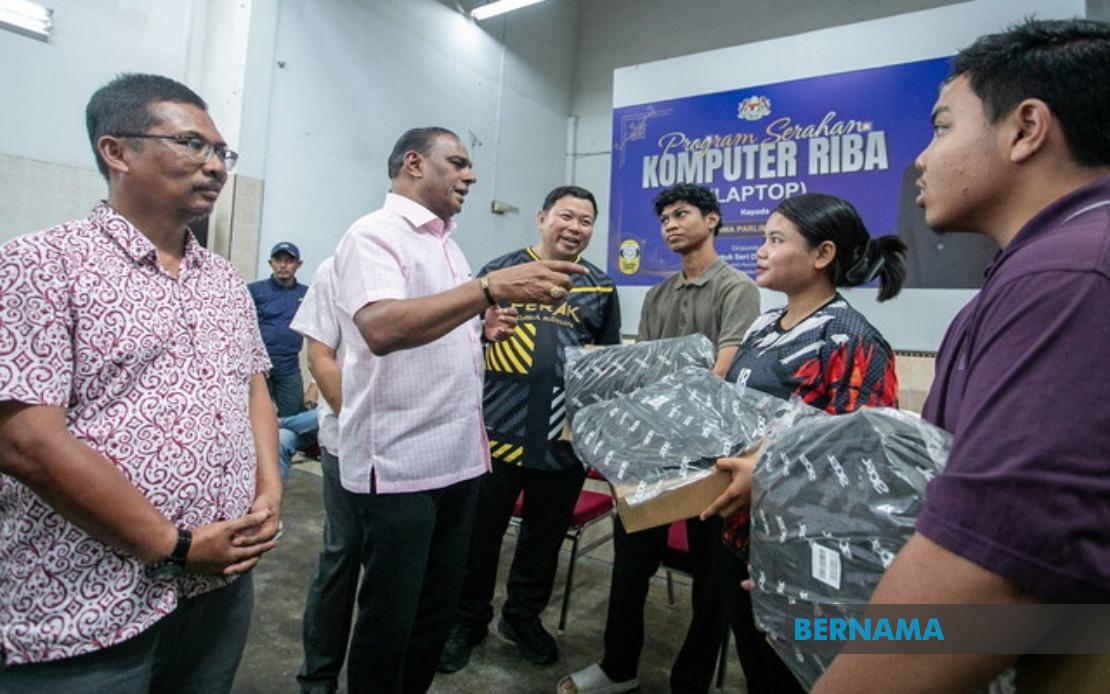
The Tapah Parliamentary Constituency Student Laptop Handover Programme distributed devices to 45 tertiary students from B40 households in a ceremony held at Mahatma Gandhi Hall, continuing a long-standing initiative aimed at bridging the digital divide among lower-income families in the region. The programme, which has been operating for over 16 years, has now provided assistance to more than 1,000 students, underscoring the persistent need for technological support in enabling equitable access to education across Malaysia's economically vulnerable demographics.
Datuk Seri M. Saravanan, Member of Parliament for Tapah, emphasised that laptops have transitioned from being optional educational tools to fundamental necessities in contemporary higher learning environments. As teaching methodologies increasingly pivot towards digital platforms and online collaboration, students without access to personal computing devices face significant disadvantages in completing coursework, participating in virtual classrooms, and developing digital literacy skills essential for future employment. The MP stressed that ensuring the B40 community—particularly those residing in his constituency—receives such technology represents a critical intervention in preventing educational inequality stemming from financial constraints.
The 45 recipients this year comprised a diverse cohort spanning multiple educational pathways. Thirty were pursuing diploma-level qualifications, representing the largest group, while five were enrolled in certificate programmes. Four students were preparing for matriculation examinations, and three were degree candidates. Additionally, one student each from the SPM, STPM, and foundation programme levels received devices, reflecting the programme's inclusive approach to supporting learners across the entire spectrum of post-secondary education in Malaysia.
Saravanan highlighted the rigorous selection process employed to identify genuinely eligible candidates, noting that a dedicated committee evaluated each application through consultations with the District Education Office and community leaders. This institutional oversight ensures that limited resources are allocated to those most in need rather than through informal patronage networks. Such transparent vetting mechanisms are particularly important in building public confidence in government assistance programmes and demonstrating accountability in resource distribution.
The initiative carries particular significance for indigenous communities, as the MP pointed to a notable demographic shift among Orang Asli youths in the Tapah parliamentary constituency. Over the past two decades, increasing numbers of indigenous students have successfully pursued higher education and entered professional fields, including medicine and law. These achievements serve as powerful role models for younger Orang Asli students, challenging historical patterns of educational underrepresentation and demonstrating pathways to upward socio-economic mobility for marginalised communities that have traditionally faced systemic barriers to tertiary education.
Aidil Iskandar Ramlan, an 18-year-old recipient, exemplifies the direct impact of such programmes on individual students and their families. The former student of SMK Syeikh Abdul Ghani in Bidor is preparing to commence a Diploma in Public Administration at Universiti Teknologi MARA (UiTM) Raub in Pahang, and he recognised the device as essential for completing assignments and engaging with digital-dependent coursework. His family background—his father employed as a school security guard and his mother managing the household—places them within the B40 income bracket where technological purchases represent substantial financial burdens that can delay or prevent educational progression.
For Aidil, the laptop transfer alleviates a significant family expenditure at a critical juncture in his educational journey. Many students from low-income households delay tertiary study entry or attempt to proceed without essential equipment, potentially compromising their academic performance and engagement. By removing this technological barrier at the point of university enrolment, such programmes tangibly improve the likelihood of successful course completion and professional qualification acquisition among disadvantaged cohorts.
Another beneficiary, 19-year-old Ea Endry Iana Aslan, similarly acknowledged the profound relief the device provides her household. Pursuing a Diploma in Early Childhood Education at FELCRA College, she would otherwise have struggled to fund a personal computer—a reality facing many first-generation learners from working-class and rural backgrounds. Her gratitude towards Saravanan reflects broader recognition that government assistance programmes at the constituency level can meaningfully influence individual life trajectories and family circumstances.
The persistence of such programmes over 16 years suggests sustained demand among the target population. Malaysia's economic stratification means that despite national development progress, significant proportions of the student-age population lack access to digital infrastructure that their wealthier peers take for granted. This technological inequality translates into educational inequality, as online learning platforms, digital assignment submission, and computational tools become prerequisites for academic competitiveness. Programmes like Tapah's laptop distribution address this systemic gap, though the fact that over 1,000 students have been aided over 16 years indicates that demand far exceeds current supply.
The emphasis on B40 assistance reflects government recognition that Malaysia's social contract requires deliberate interventions to prevent educational opportunity gaps from crystallising into permanent economic disadvantage. Lower-income students pursuing tertiary qualifications represent Malaysia's potential for inclusive economic development, as equipping them with contemporary tools increases the productivity and competitiveness of the future workforce. From a national perspective, investing in technological access for disadvantaged learners represents cost-effective human capital development.
The Tapah initiative also highlights the enduring role of constituency-level representatives in addressing local social needs. While national education policies establish frameworks, MPs and state assemblymen often mobilise community resources and partnership mechanisms to deliver targeted assistance. The involvement of the District Education Office and community leaders in applicant vetting creates accountability while leveraging local knowledge about genuine need. This decentralised approach to social provision can be more responsive to community circumstances than centralised schemes, though it also introduces variability depending on individual MP commitment and resource allocation.
Looking forward, the laptop distribution programme's continuation suggests political commitment to addressing digital access inequality, though scaling such initiatives nationally would require substantially expanded funding mechanisms. As higher education in Malaysia becomes increasingly technology-dependent, and as remote and hybrid learning modalities persist beyond the pandemic period, access to personal computing devices will remain essential for equitable educational participation. Programmes like Tapah's represent incremental progress, but meeting the full scope of technological need among Malaysia's B40 student population would require more ambitious national investment in digital equity infrastructure.

