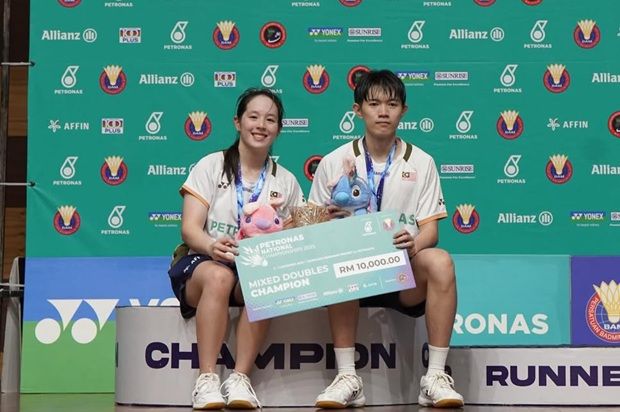
Twenty-year-old Clarissa San enters the most significant badminton tournament of her career next week carrying a message of steadiness and perspective. The Malaysian shuttler will make her Japan Open debut in mixed doubles, stepping in alongside Chen Tang Jie after Toh Ee Wei suffered an anterior cruciate ligament injury that has sidelined her in Melbourne for rehabilitation. Clarissa's opportunity comes with the weight of expectation that accompanies one of the Badminton World Federation's most prestigious events, yet her preparation has centred on a singular, unglamorous goal: remain composed and absorb the experience.
The pairing represents a significant shift in Clarissa's competitive trajectory. Previously, she had not featured in tournaments of this magnitude, making the Japan Open a watershed moment in her developing career. Her elevation came through circumstance—the unfortunate injury to Ee Wei opened a pathway that Clarissa must now navigate with maturity beyond her years. Rather than view this as a temporary arrangement, she has chosen to regard it as the beginning of an extended partnership, with plans already in place for three or four tournaments following the Japan Open. This longer-term perspective suggests confidence from the coaching staff that the pairing can develop into a competitive unit rather than merely a stopgap solution.
The guidance Clarissa receives from mixed doubles head coach Nova Widianto and Tang Jie himself emphasises psychological resilience over tactical sophistication. In high-pressure environments like the Japan Open, where elite opposition converges and expectations intensify, the mental dimension often determines outcomes more than technical preparation. Clarissa's willingness to acknowledge her nervousness and her receptiveness to reminders about staying calm and enjoying matches demonstrates emotional maturity. Tang Jie's role extends beyond courtside strategy; he functions as both mentor and stabilising presence, embodying the kind of experienced partner who can anchor a younger player through the turbulent opening rounds of a major tournament.
Clarissa brings a grounded perspective to her debut. She has deliberately avoided inflating expectations, instead setting her sights on translating her training routines into match situations. This approach reflects either admirable humility or pragmatic realism about facing opponents who likely possess greater tournament experience. The reality of women's badminton at the elite level means that the Japan Open attracts the world's best mixed doubles pairs, many of whom have competed in such environments repeatedly. For Clarissa, simply executing the fundamentals she has practised and gaining exposure to high-level competition represents a meaningful achievement.
Tang Jie's mentorship carries particular weight given the pressure cooker environment of the Japan Open. His established credentials in mixed doubles mean he understands the specific demands of the format—the rapid transitions, the court positioning that differs markedly from singles, and the communication required between partners. When Clarissa makes mistakes, which she inevitably will at her first major tournament, his guidance becomes invaluable. The relationship she describes—where Tang Jie acts as an older brother rather than merely a partner—suggests a psychological safety net that allows her to take calculated risks without fear of judgment.
The opening-round draw against Taiwan's Yang Po-hsuan and Hu Ling-fang presents a reasonable starting challenge. Taiwanese mixed doubles players typically bring solid fundamentals and court awareness, offering a stern but perhaps not prohibitive first test. The match serves as a barometer for whether Tang Jie and Clarissa can gel in real competition, whether their training synchronicity translates to tournament pressure, and whether Clarissa's composure strategies prove effective when facing unfamiliar opponents in an unfamiliar arena.
Clarissa's emergence represents part of Malaysia's continuous process of identifying and developing younger badminton talent. The country has long maintained a pipeline of young players progressing through various levels, and the Japan Open provides a crucial proving ground. Her willingness to embrace this opportunity, rather than view the disruption caused by Ee Wei's injury as a setback, speaks to her ambitions and resilience. Many young players would have felt displaced or disappointed by such circumstances; instead, Clarissa has oriented herself toward maximising the situation.
The broader Malaysian contingent at the Japan Open reveals the depth of the country's badminton programme. Jimmy Wong and Cheng Su Yin face Japan's Yuichi Shimogami and Sayaka Hobara, while Wong Tien Ci and Lim Chiew Sien draw fifth-seeded Chinese pair Guo Xinwa and Chen Fanghui—a formidable opening assignment. Independent duo Goh Soon Huat and Shevon Lai Jemie tackle Americans Chen Zhi Yi and Francesca Corbett. These matchups underscore that Malaysian badminton operates across multiple competitive tiers, with various players and partnerships pursuing different objectives within the same tournament ecosystem.
For Clarissa specifically, the Japan Open represents not merely a single tournament but a launching point for a potential long-term partnership with Tang Jie. Should they demonstrate chemistry and competitive ability, this pairing could feature prominently in Malaysia's mixed doubles plans for the coming season. The tournament provides baseline data about their capabilities against international opposition, their ability to adapt mid-match, and whether their partnership can withstand the fatigue and pressure of playing multiple matches in succession. These elements matter far more at this stage than specific results.
The emphasis on learning and improvement over results reflects mature coaching philosophy. Rather than saddling Clarissa with demands for deep tournament runs, the coaching staff have positioned the Japan Open as an educational experience. This approach reduces unnecessary psychological burden while creating space for her to play freely. In psychological terms, she is freed to compete rather than forced to perform, a distinction that often determines whether young players flourish or fold under pressure. Tang Jie's presence as a reassuring, experienced figure reinforces this environment of structured learning within competitive circumstances.
As Clarissa prepares to step onto the courts of one of badminton's most storied tournaments, her demeanour suggests she understands the magnitude of the opportunity. The injury that displaced Toh Ee Wei created an opening; how Clarissa exploits it over the coming week will likely shape her trajectory in professional badminton. With Tang Jie anchoring her side and coaches providing measured guidance, she enters the Japan Open equipped not with unrealistic dreams of rapid advancement, but with the more valuable assets of perspective, mentorship, and determination to absorb everything the experience offers.

