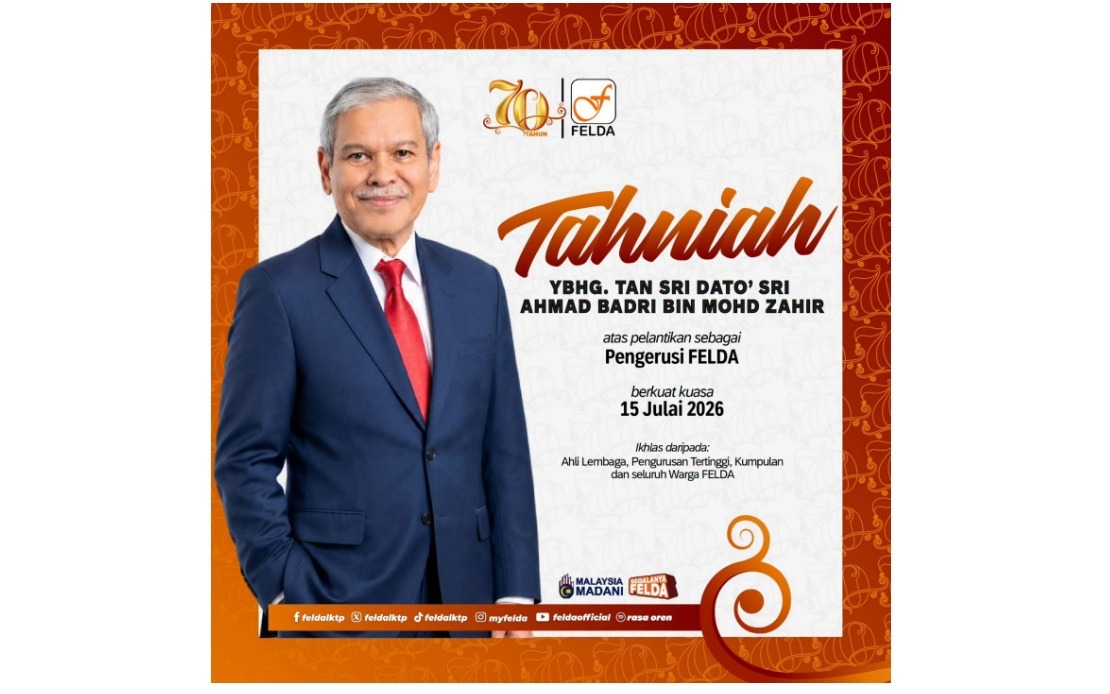
Tan Sri Ahmad Badri Mohd Zahir has been appointed as the new chairman of the Federal Land Development Authority (FELDA), signalling the government's determination to inject fresh institutional leadership into one of Malaysia's largest rural development agencies. The appointment underscores confidence in Ahmad Badri's proven track record in steering complex, strategically important organisations through periods of significant change and modernisation.
The decision to appoint Ahmad Badri reflects a deliberate strategy to anchor FELDA's transformation efforts on someone with deep roots in Malaysia's financial architecture. With over three decades spanning both the public service and private corporate sectors, Ahmad Badri brings to the role a nuanced understanding of how government institutions can be repositioned for greater efficiency and sustainability. His career trajectory traces a path through critical nodes of Malaysia's economic management, beginning with his entry into the Ministry of Finance in 1989 and progressing through increasingly senior roles.
Among his most significant prior positions was his tenure as Treasury Secretary-General from 2018 to 2020, a period when Malaysia confronted complex fiscal challenges and required careful stewardship of public finances. This experience at the apex of fiscal administration positions him well to understand the budgetary dimensions of FELDA's operations and the need to balance developmental mandates with financial prudence. His leadership of the Employees Provident Fund, Asia's largest retirement savings institution, similarly demonstrates capability in managing large, complex pools of public assets while serving millions of beneficiaries—a skillset directly transferable to FELDA's responsibility towards its settler population.
Beyond the civil service, Ahmad Badri has accumulated substantial exposure to Malaysia's corporate and financial sectors through multiple board appointments. His current role as chairman of RHB Bank Bhd places him at the helm of a major financial institution, while his chairmanship of the Malaysian Rubber Board positions him within a sector of historical and continuing importance to Malaysia's rural economy. His board memberships at institutions including Bank Negara Malaysia, Permodalan Nasional Berhad, and Tenaga Nasional Berhad during earlier phases of his career demonstrate comfort operating within high-stakes institutional environments where strategic decisions carry implications across the broader economy.
The appointment assumes particular significance given FELDA's pivotal role in rural development and settler welfare across Malaysia. The authority currently oversees interests affecting more than three million settlers, making it a custodian of economic opportunity for a substantial segment of the Malaysian population. FELDA's historical mission of transforming Federal Land Development settlements into productive agricultural enterprises has evolved to encompass broader sustainability considerations and the integration of settlers into modern commodity supply chains. Ahmad Badri's appointment appears calibrated to accelerate this evolution while maintaining the institution's foundational commitment to settler prosperity.
The formal statement announcing the appointment emphasises governance strengthening and management excellence as priorities under Ahmad Badri's leadership. These framings suggest that FELDA leadership perceives opportunities to enhance operational efficiency and institutional effectiveness. In the Malaysian context, where questions about the effectiveness of government-linked companies have periodically surfaced, the emphasis on governance quality signals intent to position FELDA as a model of institutional best practice. The invocation of Malaysia's broader sustainability and inclusive development goals contextualises FELDA's mission within contemporary policy frameworks emphasising environmental responsibility and equitable economic participation.
Ahmad Badri's educational credentials further support his positioning for the role. His Master of Business Administration from the University of Hull provides formal international business training, while his undergraduate qualification in Estate Management from Universiti Teknologi MARA (UiTM) furnishes specialised knowledge directly relevant to FELDA's land-based operations. This combination of technical expertise in land and property matters with advanced business education suggests a leader equipped to engage both technical operational questions and broader strategic positioning.
For Malaysia's agricultural and rural development sectors, this appointment carries implications beyond FELDA itself. The authority's performance influences competitiveness across palm oil production, rubber cultivation, and other commodity sectors where FELDA settlers operate. Its settler population constitutes a vital component of Malaysia's rural economy and represents an important constituency for inclusive growth policies. Ahmad Badri's mandate to drive transformation thus extends beyond internal institutional improvement to encompass the economic prospects and welfare trajectories of millions in Malaysia's rural communities.
The timing of the appointment intersects with broader questions about the modernisation of Malaysia's development institutions. As the country navigates economic diversification, technological change, and evolving global commodity markets, institutions like FELDA must adapt operational models and strategic priorities. Ahmad Badri's experience navigating institutional change during previous roles positions him to guide FELDA through comparable transitions, potentially enabling the authority to enhance settler incomes, improve agricultural productivity, and strengthen competitive positioning within regional and global supply chains.
The emphasis placed on Ahmad Badri's extensive experience and proven leadership capabilities in the official announcement reflects institutional recognition that FELDA's transformation agenda demands experienced, capable stewardship. His appointment represents both continuity with FELDA's developmental mission and recognition that advancing this mission requires fresh approaches informed by contemporary best practices in governance and management. For Malaysian settlers and the broader agricultural sector, Ahmad Badri's leadership of FELDA inaugurates a new chapter in the authority's institutional evolution, one potentially characterised by enhanced strategic focus and operational effectiveness in service of rural prosperity.

