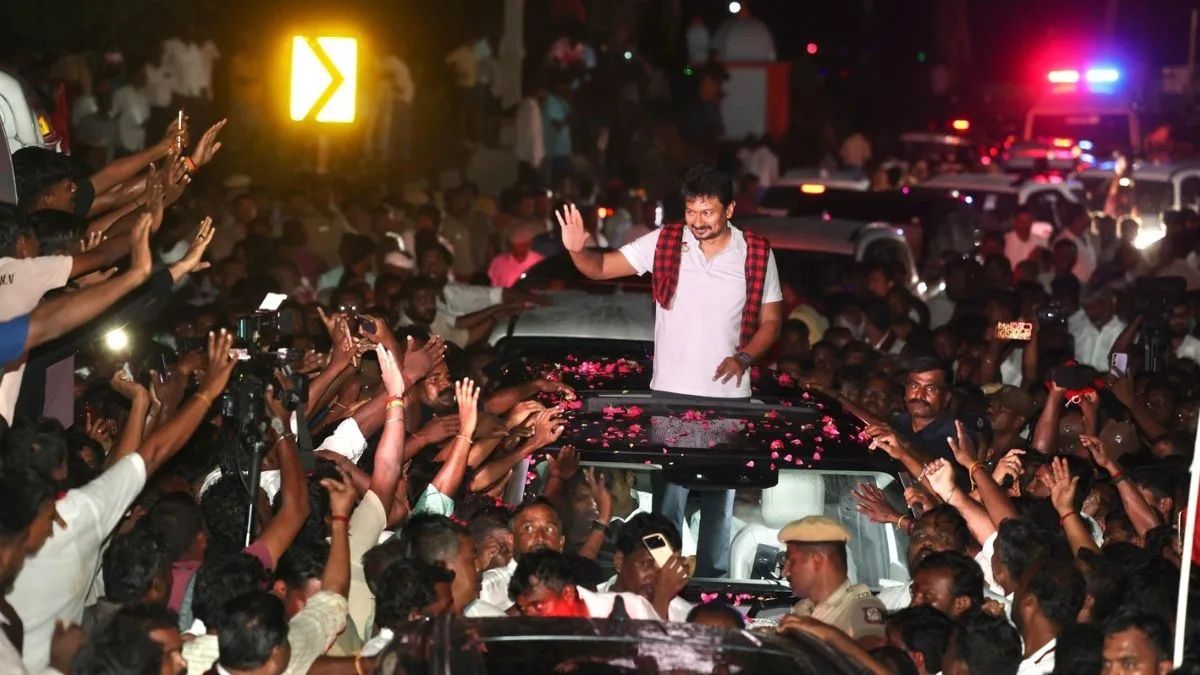
Udhayanidhi Stalin, leader of the opposition in Tamil Nadu and former deputy chief minister, was released on station bail late Tuesday evening following an extended questioning session by police investigating allegations that he made offensive remarks targeting actress Trisha Krishnan. The DMK stalwart had been arrested at his Chennai residence on Wednesday morning and transported to Sengipatti police station, where he spent several hours under interrogation before authorities granted his release.
The arrest triggered a substantial show of support from DMK workers who gathered in large numbers outside the police station. Hundreds of party cadres welcomed Stalin with chants and slogans, many of them directing criticism toward Tamil Nadu Chief Minister Vijay and his newly formed TVK political organisation. The spontaneous gathering underscored the deep polarisation affecting Tamil Nadu's political landscape following the surprising 2024 state election results that saw Vijay's fledgling party overtake the traditionally dominant DMK.
At a press conference immediately after his release, Stalin categorically denied any wrongdoing, asserting that his remarks contained no disrespectful intent toward women and characterising his arrest as a political manoeuvre designed to divert public attention from governance issues. He framed his detention as an example of selective targeting against opposition legislators, suggesting that the ruling government wielded the police apparatus to suppress political dissent rather than address substantive policy failures.
The controversy originated during a DMK-organised protest gathering in Thanjavur district focused on the contentious Cauvery water-sharing dispute with Karnataka. Stalin was addressing the assembled crowd about the neighbouring state's proposed Mekedatu hydroelectric project when a supporter shouted Trisha's name from within the gathering. In response to this interjection, Stalin paused momentarily, smiled, and remarked: "Wherever water comes, whether it comes or not, water should come there."
While the literal statement appears innocuous on its surface, observers and political opponents interpreted the comment as containing a double entendre given the contextual setup of mentioning the actress's name immediately beforehand. The remark quickly became subject to widespread interpretation across social media and television news channels, with supporters of the ruling TVK faction arguing that the language carried unmistakable sexual innuendo designed to demean and objectify a woman. This interpretation gained traction despite Stalin's post-release insistence that his words carried only a single, straightforward meaning with no malicious subtext intended.
The TVK government responded with notable swiftness and severity to the episode. Government representatives formally registered a complaint with both the National Commission for Women, India's apex body for gender equality and women's protection, and state police authorities. The ruling party's official position characterised Stalin's statement as constituting "verbal harassment" alongside the broader accusation of objectifying a woman in public discourse. This escalation from political commentary to invocation of women's protection mechanisms marked a significant intensification of the conflict between Tamil Nadu's two major political forces.
The timing of Stalin's arrest carried particular significance given the broader context of Tamil Nadu politics in the months following the 2024 election verdict. Vijay's TVK had unexpectedly emerged as the single largest party, displacing the DMK which had governed the state for five years prior. The transition created considerable tension within the state's political establishment, and observers noted that numerous DMK figures faced police action on various charges during the TVK government's first months in office. Stalin's arrest could be viewed as part of this broader pattern of intensified scrutiny against opposition-aligned politicians.
The actress at the centre of the controversy, Trisha Krishnan, has been subject to considerable speculation regarding her political associations and alleged proximity to Chief Minister Vijay. The invocation of her name during Stalin's water-rights speech appeared designed by supporters to create exactly the kind of provocative moment that subsequently unfolded. Whether this constituted genuine political commentary gone awry or a calculated attempt to provoke controversy remains a point of interpretation that divides Tamil Nadu's competing political camps.
For Malaysian observers, this episode illustrates the often-fractious nature of opposition politics in India's southern states, where personality-driven conflicts frequently intersect with substantive policy disputes. The rapid transformation of a local political speech into a matter of national women's rights concern demonstrates how India's federal institutional architecture enables escalation of purely local political controversies into national-level interventions. Furthermore, the apparent use of celebrity associations as mechanisms for political provocation reflects broader trends in South Asian electoral politics where celebrity culture and political competition frequently blur established boundaries.

