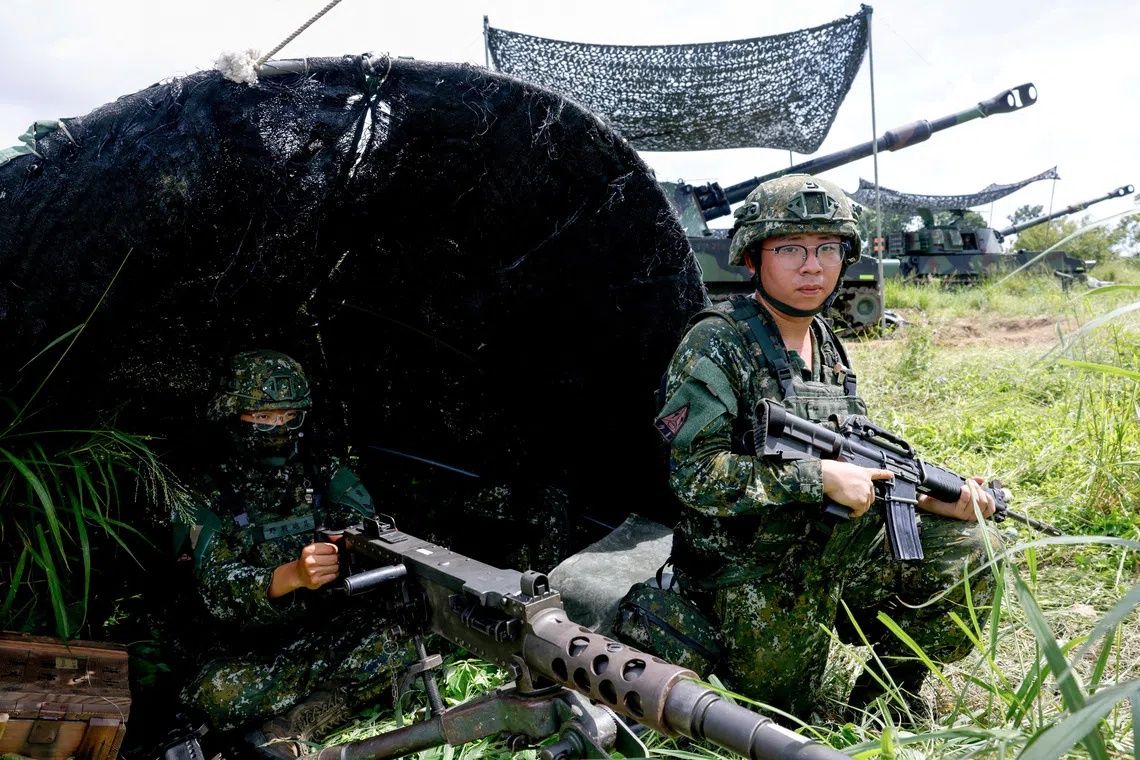
Taiwan has commenced a major 10-day military exercise designed to stress-test its defence command infrastructure and civilian response systems in the face of potential military aggression. The Han Kuang drills, which began on Wednesday and will run through August 14, represent a marked departure from previous iterations by introducing far more demanding, real-world conditions that commanders and soldiers will encounter if conflict erupts. Senior defence officials involved in the planning emphasised that Taiwan has moved beyond theoretical training scenarios toward field environments where unexpected developments demand rapid tactical reassessment and coordination across military and civilian agencies.
The exercise was triggered by an underground command centre in Taipei, which issued orders that set in motion dispersals of fighter jets across multiple locations and the mobilisation of naval assets for emergency deployment protocols. This decentralisation of military assets reflects Taiwan's strategic recognition that a rapid strike against fixed installations could severely degrade its defensive capabilities. By practising the relocation and dispersal of critical military resources, Taiwan aims to ensure that its air and naval forces remain operational even after initial attacks target primary bases and command structures. The drills will involve more than 20,000 active and reserve personnel, including approximately 5,000 reservists whose integration into rapid-response operations has long been a gap in Taiwan's preparedness.
A particularly significant innovation this year involves the adoption of a "backbrief" methodology drawn from United States military doctrine. Under this system, junior officers who receive operational orders from their commanders must restate the mission objectives and tactical details to confirm mutual understanding before execution. This practice, which emphasises clarity and alignment between leadership and subordinate personnel, addresses a perennial challenge in military organisations: the misinterpretation or incomplete transmission of command intent through hierarchical chains. Taiwanese officials acknowledged that ensuring commanders and subordinates share identical understandings of operational objectives is essential for maintaining effectiveness during the fog and friction of actual combat, where communications systems may be compromised and real-time coordination becomes difficult.
For the first time, Taiwan's civil infrastructure will also be tested through deliberate degradation of mobile internet speeds, simulating the bandwidth constraints that would emerge if China targeted telecommunications networks during an invasion. This represents a meaningful shift in how Taiwan conceptualises wartime preparedness, moving beyond purely military readiness to encompass civilian capacity to function under degraded conditions. The drill will assess how government agencies and the general population communicate, coordinate, and maintain essential services when digital connectivity is limited or unstable. Such scenarios reflect broader Chinese military doctrine, which emphasises striking critical civilian infrastructure early to demoralise the population and disrupt the coordination of defensive efforts.
The exercise also incorporates field commanders receiving deliberately unexpected and ambiguous scenarios that deviate from pre-planned enemy movement assumptions. By forcing commanders to reassess situations rapidly and adjust orders in real time, Taiwan aims to develop adaptability and decision-making capability that laboratory-style exercises cannot cultivate. Defence officials conducting the drills will evaluate how field commanders respond when the actual tactical situation diverges from intelligence estimates, testing their ability to gather new information, reassess the threat, and reissue coherent orders to subordinate units under time pressure. This focus on flexibility and cognitive agility reflects military lessons from modern conflicts where initial assumptions about enemy intentions frequently proved incorrect.
Another distinctive feature involves the simulated relocation of a major arsenal to alternative positions and the mobilisation of civilian factories to support wartime production needs. These elements underscore Taiwan's recognition that sustained conflict would require not only military mobilisation but also the integration of civilian industrial capacity into defence operations. Civilian factories, many of which possess dual-use manufacturing capability, would need to transition rapidly to producing ammunition, spare parts, and other military logistics under wartime conditions. The exercise will test whether government planning, coordination mechanisms, and industrial capacity actually exist to execute this transition or whether significant gaps remain in Taiwan's ability to sustain a prolonged conflict through domestic production.
Naval operations will include escort drills conducted off Taiwan's Pacific coast, reflecting strategic anxieties about China potentially severing the island's access to supply lines from allies across the Pacific. Taiwan depends critically on maritime trade and military resupply, particularly from the United States. Any successful Chinese blockade or naval interdiction campaign could severely constrain Taiwan's ability to sustain both civilian populations and military operations. By practising protective convoy operations and naval coordination, Taiwan signals its intention to maintain maritime access under hostile conditions. These drills carry particular significance given recent expansion of Chinese naval capabilities and Beijing's demonstrated willingness to conduct increasingly assertive operations in waters surrounding Taiwan.
Taiwan's defence establishment has introduced an "embedded reporter" mechanism to evaluate how military units would disseminate accurate information during wartime and counter Chinese disinformation campaigns. This innovation reflects growing recognition that modern conflicts involve informational dimensions as consequential as kinetic operations. During a hypothetical invasion, China would likely conduct sustained disinformation campaigns designed to demoralise the Taiwanese population, undermine military morale, and persuade international audiences that Taiwan's situation is hopeless. By incorporating war correspondents into field exercises and testing frontline news protocols, Taiwan aims to develop capacity to communicate truthfully with its population and international observers, thereby maintaining coherence and resolve under psychological pressure.
The broader context for these increasingly ambitious exercises reflects Taiwan's assessment that Chinese military pressure has intensified and that the probability of conflict, while hopefully remote, cannot be excluded from strategic planning. Taiwan's officials have described these drills as part of a systematic effort to transition from theoretical, controlled exercises to genuine field training that exposes personnel to realistic operational stress. One senior defence official characterised the shift as moving from "laboratory-like exercise in a vacuum" to training "facing real bottom-line conditions," emphasising that Taiwan recognises the inadequacy of sterile training environments for preparing military and civilian personnel for actual conflict. This reorientation reflects lessons learned from recent military exercises elsewhere and candid assessments of shortcomings in previous Taiwanese drills that observers criticised as overly scripted and insufficiently demanding.
Taiwan's defence ministry has also expanded resilience exercises to encompass how local government officials would maintain administrative functions during cascading crises ranging from natural disasters to Chinese invasion. These whole-of-society drills test government capacity to preserve continuity even when facilities are damaged, communications disrupted, and personnel displaced. The emphasis on civilian and administrative resilience reflects recognition that modern warfare targets not only military forces but also the civilian infrastructure and governmental institutions that sustain populations. By exercising local officials in maintaining essential functions under degraded conditions, Taiwan attempts to develop institutional muscle memory and identify gaps before actual conflict exposes them catastrophically.
The decision to incorporate internet speed throttling alongside military mobilisation drills signals that Taiwan views modern conflict as encompassing electronic, informational, and civilian dimensions as fundamentally as traditional military operations. Chinese military doctrine explicitly emphasises degrading civilian morale and disrupting civilian infrastructure in the opening phases of conflict. Taiwan's effort to test civilian responses to bandwidth constraints therefore addresses a realistic and significant threat vector. By familiarising civilian populations and government agencies with operating under such constraints during peacetime exercises, Taiwan aims to reduce panic, confusion, and social breakdown if such conditions actually materialise during conflict.
These exercises occur within a regional context of intensifying military competition, expanding Chinese military capabilities, and allied efforts to strengthen Taiwan's defensive posture. The Han Kuang drills demonstrate Taiwan's determination to move beyond passive vulnerability toward active cultivation of defensive capacity. While defence officials emphasised that these exercises represent preparation for contingencies rather than expectation that conflict is imminent, the progression toward more realistic, demanding training scenarios reflects sober assessment of security risks. For other regional democracies, Taiwan's approach to integrating military readiness with civilian resilience offers instructive lessons in how to build systematic preparedness against peer military competitors operating in proximate waters. The exercise ultimately reflects Taiwan's conviction that military readiness, civilian preparedness, and informational resilience must advance together if the island is to deter aggression or, if deterrence fails, sustain itself through a prolonged conflict.

