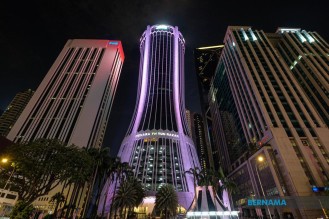
Tabung Haji's acquisition of a 30 per cent stake in construction company Putrajaya Perdana Bhd proceeded through every stage of regulatory approval during a period when the company was alleged to be controlled by fugitive financier Low Taek Jho, commonly known as Jho Low, according to testimony presented to parliament. Finance Minister II Datuk Seri Amir Hamzah Azizan revealed the timeline during parliamentary deliberations on a Royal Commission of Inquiry report into the Islamic pilgrim fund's management, pointing to sworn evidence from court proceedings into SRC International, a former 1Malaysia Development Bhd subsidiary.
The chain of approvals unfolded across a compressed timeframe in 2014. Tabung Haji's Investment Panel authorised the transaction on July 24, the board endorsed it on August 25, ministerial approval followed on August 27, and the sale and purchase agreement was finalised on December 3. The crucial detail emerged from testimony by Putrajaya Perdana director Datuk Rosman Abdullah in the SRC International case, which revealed that SRC International—allegedly secretly controlled by Jho Low through Utama Banking Group Bhd (UBG Bhd)—channelled RM170 million to Putra Perdana Construction, Putrajaya Perdana's subsidiary, in three separate tranches between July and August 2014. This money flow occurred precisely during the approval window.
According to the testimony cited in parliament, Putrajaya Perdana remained under Jho Low's control through UBG until the company's sale was completed on April 13, 2015—more than four months after Tabung Haji had already signed the acquisition agreement. This chronological overlap raises serious questions about the investment approval process and the information available to decision-makers at the time. Amir Hamzah emphasised, however, that courts had drawn no formal finding that Jho Low held beneficial ownership of Putrajaya Perdana during this critical period, and that the connection remained based on sworn testimony rather than judicial determination.
A significant procedural breakdown emerged in the documented approval process. The Tabung Haji Investment Panel explicitly requested on July 24, 2014, that management identify the ultimate shareholder of the seller company. However, the fact-finding report from 2023 revealed no record that management provided a response to this crucial inquiry, yet the investment proceeded regardless. This absence of due diligence on a fundamental ownership question represented a critical governance failure, particularly given the eventual revelation of the connection to Jho Low and the subsequent collapse of the investment thesis.
The valuation itself appears to have been inflated without adequate justification. Tabung Haji's own Research Division initially objected to the proposed valuation of RM206 million for the 30 per cent stake, estimating instead that the equity was worth between RM124 million and RM155 million. Management ultimately secured approval for RM193.5 million despite this internal disagreement and without presenting written justification for the upward revision. Additionally, the approved stake increased from the initially proposed 25 per cent to 30 per cent without formal explanation to either the Investment Panel or the board of directors prior to signing the agreement. This departure from internal assessments suggested either inadequate scrutiny or pressure to approve an inflated price.
The investment rested entirely on two specific promises from the seller that never materialised. Tabung Haji was assured the company would be relisted on the stock exchange within a year and would achieve a profit of RM86 million in 2015. These representations proved false, yet the fund proceeded with investment despite the aggressive timelines and challenging targets. Compounding the governance concerns, the Royal Commission's investigation noted that Tabung Haji's chairman at the time also served as chairman of Putrajaya Perdana, creating a significant conflict of interest that may have compromised independent decision-making at the fund level.
Another critical disclosure involved the seller's acquisition cost. Cendana Destini Sdn Bhd, the investment vehicle through which the stake was sold to Tabung Haji, had acquired a majority shareholding in Putrajaya Perdana for RM260 million in 2012 from a business group linked to Jho Low. This meant the seller's basis for a 30 per cent stake stood at approximately RM78 million in 2012. By December 2014, when Tabung Haji paid RM193.5 million for the identical 30 per cent stake, the valuation had increased nearly 2.5 times in just two years, despite the company showing no material growth or improvement that would justify such a dramatic revaluation. This disparity was never disclosed to decision-makers in the investment approval chain.
Due diligence, the essential foundation of prudent investment, was relegated to an afterthought. The fact-finding assessment confirmed that comprehensive due diligence was conducted only after all approvals had been obtained and after the sale agreement was signed. This inverted process meant the Investment Panel and board of directors made their approval decisions without the benefit of independent assessment of the company's assets, liabilities, management quality, or operational viability. The 2023 fact-finding report identified a systematic pattern where four investments failed to undergo required due diligence procedures, and recommendations from the Risk Management Department were systematically overlooked or not properly integrated into decision-making processes.
The investment's subsequent deterioration proved rapid and comprehensive. When the two foundational promises failed to materialise, Tabung Haji exercised a put option in March 2018, requiring the seller to repurchase the shares for RM210.7 million. The seller failed to make payment, leaving Tabung Haji with a worthless investment. By the 2024 financial year, the RM193.5 million investment had been written off entirely as a complete loss, representing a total capital destruction for the fund.
Tabung Haji has since filed a legal claim to recover the investment, obtaining a Mareva injunction to freeze the seller's assets while pursuing court-directed recovery. The case reflects the broader pattern of governance failures and questionable transactions that prompted the Royal Commission's investigation into the fund's management. With court-ordered mediation scheduled and trial set for June 23, 2027, the case remains unresolved, leaving the fund's depositors bearing the cost of what appears to have been an investment decision made under inadequate scrutiny, with incomplete information, and without proper independent verification of the underlying business proposition or the integrity of the counterparty.
The transaction exemplifies how institutional investment processes can be compromised through weak governance, conflicts of interest, and incomplete information disclosure. For Malaysian investors and particularly for Tabung Haji depositors whose savings were invested in this failed venture, the case underscores the importance of rigorous oversight mechanisms and the dangers of allowing approval to precede rather than follow independent investigation and due diligence. The involvement of entities connected to Jho Low, who remains a fugitive from Malaysian justice, adds another layer of concern regarding how such connections escaped initial detection within the fund's decision-making framework.

