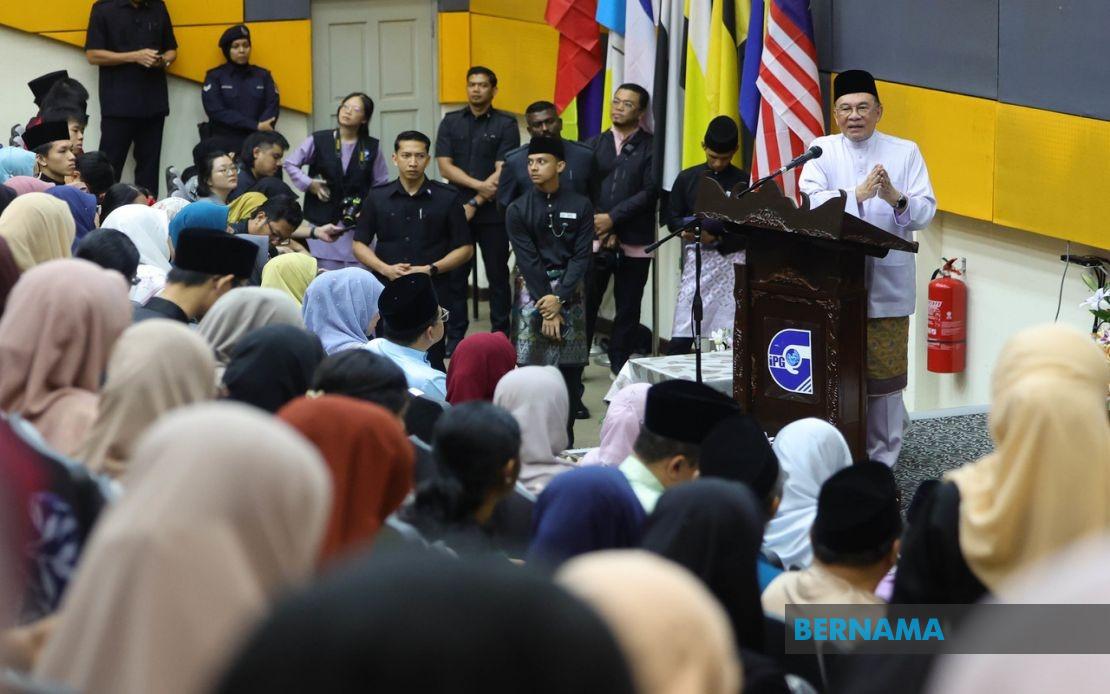
Prime Minister Datuk Seri Anwar Ibrahim has pinpointed the central obstacle to Malaysia's governance transformation: not a shortage of capability or resources, but the unwillingness of powerful constituencies to abandon established patterns of conduct. Speaking at an engagement session with educators and students in Bandar Enstek, Anwar highlighted how individuals accustomed to the current system—particularly those who have benefited from its weaknesses—actively resist efforts to modernise administrative structures and curb corruption.
During his more than three years heading the government, Anwar has observed firsthand how reform initiatives encounter sustained pushback from quarters invested in maintaining the status quo. This resistance manifests not as crude obstruction but as a subtle but persistent preference for familiar arrangements, even when those arrangements are demonstrably inefficient or corrupt. The Prime Minister's observation reveals a sophisticated understanding of institutional inertia: that systems perpetuate themselves partly through the self-interest of those who have learned to navigate them successfully.
The government's commitment to strengthening institutional accountability and eliminating normalised corrupt conduct remains resolute, despite public discomfort with the necessary disruptions. Anwar acknowledged that these efforts generate friction and displeasure among segments resistant to change. However, he framed the push for systemic improvement as a moral and civilisational imperative, grounded not merely in technocratic efficiency but in religious and cultural obligations towards transparency and good governance.
Anwar's characterisation of the resistance reveals a paradox at the heart of Malaysian society. Those who obstruct reform, he suggested, may present themselves as modern through their appearance and lifestyle choices, yet they fundamentally reject the philosophical modernisation that genuine systemic change demands. This observation cuts deeper than simple nostalgia for old ways; it suggests that superficial modernisation can coexist with deeply conservative institutional thinking, particularly when that conservatism serves personal advantage.
The Prime Minister's diagnosis has significant implications for understanding Malaysia's reform trajectory. If the primary impediment is not technical or intellectual capacity but rather entrenched resistance from beneficiaries of existing dysfunction, then reform cannot succeed through better policy design alone. It requires either demographic or political change that shifts the balance of power away from those defending the old system, or alternatively, persuasion and institutional pressure sufficient to overcome self-interest.
The stakes of this struggle extend beyond abstract notions of good governance. Malaysia's position in the regional and global economy increasingly depends on institutional credibility and administrative efficiency. Corruption and weak governance create transaction costs that erode competitiveness and discourage high-quality investment. Countries that successfully transcend entrenched resistance—such as Singapore or South Korea in their respective contexts—tend to experience accelerated development precisely because administrative reliability becomes a competitive advantage.
For Malaysian readers and observers, Anwar's remarks underscore why reform programmes, however well-intentioned, often disappoint public expectations. The technical solutions—new oversight bodies, transparency mechanisms, computerised systems—address only part of the challenge. The harder work involves shifting institutional cultures and undermining the networks through which corrupt or inefficient conduct has become normalised. This requires sustained leadership commitment and often faces resistance from multiple directions simultaneously.
The engagement at the Institute of Teacher Education campus was itself strategic. Educators and students represent constituencies less invested in preserving established administrative hierarchies and potentially more receptive to systemic improvement. By communicating directly with these groups, Anwar was building a constituency for reform that understands the government's vision and can reinforce it through their respective communities and professional networks.
The broader regional context matters here as well. Southeast Asia has witnessed varying trajectories in confronting institutional corruption and governance deficiencies. Some countries have made substantial progress through determined reform campaigns, while others have struggled when reform efforts proved insufficient to overcome deeply rooted resistance. Malaysia's trajectory will partly depend on whether the momentum for change can be sustained and whether institutions can be insulated from political interference or capture by entrenched interests.
Anwar's candid acknowledgement that reform will prove unpopular in certain quarters reflects political realism. Genuine institutional change necessarily redistributes advantage and disadvantage; those experiencing the latter will resist. The Prime Minister's framing suggests that his government has moved beyond seeking consensus on reform and instead is proceeding on the basis that certain changes are non-negotiable regardless of opposition from those defending privilege or comfortable corruption.
The challenge ahead involves translating this rhetorical commitment into sustained implementation. One test will be whether the government proves willing to pursue accountability against powerful individuals within its own structures and constituencies, or whether reform remains selectively applied to outsiders and the relatively powerless. Malaysian observers will be watching whether Anwar's identification of resistance becomes a pretext for inaction, or whether it signals genuine determination to overcome institutional obstacles regardless of the political cost.

