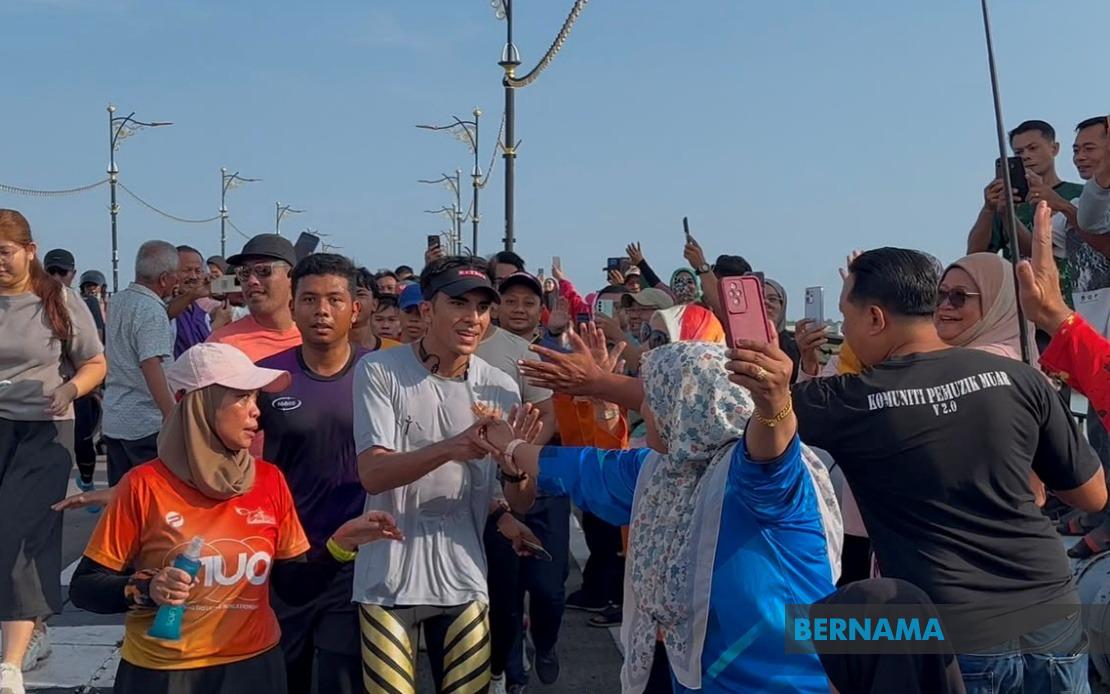
Muar Member of Parliament Syed Saddiq Syed Abd Rahman crossed the finishing line at Laman Maharani on July 19 morning, bringing to a close his ambitious four-day "Larian Kesyukuran" (Gratitude Run) that had commenced from the Palace of Justice in Putrajaya on July 16. The 170-kilometre journey concluded before a gathering of approximately 2,000 well-wishers who had assembled at the venue since dawn, creating an atmosphere of celebration and community solidarity that underscored the initiative's resonance with residents.
The final leg of the marathon charity drive took Syed Saddiq across 17 kilometres through Melaka, beginning from Simpang Sungai Rambai and proceeding across the Sultan Ismail Bridge with accompaniment from members of the 'Muo Runner' group. His arrival at 9.15 am marked not merely the completion of a personal physical endeavour but represented the culmination of a broader effort to galvanise community engagement around charitable giving. The routing through multiple states and towns had been strategically designed to maximise public visibility and participation along the entire corridor.
The financial outcome substantially surpassed initial projections, with the initiative ultimately generating RM650,959.2 against an original target of RM200,000. This more than threefold surplus demonstrates the considerable public appetite for supporting constituency-level welfare initiatives when presented through such high-profile, participatory campaigns. Speaking immediately after completing the run, Syed Saddiq expressed deep gratitude for the breadth of public backing, emphasising that individual donations ranged from significant contributions down to 50 sen from a child, reflecting the inclusive nature of the fundraising approach.
The parliamentarian made an unequivocal commitment that 100 per cent of collected funds would be deployed directly toward welfare assistance programmes benefiting Muar residents. The intended allocation encompasses provision of food baskets for families experiencing economic hardship alongside distribution of tablet devices to students from disadvantaged backgrounds. Such targeted use of the funds reflects growing recognition within Malaysian political circles of the digital divide's impact on educational outcomes, particularly for rural and lower-income student populations competing in an increasingly technology-dependent learning environment.
Particular significance attaches to the geographic breadth of support mobilised beyond Muar's immediate boundaries. Constituents and well-wishers from surrounding parliamentary constituencies, including Batu Pahat, travelled specifically to the finishing point to offer moral and financial support. The case of Aminah Abd Rahman, aged 64, and her daughter Syarifah Fatimah Syed Ali, 26, exemplifies this pattern. Despite residing outside the Muar constituency, they made the deliberate decision to monitor the run's daily progress through social media channels and subsequently journey to Laman Maharani to contribute and express solidarity.
Aminah's observation that not every elected representative undertakes such physically demanding and visible public fundraising initiatives captures an important distinction in political engagement approaches within Malaysia. The willingness to subject oneself to sustained physical exertion across multiple days, publicly documented through media coverage and social channels, represents a departure from conventional constituency service models. This approach potentially generates heightened emotional connection with constituents and demonstrates tangible personal commitment beyond conventional electoral cycles.
The phenomenon of supporters travelling from neighbouring constituencies carries broader implications for how elected representatives are perceived and evaluated across regional boundaries. In an era of social media transparency, noteworthy political initiatives generate attention and comparative assessment across wider geographic areas than traditional electoral boundaries would suggest. Syed Saddiq's charity run thus functioned simultaneously as a Muar-focused welfare initiative and as a demonstration of parliamentary engagement visible and accessible to residents across Johor's multiple constituencies.
The timing and execution of the campaign reflects sophisticated understanding of modern fundraising dynamics. The four-day structure provided sustained media coverage opportunities while the specific routing through multiple towns and the Melaka checkpoint created natural storytelling moments. The escalating momentum narrative—beginning from the capital's Palace of Justice and concluding in a major parliamentary constituency—formed a coherent arc that media outlets and social platforms could readily communicate to broader audiences.
The initiative also illustrates evolving constituent expectations regarding elected representatives' engagement modalities. Traditional constituency service—office hours, complaint resolution, allocation of development funds—increasingly coexists with expectations that politicians will undertake visible, personally demanding activities that generate media coverage and demonstrate commitment beyond administrative routine. The charity run format, combining fundraising with public participation opportunities, satisfies both welfare objectives and political brand-building imperatives in ways that conventional service delivery might not.
Future implications for Malaysian political practice may include increasing adoption of similar high-profile fundraising and engagement initiatives by parliamentarians across constituencies. The Muar campaign's success in mobilising support significantly beyond initial projections suggests that constituents respond positively to politicians who undertake personally challenging endeavours visibly connected to welfare objectives. However, such approaches also raise questions about sustainability, equity across constituencies with varying resource bases, and whether the emphasis on high-profile individual campaigns might overshadow more routine but equally essential constituency service functions.

