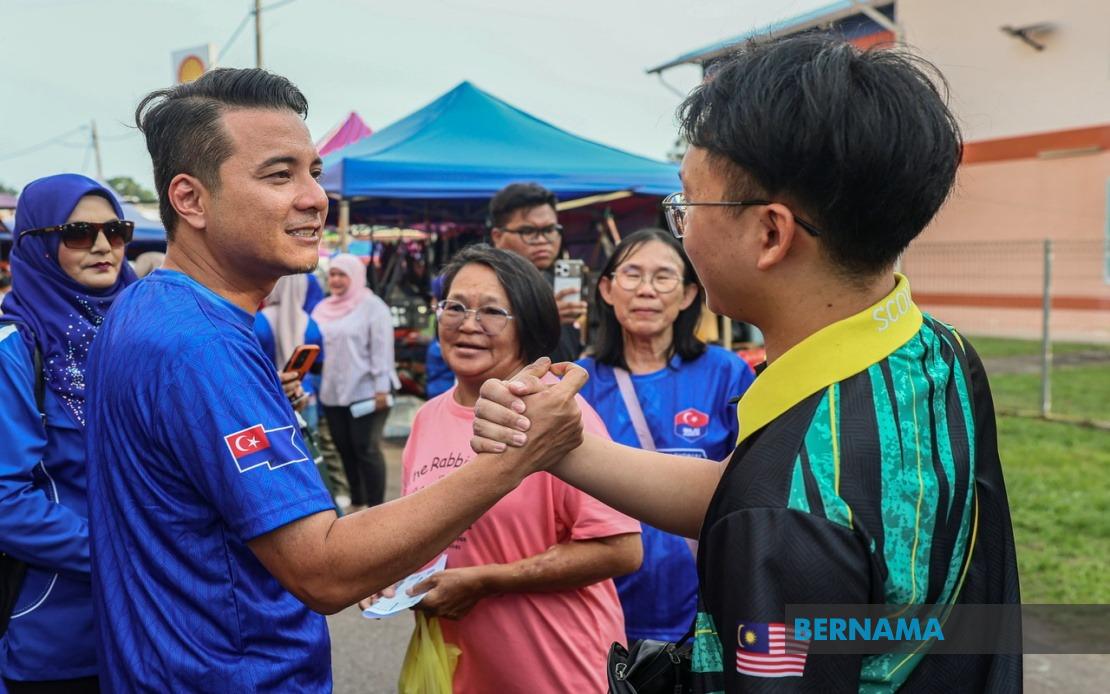
Barisan Nasional candidate Syed Hussien Syed Abdullah is campaigning for Mahkota on a distinctive development platform centred on allowing residents to pursue higher-wage employment opportunities in Johor's major urban and industrial zones while maintaining the affordability and lifestyle benefits of countryside living. The approach reflects broader efforts by the coalition to position itself as capable of delivering tangible economic benefits through strategic infrastructure investment and regional development coordination.
Central to this vision is the expansion of public transport infrastructure, particularly the Electric Train Service, which would reduce travel friction between Kluang and the state's major employment centres. By shortening effective commute times, improved connectivity effectively extends the geographic range within which workers can reasonably access premium-paying positions in industrial areas while retaining their residency in lower-cost localities. This represents a practical response to a persistent tension in Malaysian development: young professionals from smaller towns often face a binary choice between relocating entirely to urban areas or accepting limited local employment opportunities. For Mahkota residents, better transit connections could dissolve this false choice.
Syed Hussien's proposal aligns explicitly with the Johor Economic Transformation Plan launched by Menteri Besar Datuk Onn Hafiz Ghazi, which aims to distribute economic growth across all ten districts rather than concentrating expansion in a handful of established centres. This framing positions the Mahkota initiative within a state-level economic strategy, lending institutional weight to what might otherwise appear a single candidate's localized pledge. The JETP approach suggests recognition within Johor's leadership that inclusive growth patterns require deliberate coordination of transport, industrial zoning, and residential development across district boundaries.
On the campaign trail, Syed Hussien reported that the BN machinery had reached more than half of Mahkota's areas, with expectations to complete broader coverage within four to five days. He attributed this momentum to sustained grassroots engagement rather than time-bound campaign bursts, combining digital outreach with direct voter contact. This emphasis on consistent organizational presence reflects lessons from recent Malaysian electoral contests, where ground-level party infrastructure often proves decisive in determining outcomes at the state assembly level.
When addressing the Chinese community within the constituency, Syed Hussien highlighted his fluency in Mandarin while cautioning that linguistic capability alone cannot substitute for substantive fairness and respect. His framing of language proficiency as secondary to equitable treatment signals awareness of sensitivities around representation and inclusion without elevating cultural symbols above material governance. This calibrated messaging suggests an attempt to avoid both patronizing essentialism and performative multiculturalism.
Syed Hussien identified young voters as potentially determinative in Mahkota's outcome and emphasized BN's commitment to avoiding populist inducements in their favour. Instead, the coalition aims to encourage what he characterized as political maturity and responsible civic participation by helping young people understand voting as carrying genuine responsibility rather than as an opportunity for politicians to offer unrealistic benefits. This rhetorical positioning presents BN as the serious, forward-thinking choice against opponents who might resort to short-term promises, though it also reflects a calculated risk that young voters may respond better to substantive proposals than to cautionary messages about avoiding disappointment.
The Mahkota contest involves three major candidates: Syed Hussien representing Barisan Nasional, Dr Ahmad Zuhan Md Zain for Pakatan Harapan, and Abd Hamid Ali contesting as a Bersama candidate. This three-way split creates multiple scenarios for coalition-building and vote-splitting that could significantly influence the final outcome. The composition of competing candidacies across Johor's 56 state seats—with 172 candidates in total—suggests a genuinely competitive electoral environment where incumbency and organizational capacity may determine results as much as policy positioning.
Election day is scheduled for July 11, with early voting available on July 7. The timeline provides candidates roughly one week to convert their campaign messaging into actual voter support, a compressed window that privileges parties with established organizational networks and pre-existing voter relationships. For a candidate like Syed Hussien, who achieved a substantial majority of 20,648 votes in a 2024 by-election, the baseline expectation likely involves consolidating that support while potentially expanding reach within newly engaged segments of the electorate.
Syed Hussien's emphasis on connecting Mahkota to Johor's broader economic transformation reflects a strategic choice to position local development within state and regional contexts rather than framing Mahkota's future in isolation. This approach mirrors trends across Southeast Asian electoral politics, where candidates increasingly invoke subnational development plans and connectivity initiatives as evidence of governing competence. The credibility of such positioning depends heavily on whether infrastructure commitments like expanded ETS service actually materialize and deliver the promised benefits to commuting workers.
The 'Work in the City, Live in the Countryside' framing also implicitly addresses urbanization pressures that have historically driven demographic concentration in Malaysia's largest metros. By suggesting that residents need not choose between economic opportunity and affordable rural living, the vision potentially appeals to multiple voter segments: young professionals seeking career advancement, families concerned about rising urban housing costs, and established residents attached to Kluang's communities. Whether this aspirational vision can translate into tangible electoral support depends partly on whether voters perceive Syed Hussien and BN as capable of delivering the transport, economic, and planning infrastructure such a model would require.
For Southeast Asian observers of Malaysian politics, the Mahkota campaign illustrates broader trends in how regional candidates position themselves relative to state-level economic planning and infrastructure investment. The emphasis on transport connectivity as a development tool reflects recognition that geographic accessibility increasingly determines economic opportunity distribution across more dispersed settlement patterns. As Johor and other Malaysian states pursue competitive positioning within regional economic networks, candidates who credibly connect local constituencies to these larger frameworks may find themselves better positioned to claim voter support.

