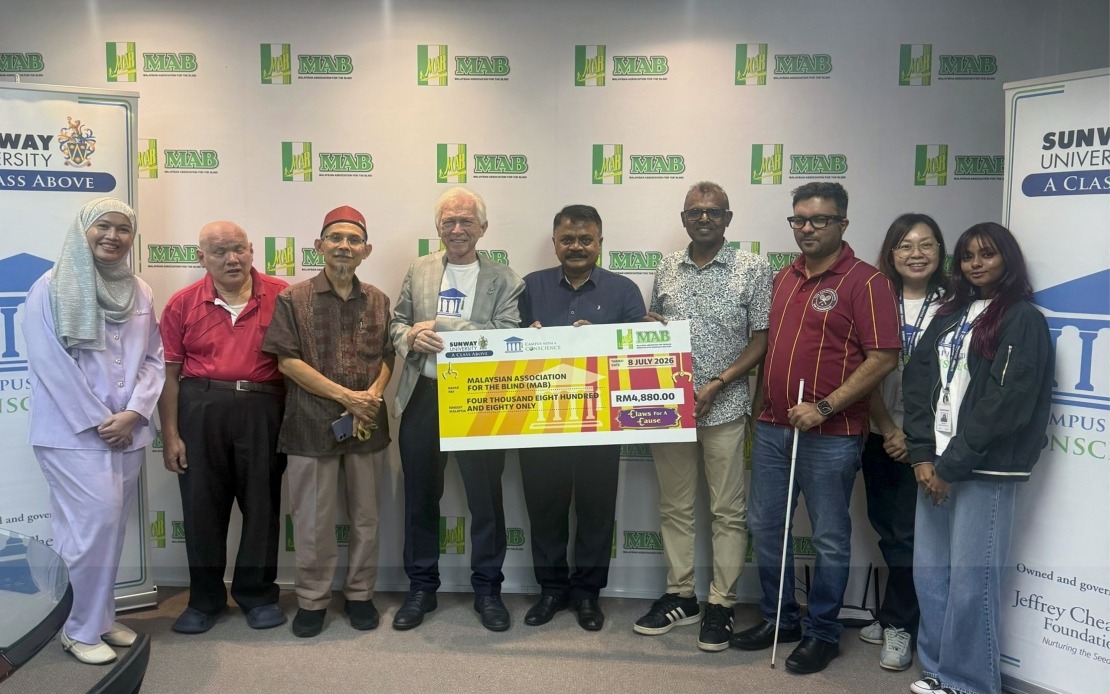
Sunway University has demonstrated its commitment to corporate social responsibility by organising a successful fundraising campaign that generated RM4,880 for the Malaysian Association for the Blind (MAB). The "Claws For A Cause" initiative, which operated throughout a week on the university's campus, transformed a conventional arcade game into a vehicle for charitable giving, engaging both students and staff members in a cause that directly benefits individuals living with visual impairments across Malaysia.
The campaign was executed under the university's broader "Campus With A Conscience" programme, a framework designed to embed social responsibility into the institution's everyday operations and culture. By partnering with entertainment company Space Panda, Sunway University was able to repurpose a claw machine—typically associated with recreation and entertainment—into an effective fundraising tool. Participants paid to play the game, with proceeds directed entirely to MAB, creating a model where leisure and charitable action converge organically.
Professor Sibrandes Poppema, President and Vice-Chancellor of Sunway University, framed the initiative as an extension of the institution's core mission. He emphasized that the university's role encompasses far more than delivering academic education; rather, it positions itself as a driver of positive social transformation within communities. His statement reflected a growing trend among Malaysian universities to position themselves as anchors of societal benefit, integrating social engagement alongside research and innovation as pillars of institutional identity.
The fundraising model employed here carries particular significance for Southeast Asian institutions navigating the balance between academic excellence and social accountability. Rather than relying solely on traditional donation mechanisms or charity galas, Sunway University opted for an experiential approach that normalises giving within the campus community. This democratises participation—students and staff can contribute without requiring substantial individual donations, instead paying modest amounts to engage in an activity they already find enjoyable.
Space Panda's involvement represents an important partnership model where private sector entertainment companies collaborate with educational institutions on social causes. Marcus, the company's director, articulated a philosophy that modest, collective gestures of kindness accumulate into meaningful impact. This reflects a broader Southeast Asian business ethos increasingly emphasizing stakeholder value beyond shareholder returns, particularly among companies targeting younger demographics attuned to corporate social responsibility.
The Malaysian Association for the Blind, as the beneficiary organisation, works to support and empower individuals navigating visual impairments across the country. A contribution of RM4,880, while seemingly modest in absolute terms, can translate into meaningful resources for organisations operating in Malaysia's non-profit sector where funding constraints frequently limit programme expansion. Such support can facilitate vocational training, counselling services, assistive technology access, or awareness campaigns designed to reduce stigma and discrimination.
The campaign's success also underscores the potential for campus-based fundraising to generate reliable community resources. Universities house concentrated populations of young people who, when mobilised around causes aligned with their values, demonstrate significant aggregate purchasing power. Malaysian tertiary institutions, particularly private universities with well-resourced campuses, are increasingly recognising this potential and structuring programmes to activate it regularly.
From a broader perspective, initiatives like "Claws For A Cause" address a structural reality in Malaysia's non-profit landscape: charitable organisations often struggle with funding visibility and consistent support streams. When universities institutionalise fundraising campaigns and integrate them into campus calendars, they create predictable revenue channels for partner organisations while embedding philanthropic consciousness into student culture. This generational engagement matters, as university-age individuals who develop giving habits early tend to maintain them throughout their careers.
The partnership model employed here also reflects how institutional collaboration can amplify impact beyond what individual entities could achieve independently. Space Panda provided equipment and expertise in entertainment gaming; Sunway University contributed campus space, participant reach, and institutional credibility; MAB received financial support and visibility. This tripartite arrangement demonstrates how structured partnerships can create value multiplication, a principle increasingly central to Malaysian corporate governance discussions.
Looking forward, the initiative establishes a template that other Malaysian universities and companies might replicate, adapting mechanics to different causes and communities. Such campaigns need not be limited to disability-focused charities; similar models could support educational scholarships, environmental conservation, healthcare initiatives, or community development programmes. The scalability potential of this approach makes it particularly attractive for institutions seeking to deepen community engagement without requiring extraordinary financial outlays.
The success of "Claws For A Cause" also reflects shifting expectations around corporate citizenship among Malaysian stakeholders. Rather than viewing social responsibility as a compliance obligation or marketing exercise, forward-thinking institutions increasingly present it as integral to their identity and operations. Sunway University's framing emphasises that such initiatives flow naturally from institutional values, not external pressure, which resonates with increasingly sophisticated audiences sceptical of performative corporate social responsibility.
Ultimately, campaigns like this matter because they normalise the connection between everyday activity and social benefit. By embedding fundraising into familiar campus experiences, Sunway University demonstrates that supporting vulnerable populations need not require extraordinary sacrifice or inconvenience from supporters. This psychological reframing—making generosity convenient and integrated—potentially shifts community attitudes toward charitable engagement, particularly among younger populations still forming their relationship with civic participation and social investment.

