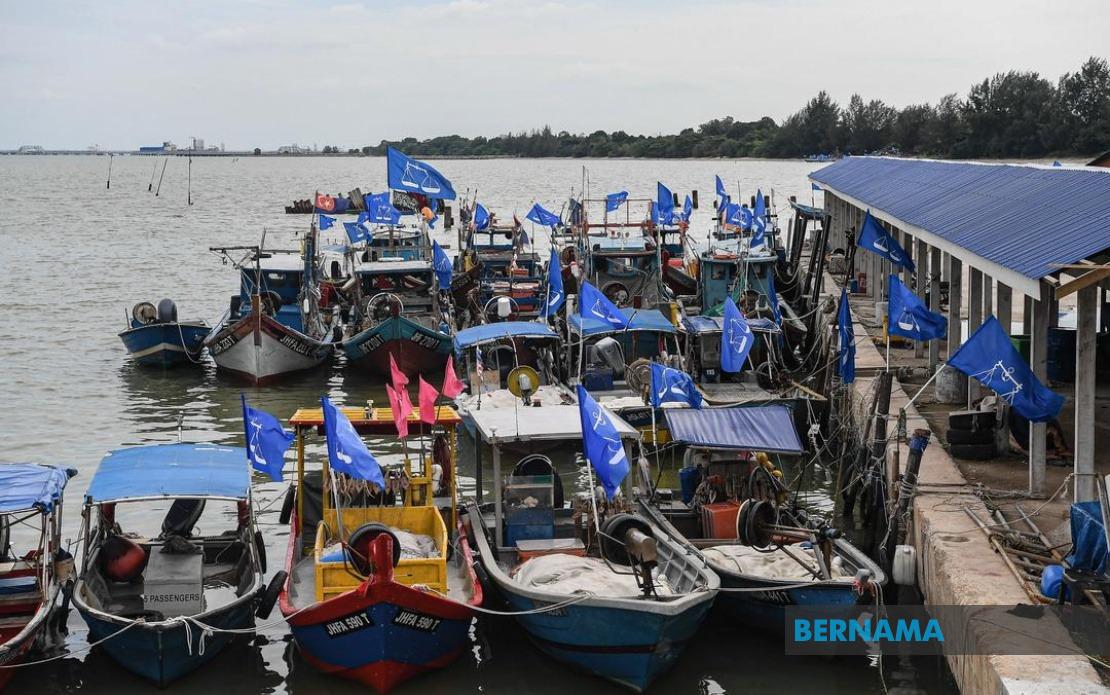
Residents of Sungai Rengit in Kota Tinggi are banking on the elected representative from the 16th Johor state election to finally resolve critical infrastructure and security problems that have plagued the coastal community for nearly ten years. Located within the Tanjung Surat state constituency, this strategically positioned town serves as a crucial service hub for workers at the Pengerang Integrated Petroleum Complex, yet the deteriorating conditions at its food court and fishing facilities have left traders and fishermen increasingly frustrated.
The traders at Medan Selera Sungai Rengit have endured a prolonged displacement that began when they were relocated from their original location to accommodate a development project. What was initially presented as a temporary arrangement has now stretched far beyond expectations, leaving business operators in a state of limbo. The alternative site offered to them falls short of their commercial needs, burdened by inadequate parking and its positioning on a one-way road that deters both customers and foot traffic. Rather than accept this suboptimal relocation, many traders argue that upgrading the existing temporary site would be far more beneficial, as customers have already established patterns of visiting the original location.
Beverage vendor Lai Swee Hong, who has operated her business for three decades, articulated the fundamental challenge facing traders at the temporary facility. Her stalls, like those of her neighbours, consist of nothing more than canvas canopies and plywood partitions, providing minimal protection against the elements or security threats. The absence of proper doors and structural integrity has made theft a recurring problem, while exposure to monsoon rains and tropical heat accelerates deterioration. When traders were first informed of the relocation, they were promised only eighteen months at the temporary site; instead, they have remained there for roughly a decade with no transparent timeline for permanent resolution. This prolonged uncertainty has compounded their financial stress and sense of neglect by local authorities.
Security represents perhaps the most pressing concern among the trading community. Food vendor Wini Fasiha Zawawi reported a pattern of thefts and losses dating back to the previous year, impacting the livelihoods of already marginal small business operators. Despite filing police reports and lodging complaints with local government authorities, meaningful security interventions have failed to materialise. While police patrols occur sporadically, stolen goods continue to vanish from unprotected stalls, eroding trader confidence in both enforcement capacity and political commitment to their welfare. The cumulative effect of these incidents, though individually modest in financial terms, collectively drains the limited profit margins on which these families depend.
Parallel to the traders' grievances, Sungai Rengit's fishing community faces distinct but equally pressing economic pressures. The sector contends with rising operational costs at sea, compounded by an increasingly difficult cost of living environment that squeezes household budgets. Fishermen like Sin Hock Hwee, who has worked the waters since adolescence, attribute their current survival largely to existing fuel subsidies. The subsidy programme provides essential relief against soaring fuel prices that would otherwise render fishing economically unviable for small-scale operators. However, fishermen fear that without continued political support and potentially enhanced assistance, the generational nature of their profession will become unsustainable for younger cohorts seeking to enter the industry.
Young fisherman Hidayat Isa articulated a broader vision for community development that extends beyond immediate financial relief. He emphasised the need for proactive investment in jetty infrastructure and facilities that would modernise the fishing sector's operational capacity. More significantly, Hidayat called for elected representatives to demonstrate genuine responsiveness to the voices and concerns of emerging fishermen, ensuring their perspectives shape policy decisions affecting the sector's future. He proposed that Kampung Sungai Rengit be designated as an adopted village for the incoming assemblyman, creating a formal framework for sustained political engagement and resource allocation. This suggestion reflects a deeper frustration that despite their strategic economic importance to the region, fishing communities often lack consistent political attention.
The Tanjung Surat state seat contest has become a direct competition between two candidates with markedly different party affiliations. Pakatan Harapan's nominee Faizul Abdul Ghani faces incumbent Aznan Tamin, representing Barisan Nasional. Both candidates will campaign against the backdrop of these accumulated grievances from traders and fishermen, offering distinct visions for addressing infrastructure deficits and economic support. The election outcome will significantly influence resource allocation priorities for the constituency's most vulnerable economic sectors.
The broader context of this election cycle encompasses 172 candidates competing across 56 state seats in Johor, with polling scheduled for July 11 following early voting on July 7. This competitive environment has elevated the salience of localised constituency issues, with candidates seeking to distinguish themselves through commitments to specific community concerns. The traders and fishermen of Sungai Rengit represent precisely the constituency demographic whose support can shift outcomes in tightly contested seats, granting their accumulated grievances substantial political relevance.
For traders and fishermen accustomed to feeling marginalised by development priorities that favour larger commercial interests and industrial complexes, this election represents a rare opportunity to demand accountability. The decade-long delay in resolving the traders' situation—coupled with inaction on security and inadequate attention to fishing sector welfare—has created palpable resentment toward incumbent governance structures. Whether the incoming assemblyman prioritises these community issues will serve as an early indicator of whether representative democracy in peripheral constituencies can deliver tangible improvements to the working poor and traditional industries that continue to sustain rural and coastal Malaysian communities.

