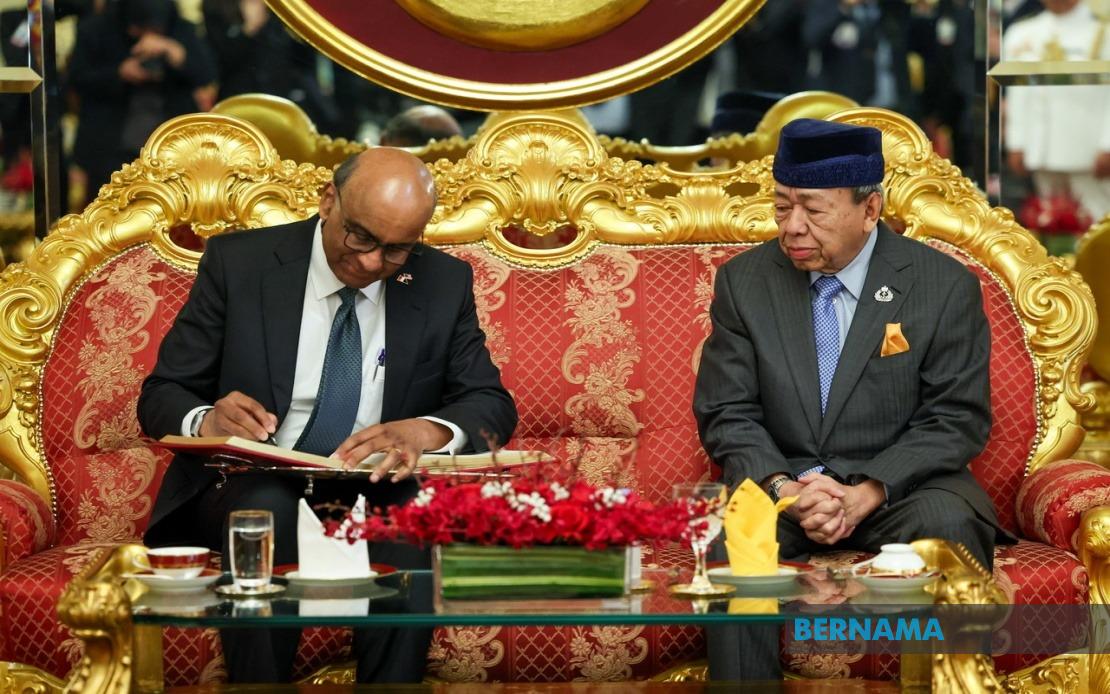
Singapore President Tharman Shanmugaratnam was received in audience by Sultan Sharafuddin Idris Shah, the Sultan of Selangor, on July 14 at Istana Alam Shah in Klang during an official state visit to Malaysia. The president arrived at the palace at 11 am and was welcomed by Tengku Amir Shah, the Raja Muda of Selangor, marking a significant moment in diplomatic protocol between Malaysia's Selangor state and the island republic.
The formal engagement was attended by Entrepreneur Development and Cooperatives Minister Steven Sim, who assumed the role of minister-in-attendance for the presidential visit. The substantive discussions and courtesies extended during the meeting reflected the customary respect accorded to visiting heads of state, with the audience proceedings extending approximately ninety minutes before concluding at 12.40 pm.
President Tharman's three-day visit to Malaysia, which began on July 13 and concludes on July 15, was undertaken at the invitation of His Majesty Sultan Ibrahim, King of Malaysia. This official state visit represents a continuation of high-level bilateral engagement between the two Southeast Asian neighbours, signifying the importance both governments place on maintaining strong institutional relationships at the highest levels.
The timing of this visit carries particular significance as it serves to reciprocate His Majesty Sultan Ibrahim's own state visit to Singapore, which took place on May 6 and 7, 2024. Such reciprocal official visits between heads of state or comparable dignitaries underscore the commitment of both nations to preserving cordial diplomatic relations and demonstrating mutual respect through structured engagement protocols. The exchange reinforces the tradition of regular high-level contact that characterises the Malaysia-Singapore relationship.
Economically, the bilateral relationship between Malaysia and Singapore remains remarkably robust. Singapore stands as Malaysia's second-largest trading partner globally, a position that underscores the depth of commercial interdependence between the two nations. Within the Association of Southeast Asian Nations framework, Singapore holds an even more prominent position as Malaysia's largest trading partner among ASEAN member states, reflecting the significance of the regional partnership.
The economic dynamism of the Malaysia-Singapore relationship extends beyond simple trade figures. Both nations have developed intricate supply chains, joint ventures, and investment flows that bind their economies together. Malaysian companies maintain substantial operations in Singapore, while Singaporean investors continue to view Malaysia as a crucial market for expansion and diversification. The financial services sector, manufacturing, logistics, and petrochemicals all represent areas of substantive bilateral collaboration.
From a geopolitical perspective, the maintenance of strong bilateral relations between Malaysia and Singapore carries implications beyond the dyadic relationship. Both nations play consequential roles in regional stability and economic governance through ASEAN mechanisms. The strength of their bilateral ties indirectly influences the cohesion and effectiveness of regional groupings, particularly as ASEAN navigates complex challenges related to maritime security, trade connectivity, and great power competition in Southeast Asia.
The location of the audience at Istana Alam Shah in Klang symbolises the federal structure of the Malaysian political system, where sultans of individual states maintain ceremonial and constitutional significance in national and international affairs. By conducting the formal reception at the state palace rather than exclusively at federal level venues, the engagement affirms the role of the Selangor sultanate in Malaysia's diplomatic representation. The Raja Muda's presence further emphasises the involvement of Selangor's established succession in state-level diplomacy.
Such state-level diplomatic gestures often carry practical significance beyond ceremonial considerations. Selangor, as Malaysia's most economically developed state and home to the Klang Valley industrial belt, maintains direct interests in bilateral economic relations with Singapore. The state's positioning as a manufacturing and logistics hub makes the Singapore relationship particularly relevant to provincial development strategies. When state rulers and heirs engage directly with visiting dignitaries, it can facilitate conversations about specific commercial opportunities and regional projects that benefit from both state and national level coordination.
The Foreign Ministry's characterisation of the visit as reciprocating previous engagement reflects a structured approach to diplomatic scheduling, ensuring that official visits between nations occur within reasonable temporal proximity. This prevents any perception of imbalance in diplomatic attention while allowing sufficient interval for the host nation to prepare adequate ceremonial and substantive responses. The May 2024 visit by Sultan Ibrahim had likely been scheduled months in advance, making the July return visit a logically sequenced diplomatic engagement.
Looking forward, such regular high-level exchanges serve important confidence-building functions, particularly in addressing any bilateral concerns that may arise between neighbouring nations sharing borders and overlapping maritime jurisdictions. Direct communication between rulers and presidents provides channels for resolving potential misunderstandings at their earliest stages and reinforces personal relationships that facilitate cooperation at multiple governmental levels. The continuation of these reciprocal visits signals that both Malaysia and Singapore remain committed to sustained engagement despite any periodic friction in their relationship.

