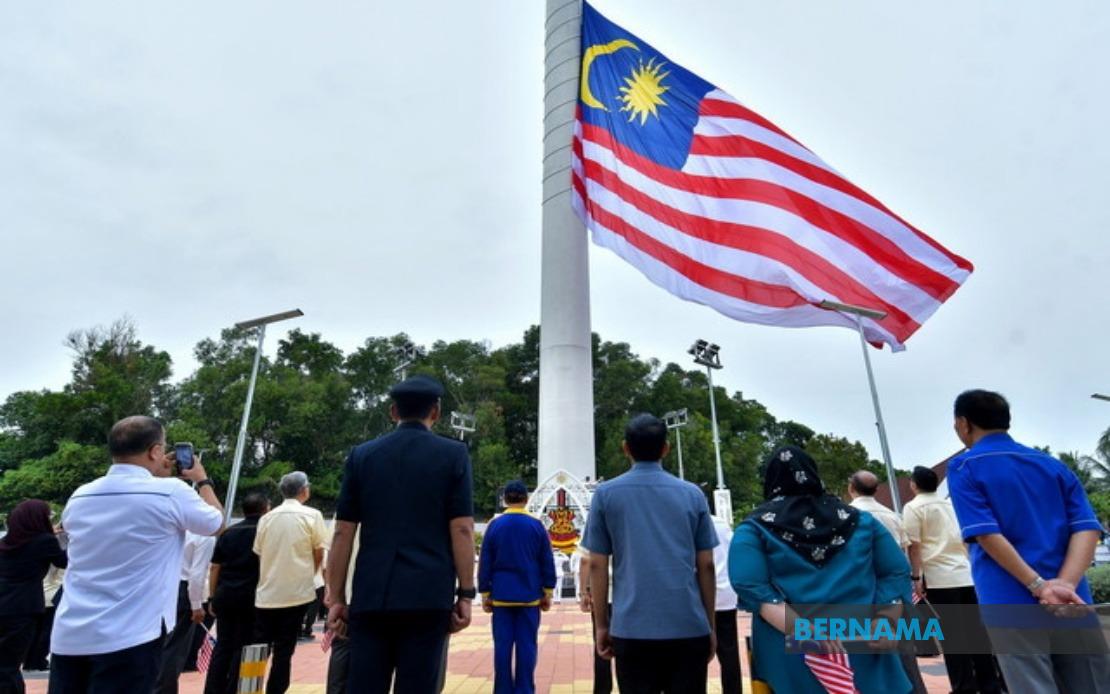
The Sultan of Selangor, Sultan Sharafuddin Idris Shah, has emphasized that the Jalur Gemilang transcends its ceremonial role as a flag displayed during Independence festivities, functioning instead as a profound emblem of nationhood that belongs equally to every Malaysian citizen. Speaking at a flag-hoisting ceremony held at Dataran Selangor on Aug 26, the Ruler articulated a vision of national identity that prioritizes common citizenship over the divisions that characterise Malaysian society. His intervention comes as the nation approaches its annual independence celebrations, a period traditionally marked by heightened patriotic expression yet often challenged by underlying social tensions.
Sultan Sharafuddin's remarks acknowledge a fundamental paradox in Malaysian national life: despite possessing a shared flag and constitutional framework, Malaysians remain deeply differentiated by ethnicity, religious belief, linguistic preference, and political conviction. Rather than viewing these diversities as incompatible with national unity, the Ruler positioned them as contextual reality within which the Jalur Gemilang serves as a unifying emblem. This framing suggests that authentic patriotism resides not in erasing or minimising difference, but in recognising that such differences exist within a overarching structure of shared citizenship and mutual obligation.
The Sultan's endorsement of the extended flag display throughout the National Month—from Aug 26 through Sept 17, spanning both National Day and Malaysia Day observations—serves as official sanction for public expressions of patriotism. Yet his accompanying commentary reveals a sophisticated understanding that the mere proliferation of flags, however visually impressive, represents only the superficial dimension of national cohesion. The proliferation of thousands of Jalur Gemilang across the country constitutes an easily accomplished symbolic gesture that risks masking the considerably more difficult work of building genuine social harmony.
A critical element of Sultan Sharafuddin's message targets the nation's younger generation, advocating for educational and social initiatives that cultivate respect across religious, ethnic, and cultural boundaries. This generational focus reflects recognition that Malaysia's future stability depends on inculcating values of acceptance and mutual recognition among those who will inherit the nation's contemporary challenges. By positioning respect for diversity as a fundamental national value requiring active cultivation rather than assumed inheritance, the Ruler implicitly challenges Malaysian institutions—educational, governmental, and familial—to prioritise this objective.
The Sultan's call for exemplary leadership from political and governmental figures represents an equally significant dimension of his message. His explicit reference to leaders and politicians avoiding the weaponisation of political, racial, or religious difference addresses a persistent Malaysian governance challenge: the recurring tendency of political actors to mobilise divisive rhetoric for electoral advantage. By framing such conduct as fundamentally inconsistent with the values represented by the Jalur Gemilang, Sultan Sharafuddin leveraged his constitutional authority and moral standing to articulate standards of comportment expected from those wielding political power.
The Ruler's observation that the national flag has never distinguished between ethnic groups—whether Malays, Chinese, Indians, Kadazan-Dusuns, or Ibans—or between adherents of different faiths constitutes a powerful normative statement about what Malaysian nationality represents. This enumeration of specific communities reflects awareness of Malaysia's actual demographic and cultural composition, avoiding abstract universalism in favour of concrete acknowledgement of the nation's actual pluralism. By insisting that the flag recognises no such distinctions, Sultan Sharafuddin asserted that the flag's symbolism must supersede ethnic and religious particularism.
For regional observers, Sultan Sharafuddin's intervention offers insight into the ceremonial role of constitutional monarchies within plural societies. While Malaysian sultans operate within a carefully circumscribed constitutional framework, occasions such as National Day provide platforms for articulating values and priorities that, while formally distinct from executive governance, carry considerable moral weight. The Sultan's framing of patriotism as requiring both individual respect and social tolerance resonates across Southeast Asia, where multiple nations navigate the complex relationship between national sovereignty and internal diversity.
The transformation of Independence anniversary celebrations into mechanisms for reinforcing social cohesion, rather than merely commemorating historical events, reflects deliberate strategic thinking about how ritual occasions can reinforce national values. Sultan Sharafuddin's suggestion that Independence Day should prompt reflection on the contributions of those working to bridge societal differences indicates receptiveness to viewing commemoration as opportunity for forward-looking affirmation rather than rearward-focused nostalgia. This approach acknowledges that durability of Malaysian independence depends not on military strength alone, but on ongoing commitment to inter-communal respect and institutional integrity.
The Sultan's most expansive claim—that the true significance of both independence and the national flag resides in their capacity to facilitate peaceful coexistence grounded in mutual respect—establishes an ambitious standard for national achievement. This formulation transcends territorial or institutional definitions of nationhood, locating authenticity instead in the subjective experience of citizens who genuinely feel respected and valued within their political community. For Malaysia, a nation constructed explicitly through constitutional arrangements negotiated by representatives of its major communities, this aspiration directly invokes the foundational social contract underlying Malaysian statehood.
The Sultan's commentary arrives amid broader regional discussions about national identity and cohesion in Southeast Asia. As multiple ASEAN nations experience demographic shifts, transnational migration, and evolving political contestation, the question of how national symbols can maintain meaning across diverse populations remains urgent. Malaysia's specific experience—with its constitutionally entrenched pluralism and history of inter-communal negotiation—offers particular lessons about sustaining national unity without requiring cultural homogenisation or suppression of identity.
Looking beyond the ceremonial dimensions, Sultan Sharafuddin's insistence that building genuinely inclusive Malaysia represents a task more substantial than flag display points toward concrete governance imperatives. Implementation of his vision requires educational curricula explicitly promoting interfaith and intercultural understanding, political discourse norms that penalise divisive rhetoric, and institutional mechanisms ensuring that minority communities experience meaningful representation and recognition. These represent challenges extending far beyond the constitutional and ceremonial authority of the Selangor throne.
The Sultan's call for Malaysians to harness independence anniversary occasions as opportunities for reinforcing unity and togetherness establishes an interpretive framework for national commemoration that privileges social cohesion and institutional renewal. This approach reframes Independence Day from celebration of liberation from colonial authority to occasion for recommitment to the ongoing project of maintaining the pluralistic nation-state created through independence. For Malaysian readers and regional observers alike, Sultan Sharafuddin's message articulates an ambitious yet grounded vision of nationalism rooted in shared citizenship rather than ethnic or religious domination.

