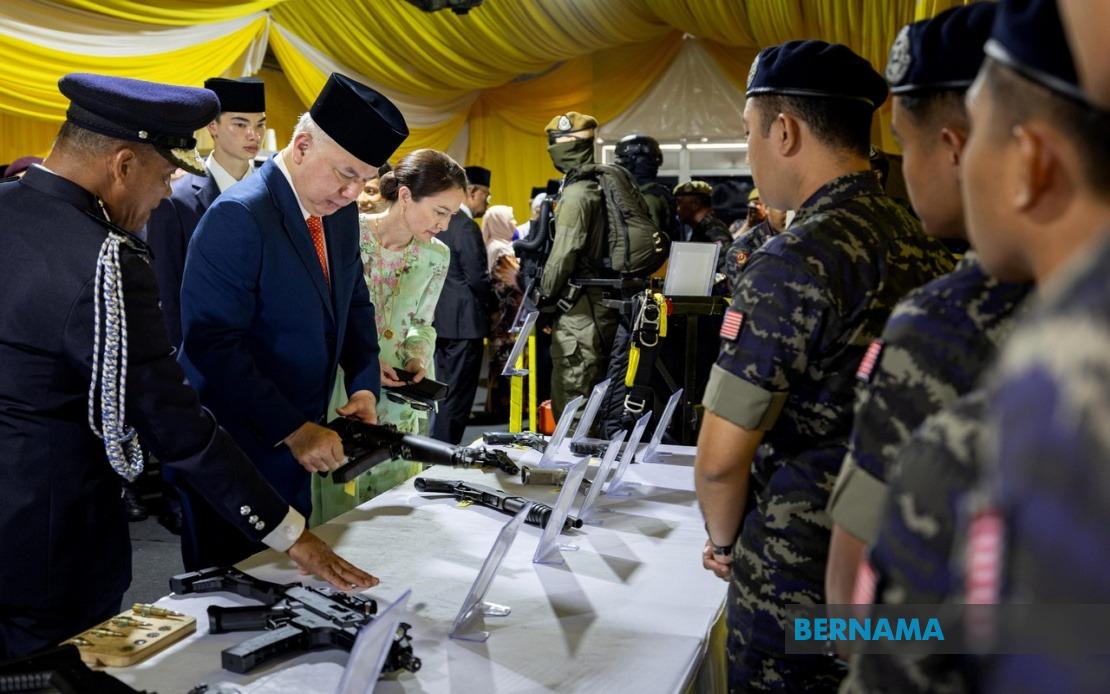
The Sultan of Perak, Sultan Nazrin Shah, formally inaugurated the Sultan Nazrin Shah 69 Commando Camp in Ulu Kinta on July 7, marking a significant milestone for one of Malaysia's most storied special operations units. The ceremonial opening was attended by senior members of the Perak royal household, including Tuanku Zara Salim, the Raja Muda Raja Jaafar Raja Muda Musa, and Raja Iskandar Dzurkarnain Sultan Idris Shah, alongside key federal figures including Home Minister Datuk Seri Saifuddin Nasution Ismail and Inspector-General of Police Tan Sri Mohd Khalid Ismail.
The establishment of this new facility represents a substantial national investment in Malaysia's internal security apparatus. Constructed at a cost exceeding RM206 million across a sprawling 338-hectare site, the camp was meticulously designed to align with contemporary operational demands and infrastructure standards. The facility was formally transferred to the Royal Malaysia Police in 2024, positioning it as a comprehensive hub for operations, training, and administrative functions that will serve the 69 Commando unit for decades ahead. This scale of investment underscores the government's recognition of the evolving security landscape facing the nation and the need for elite units to operate from bases equipped with modern facilities.
Home Minister Saifuddin Nasution framed the camp's opening within the broader security vision of the MADANI Government, emphasising that the new facility embodies the administration's determination to equip national security forces with the tools and environments necessary to confront increasingly sophisticated threats. He articulated that the camp's development extends beyond mere infrastructure, serving as a tangible demonstration of state appreciation for the sacrifices made by commando personnel spanning more than five decades of service. The opening thus carries symbolic weight, acknowledging both past contributions and future operational requirements in an era of complex security challenges.
Malaysia's standing within global security metrics received emphasis during the ceremony, with the Home Minister noting the nation's ranking of 12th out of 163 countries in the latest Global Peace Index. This achievement, he stressed, reflects not only government policy but also the dedication of security personnel who work to maintain the nation's stability. For Malaysian readers, this ranking situates the country within a relatively secure tier of nations globally, a position that security officials argue depends significantly on the capabilities and readiness of specialised units like the 69 Commando.
The 69 Commando unit itself carries a distinguished operational history extending back to its establishment in 1969. Throughout its existence, the unit has been deployed across multiple significant security operations, from counter-insurgency campaigns against communist remnants to high-profile incidents requiring precision response. The unit's involvement in the 2000 Al-Maunah incident, the 2013 Ops Daulat operation in Lahad Datu, Sabah, and the special deployment connected to the 2014 MH17 tragedy demonstrates the breadth of missions undertaken by this elite force. Beyond these major operations, the 69 Commando maintains ongoing responsibilities in counter-terrorism, hostage rescue, and responses to emerging security threats, positioning the unit as a critical component of Malaysia's security infrastructure.
For the broader Southeast Asian context, Malaysia's investment in specialised commando capabilities reflects regional trends in strengthening counter-terrorism and internal security capacity. Neighbouring countries face similar pressures from transnational security threats, and Malaysia's commitment to modernising its elite units signals a regional approach to maintaining stability. The facility's design as a training and operational hub may also facilitate regional cooperation and knowledge-sharing among Southeast Asian security forces, contributing to collective regional resilience.
The new camp's infrastructure is designed to nurture incoming generations of commando personnel, ensuring continuity of expertise and operational excellence. By providing a dedicated, purpose-built environment for training and operations, the facility aims to sustain the institutional knowledge that has accumulated within the 69 Commando over its five-decade history. This intergenerational knowledge transfer proves critical for maintaining operational effectiveness in an environment where threats constantly evolve and require adaptive responses.
From a Malaysian perspective, the RM206 million expenditure on this facility represents a significant allocation within the defence and security budget. Such investment decisions reflect government prioritisation of internal security and the recognition that infrastructure investments today translate into operational capabilities tomorrow. The scale of the project also implies substantial local economic activity during its construction phase, providing employment and development benefits to the Ulu Kinta region and surrounding communities in Perak.
Home Minister Saifuddin Nasution's remarks during the ceremony emphasised that the camp transcends its physical manifestations, functioning instead as a symbolic affirmation of national commitment to security and sovereignty. He articulated confidence that the facility would serve as a foundation for the 69 Commando to maintain its trajectory of excellence, courage, and sacrifice in defence of national interests. This framing positions the infrastructure investment within a narrative of national pride and collective security responsibility, appealing to broader public understanding of why resources are allocated to defence and security operations.
The opening of the Sultan Nazrin Shah Camp also reflects the Malaysian government's approach to naming significant national infrastructure after members of the royal household. By designating the facility in honour of the Sultan of Perak, the government acknowledges the constitutional role of the monarchy in the Malaysian system and the historical connection between the Perak royal household and the state's development. This naming convention maintains cultural continuity while simultaneously reinforcing the legitimacy and importance of the facility within Malaysia's institutional framework.
Looking forward, the facility stands positioned as a catalyst for enhanced operational capabilities within the 69 Commando. With modern training infrastructure, accommodation facilities, and operational complexes now in place, the unit can focus resources on capability development rather than infrastructure limitations. The camp's strategic location in Ulu Kinta, within Perak, places it centrally positioned relative to major population centres, facilitating rapid deployment responses to security incidents across the peninsula.
The presence of Menteri Besar Datuk Seri Saarani Mohamad at the ceremony underscores the significance of the facility within the Perak state context. The camp represents one of the largest federal security infrastructure projects in the state in recent years, potentially influencing broader economic and development patterns within the region. For Perak residents, the facility's presence brings both the tangible benefits of employment and security, alongside the intangible reassurance of enhanced state capacity to respond to threats.
The official inauguration of the Sultan Nazrin Shah 69 Commando Camp marks a transition point in Malaysia's security infrastructure development. With the facility now operational, the 69 Commando unit enters a new phase equipped with resources commensurate with contemporary operational demands. The ceremony itself, attended by senior political and security figures, reflects the importance the Malaysian government assigns to maintaining elite commando capabilities as a cornerstone of national security strategy moving into the coming decades.

