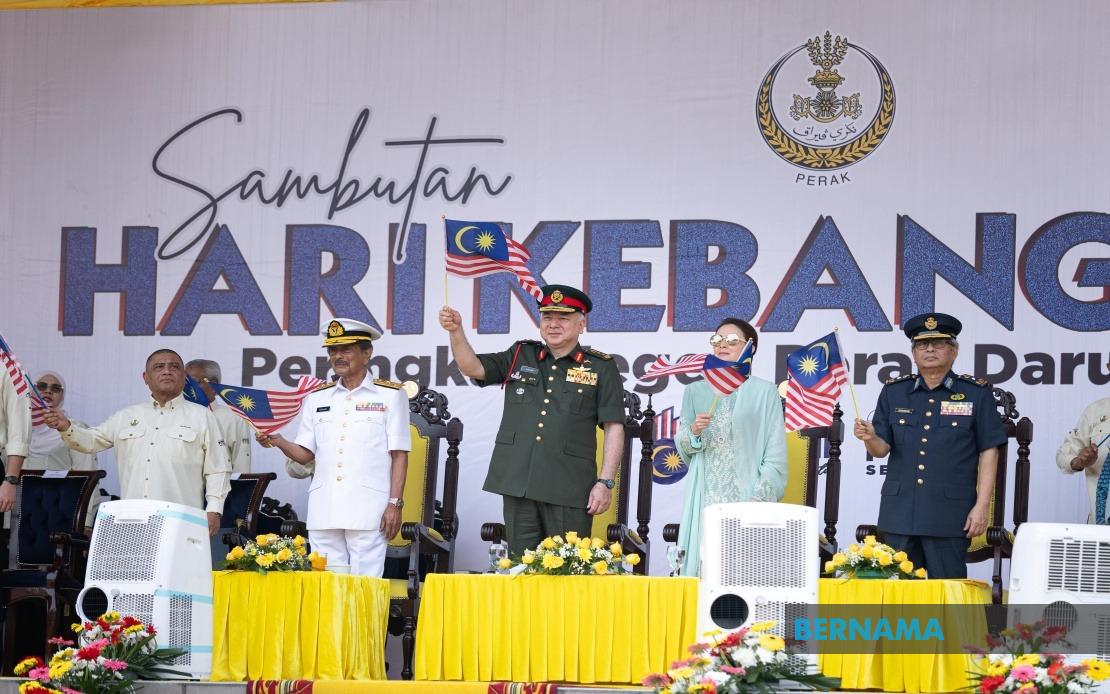
Sultan of Perak Sultan Nazrin Shah presided over the Perak National Day 2026 Awards Presentation Ceremony at Dewan Bandaran Ipoh on August 31, conferring recognition upon 11 service personnel whose contributions to national defence and security merited formal acknowledgement. Accompanied by Raja Permaisuri Tuanku Zara Salim, the royal couple received Menteri Besar Datuk Seri Saarani Mohamad, State Secretary Datuk Ahmad Suaidi Abdul Rahim, and members of the State Executive Council. The presence of Raja Muda Raja Jaafar Raja Muda Musa and Raja DiHilir Raja Iskandar Dzurkarnain Sultan Idris Shah underscored the significance of the occasion within Perak's political and ceremonial calendar.
The award recipients encompassed a cross-section of Malaysia's defence establishment, comprising six personnel from the Malaysian Armed Forces, two from the Royal Malaysia Police, and three from the Royal Malaysian Navy. Each honouree received RM1,000 in cash alongside a certificate of appreciation, a modest but symbolic gesture honouring their willingness to place personal safety secondary to national interests. The composition of recipients reflected both active-duty and retired service members, acknowledging that sacrifice and valour deserve recognition regardless of current employment status.
Among the most poignant cases recognised was Warrant Officer 2 Mohamad Razali Din, whose service during Operation Naga resulted in permanent physical disability when he stepped upon a landmine in Banding, severing his left leg below the knee. Such injuries represent the often-invisible cost of military operations—personnel who continue living with the consequences of their service long after active duty concludes. Mohamad Razali's recognition at the state level brings attention to the broader conversation about rehabilitation and support systems for disabled veterans across Malaysia.
Warrant Officer 2 Megat Abdullah Megat Othman's distinction stemmed from operational success rather than sacrifice borne through injury. His record during Operation Batu Kawah in Sri Aman, where he neutralised three communist terrorists, exemplified active defence work that shaped Malaysia's security landscape during critical periods. The presentation to him of both a commando knife and certificate of appreciation acknowledged operational excellence within the military hierarchy. Such historical recognition connects contemporary audiences with Malaysia's counter-insurgency efforts and the role personnel like Megat Abdullah played in securing the nation's territorial integrity.
The remaining Malaysian Armed Forces recipients—Staff Sergeant Idris Ismail, Corporal Mokhtar Sulaiman, Lance Corporal Khairul Anuar Abdul Hamid, and Lance Corporal Alias Abd Wahab—represented the broader ranks of military personnel whose dedication sustained Malaysia's defence capabilities over decades. While individual details of their specific contributions were not detailed in formal records, their collective recognition acknowledged that national security rests upon the cumulative commitment of service members across all ranks. This inclusive approach to honouring personnel reinforces the principle that protection of state sovereignty requires contributions from soldiers at every level of the military structure.
The Royal Malaysia Police contingent comprised retired Sub-Inspector Omar Jayus and retired Sergeant Major Abdul Malek Nordin, individuals who transitioned from active policing into retirement having served their communities through law enforcement. The acknowledgement of retired personnel within formal state ceremonies sends an important cultural signal about the continuity of national appreciation for those whose working lives centred on public safety. Police personnel, often operating in environments less visibly combat-oriented than military units, nonetheless assume significant personal risk in maintaining internal security and order.
Three retired Royal Malaysian Navy officers were similarly honoured: First Admiral Mohamad Imran Abd Hamid, Commander Mohd Akhbar Mohd Yusof, and Warrant Officer 2 Ahmad Safwi Shaari. These senior naval ranks indicate recognition of officers who shaped maritime security policy and operations throughout their careers. The RMN's role in protecting Malaysia's extensive coastlines and strategic waters—crucial to regional security architecture and maritime commerce—justifies formal state-level acknowledgement of its personnel's contributions.
Beyond individual recognition, Sultan Nazrin's ceremony encompassed broader National Day 2026 competitions, including National Month parade assessments and beautification contests. This integration of commemorative activities within a single formal event reflects the modern approach to national celebrations in Perak, combining recognition of historical and ongoing sacrifice with contemporary community engagement. Such ceremonies serve multiple functions simultaneously: honouring individuals, reinforcing national values, and providing platforms for state leadership to articulate broader political and social philosophies.
Menteri Besar Saarani's keynote address contextualised the awards within a larger meditation on Malaysian national identity and cohesion. His emphasis on Malaysia's diversity—explicitly rejecting homogeneous definitions of nationhood—addressed a contemporary political preoccupation across the country. Saarani articulated the principle that national strength derives from plurality managed through shared constitutional frameworks, common language, and institutional continuity embodied in the institution of the Malay Rulers. This framing presents the honours ceremony not merely as backward-looking recognition but as affirmation of ongoing principles sustaining the Malaysian project.
Saarani's warning against erosion of communal bonds through seeing differences before seeing individuals addressed a societal anxiety resonating across Southeast Asia's multi-ethnic democracies. His observation that neighbourliness and friendship collapse when racial, religious, or group identifications precede personal recognition articulated concerns about polarisation affecting civil society fabric. The metaphor of widening distance causing previously unifying elements to blur reflected concerns about social fragmentation affecting Malaysia's traditional consensus-building approaches to governance.
The ceremony thus operated on multiple registers simultaneously. For honoured service personnel and their families, formal state recognition provided tangible validation of sacrifice and commitment. For attending dignitaries and broader publics, the event reinforced narratives about national values, security provision, and the continuing relevance of constitutional frameworks and traditional institutions. Within Perak specifically, the ceremony illustrated how state-level leadership engages with national themes while maintaining distinctive regional political identities and ceremonial practices.
For Malaysian and Southeast Asian observers, the event reflected persistent patterns of how young democracies navigate tensions between security provision and civil liberties, between national unity and legitimate expression of group interests, and between formal recognition of sacrifice and substantive welfare provision for service personnel. The modest financial awards—RM1,000 per recipient—raise implicit questions about adequacy of support systems for retired military and police personnel in Malaysia, suggesting potential areas where policy discourse might productively develop.

