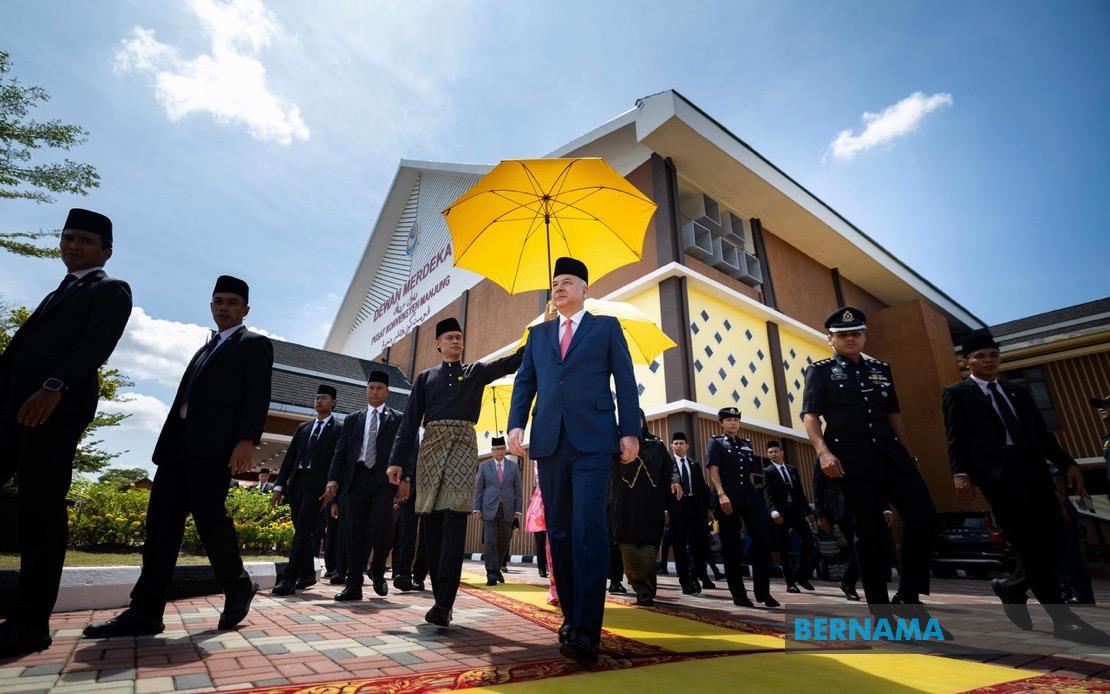
Sultan Nazrin Shah, the reigning monarch of Perak, formally inaugurated the Merdeka Hall at Manjung Municipal Council headquarters in Lumut on August 4th, bringing together senior state and federal officials for a ceremony that carried symbolic weight beyond its immediate ceremonial purpose. The occasion drew the Raja Permaisuri Tuanku Zara Salim and Raja Di Hilir Raja Iskandar Dzurkarnain Sultan Idris Shah, alongside Perak Menteri Besar Datuk Seri Saarani Mohamad and Higher Education Minister Datuk Seri Dr Zambry Abd Kadir, underscoring the significance accorded to the infrastructure project by both state and national leadership.
The opening represented the culmination of a five-year development cycle that began in 2016, when the preceding Menteri Besar initiated plans to rebuild the facility. This extended timeline reflects both the complexity of major municipal infrastructure projects in Malaysia and the coordination required between state governments and federal budget allocation mechanisms. The project's eventual greenlight and completion demonstrate how initiatives can persist across administrative transitions when there exists sufficient political consensus and genuine need within a community.
At RM12.7 million, the Merdeka Hall represents a substantial capital investment in Manjung's public infrastructure. With a capacity of 2,500 attendees, the venue is designed to accommodate conferences, official functions, and community gatherings—the core activities that characterise municipal civic life across urban centres in Malaysia. This scale positions Manjung among mid-tier Malaysian municipalities in terms of public assembly capability, comparable to facilities in towns of similar administrative standing across the peninsula.
Menuri Besar Saarani articulated the opening as fulfilling three interconnected objectives for Manjung. The first dimension involves completing a governance initiative that spanned years, demonstrating administrative follow-through despite changes in political leadership. The second component celebrates the Manjung Municipal Council's 25th anniversary as a municipal body, having been upgraded from district council status in 2001—a timeline placing it among the earlier municipalities established under Malaysia's modern local government restructuring. The third objective signals Manjung's strategic aspiration to achieve Tourism and Maritime City designation by 2030, positioning the RM12.7 million facility as foundational infrastructure supporting that economic diversification goal.
The naming of the facility as Merdeka Hall carries deliberate historical and symbolic resonance within the Malaysian political context. Saarani's remarks on the name emphasised independence as an ongoing trust requiring continuous stewardship, framing the hall as a repository for values sustaining national dignity. This rhetorical choice places a municipal infrastructure project within the broader national narrative, a common practice in Malaysian official ceremonies that grounds local development within national founding principles and constitutional values.
Manjung, located in Perak's coastal regions around Lumut, has historically balanced industrial and maritime activities with emerging tourism potential. The district's strategic location on the Straits of Malacca and its proximity to major ports position it advantageously within Malaysia's broader maritime economy. The aspiration to formalize Tourism and Maritime City status reflects recognition that coastal towns in Southeast Asia increasingly compete for position within regional tourism networks and maritime value chains, requiring upgraded public facilities to support both tourism infrastructure and municipal governance.
The timing of the opening ceremony to align with the council's silver jubilee celebration was intentional, creating narrative convergence between past institutional achievement and future development ambitions. The Manjung Municipal Council was established as a district council on January 1, 1980, before being elevated to municipal status on August 1, 2001—a progression reflecting institutional maturation and expanding administrative responsibilities as the district developed beyond its original configuration.
Saarani's emphasis on governance continuity and cooperation between federal and state administrations addresses a persistent structural challenge within Malaysian federalism. Central-local relations require sustained collaboration, particularly for major infrastructure financing where federal budgets must align with state priorities. The project's completion across different political administrations suggests that infrastructure continuity can transcend partisan shifts when projects enjoy deep community support and clear developmental logic.
The invocation of the hall as a space for knowledge nurturing and consensus-building reflects aspirations common to Malaysian municipal governance discourse—framing public infrastructure as catalysts for social cohesion and informed deliberation. Such language positions the facility beyond mere functional venue toward a symbolic anchor for community identity and institutional effectiveness.
For Malaysian readers, the opening illustrates broader patterns in how local governance infrastructure develops through extended coordination between different governmental levels and across political transitions. Manjung's experience demonstrates that significant municipal projects require sustained commitment and federal-state alignment, with costs and timelines often extending beyond initial planning horizons. The facility's positioning within Manjung's tourism and maritime development strategy reflects how coastal Malaysian municipalities increasingly compete for investment and visitor attention within a regionalising Southeast Asian economy.
The gathering of senior royal and political figures signified the importance accorded to Manjung's development trajectory within Perak's administrative priorities. As the state faces competitive pressures from other Malaysian regions for investment and tourism revenue, demonstrating institutional capacity through upgraded public facilities represents a tangible signal of governance competence and forward-thinking local administration.

