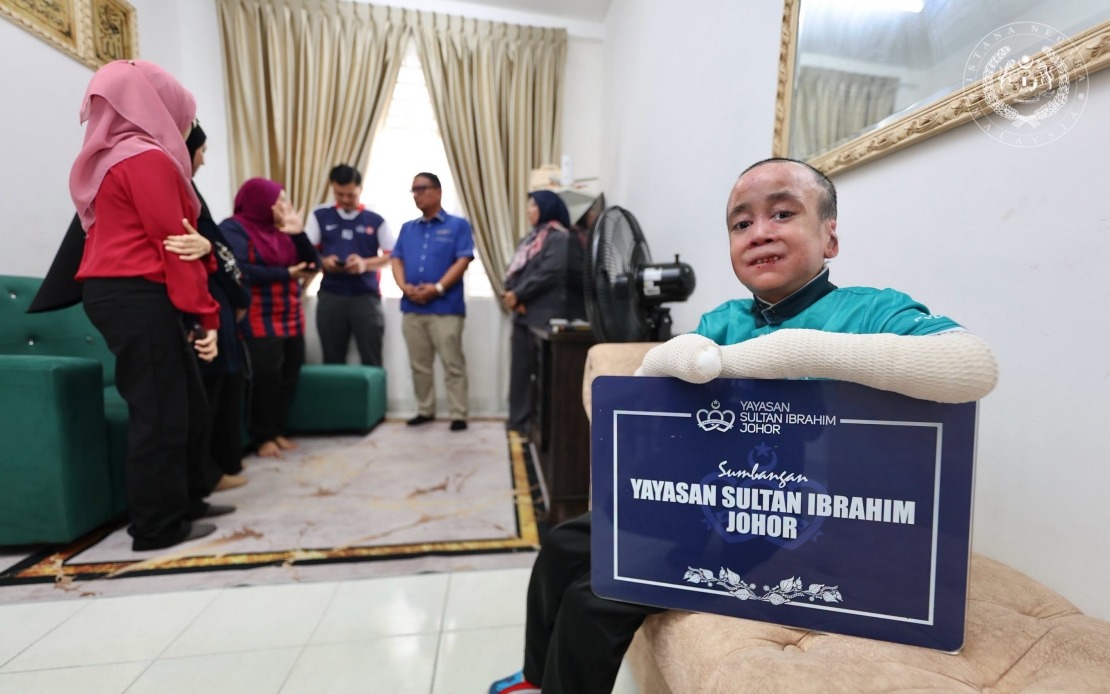
The Yayasan Sultan Ibrahim Johor (YSIJ) has stepped in to support Muhammad Hazreel Mikhail Hizar, a 15-year-old from Johor Bahru managing epidermolysis bullosa, a severe inherited skin condition that has affected him since infancy. Through its Ziarah Kasih community outreach initiative, the foundation presented financial assistance to ease the household's burden at the Sungai Tiram People's Housing Project yesterday, marking another intervention in the lives of vulnerable families across the southern state.
Epidermolysis bullosa represents one of Malaysia's lesser-known chronic health challenges, characterised by extreme skin fragility that causes blistering and wounds from even minor friction or trauma. For Hazreel, the condition demands rigorous daily protocols including meticulous wound cleansing, careful bandaging, and constant vigilance against infection—a reality that transforms medical management from occasional treatment into an all-consuming household operation. The disorder's severity necessitates perpetually cool surroundings, making air-conditioning not a luxury but a medical essential, as elevated temperatures exacerbate skin deterioration and infection risk.
Hazreel's mother, Noor Halimaton Hashim, carries the primary burden of his care as a single parent raising three children on severely constrained resources. Her situation illustrates the often-invisible struggle facing caregivers of children with chronic conditions: the impossibility of maintaining full-time employment while providing the intensive, around-the-clock supervision that epidermolysis bullosa demands. Many parents in similar circumstances find themselves forced into economic dependency, caught between their child's medical needs and household survival.
The assistance channelled through YSIJ arrives at a critical juncture for this household. Beyond the immediate financial relief, the foundation's intervention carries symbolic weight—an acknowledgment from institutional leadership that families managing rare diseases deserve structured support rather than relegation to charitable goodwill alone. In Malaysia's healthcare landscape, where inherited skin disorders remain relatively uncommon, affected families often navigate their journey with limited awareness, sparse medical resources, and fragmented social safety nets.
The Ziarah Kasih programme, through which this support was delivered, exemplifies a targeted approach to welfare provision that moves beyond impersonal bureaucratic processing. By conducting personal visits and assessing circumstances directly, the foundation can tailor interventions to match actual household needs rather than applying standardised formulas. For Noor Halimaton, this personalised approach validated her struggles and connected her family to meaningful institutional support.
Epidermolysis bullosa's medical complexity extends beyond visible wounds. Children with the condition face heightened vulnerability to secondary infections, including life-threatening bacterial sepsis, requiring vigilant infection control and sometimes prophylactic medical management. Nutritional requirements often exceed normal benchmarks due to the body's constant repair processes, while psychological impacts—social isolation, reduced mobility, depression—compound the physical burden. These multifaceted challenges demand coordinated support spanning medical, financial, and emotional domains.
For families in Johor's lower-income housing schemes, where Hazreel's family resides, access to consistent healthcare and supportive resources remains inconsistent. The Sungai Tiram People's Housing Project population typically comprises working-class Malaysians dependent on informal or precarious employment, already vulnerable to economic shocks. A child's chronic condition can rapidly destabilise such households, pushing families toward debt and desperation. YSIJ's intervention recognises this vulnerability and attempts to stabilise housing and living circumstances.
The foundation's involvement signals broader questions about Malaysia's welfare infrastructure for rare disease patients. While major health conditions like diabetes and heart disease benefit from established programmes and widespread awareness, hereditary skin disorders occupy marginal positions in public health planning. Families like Hazreel's often discover support networks through accident rather than design, missing interventions during critical periods when structured assistance could prevent cascading crises.
Noor Halimaton's gratitude, expressed through official channels, underscores the psychological dimension of charitable intervention. Beyond material assistance, institutional recognition validates a family's struggle and combats the shame and invisibility that often accompanies poverty and chronic illness. For single mothers particularly, such acknowledgment can restore dignity and strengthen psychological resilience during exhausting caregiving seasons.
Looking forward, Hazreel's case exemplifies why Southeast Asian nations must develop more comprehensive approaches to rare disease support. Malaysia possesses the institutional capacity and regional healthcare expertise to establish specialist networks for epidermolysis bullosa and similar conditions, ensuring earlier diagnosis, better management protocols, and coordinated family support. Foundations like YSIJ, operating at state level, can model best practices for scaling such initiatives nationally.
The assistance provided to this teenager represents not merely charitable impulse but an investment in family stability and a young person's developmental prospects. When chronic illness no longer forces catastrophic choices between treatment and basic survival, affected individuals can focus energy on education, social integration, and building meaningful lives. For Malaysia's health and social policy frameworks, Hazreel's story illuminates both current compassionate responses and persistent gaps requiring systematic attention.

