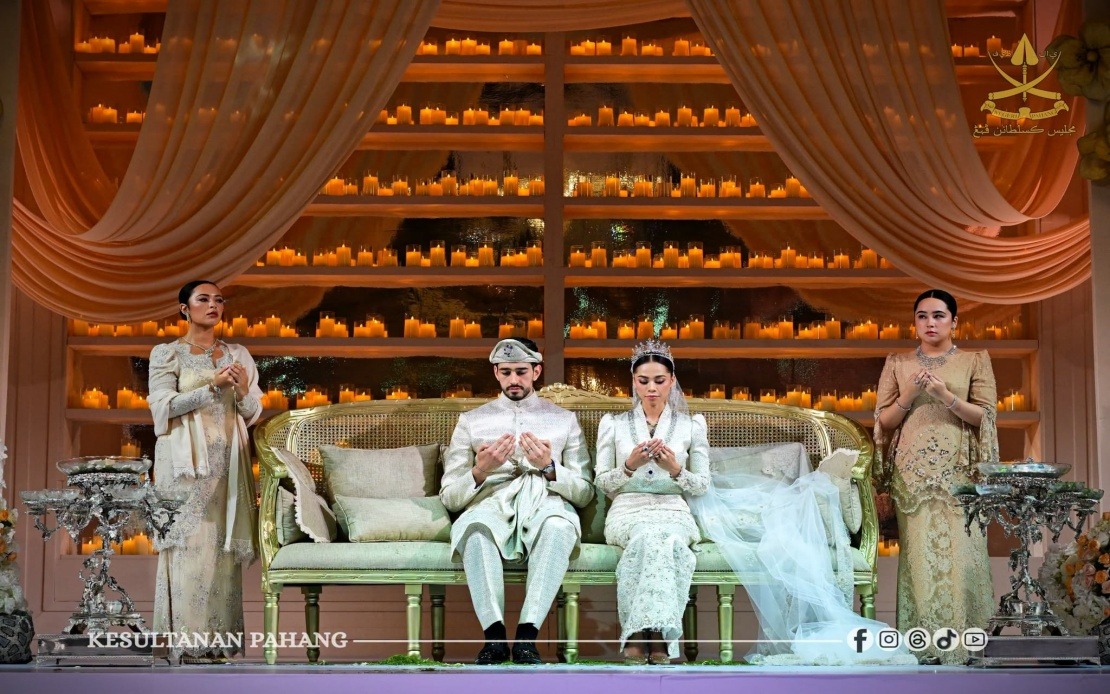
Pahang Sultan Al-Sultan Abdullah Ri'ayatuddin Al-Mustafa Billah Shah graced the wedding reception of his daughter, Tengku Puteri Raja Tengku Puteri Ilyana Alia, and her new husband Christopher Lionel Froggatt, at a Kuala Lumpur hotel on Thursday. The presence of the reigning monarch underscored the significance of the union, which represents a contemporary blend of royal tradition and international matrimonial bonds increasingly common among Southeast Asian royal families.
The Sultan was accompanied by an entourage that reflected the prominence of the occasion. Tengku Hassanal Ibrahim Alam Shah, who holds the position of Regent of Pahang, stood alongside his father, as did members of the extended royal household from both his immediate and broader family circles. This substantial royal turnout demonstrated the importance placed on celebrating the union within the sultanate's formal structures.
Guests of note at the event included Pahang Menteri Besar Datuk Seri Wan Rosdy Wan Ismail, representing the state government's endorsement of the marriage. Particularly notable was the attendance of Shaikh Mohammed Hamad Tahnoon Al Nahyan, who represented the President of the United Arab Emirates. This diplomatic presence signals strengthening ties between Malaysia's eastern corridor and the Gulf region, reflecting broader regional alignment efforts and trade relationships that have grown significantly in recent years.
The wedding reception adhered to elaborate Malay-Muslim royal ceremonial practices that have governed state occasions across peninsular Malaysia for centuries. The newly married couple positioned themselves formally on an elevated dais, the traditional focal point for royal wedding festivities, where they became the centre of a sequence of ceremonial observances.
Among the rituals performed was the 'Istiadat Menyuap Nasi Semangat', a customary feeding ceremony symbolising the couple's union and commitment. This particular ritual was conducted by Tengku Puteri Seri Lela Wangsa Tengku Tan Sri Meriam Sultan Ahmad Shah, whose role in overseeing this moment reflected her standing within the royal family hierarchy and the ceremonial traditions of Pahang's court.
Following this initial rite, the 'Istiadat Bersanding dan Merenjis' commenced, where the Sultan himself performed the traditional sprinkling of scented water and flower petals over the couple. This segment of the proceedings symbolises blessings from the reigning patriarch and remains one of the most visually distinctive elements of Malay royal weddings. Other family members subsequently participated in this practice, extending collective blessings across the family structure.
The Sultan then undertook the 'Istiadat Meletakkan Panca Bicara', a gesture of formal blessing and honouring the newlyweds that carries deep symbolic weight in the context of royal Pahang customs. This ceremonial act affirmed the union at the highest formal level and integrated the couple into the broader fabric of royal succession and family continuity, matters of considerable constitutional and cultural importance in Malaysia's monarchical system.
The proceedings concluded with a prayer offered by Pahang Mufti Datuk Dr Asmadi Mohamed Naim, anchoring the celebration within Islamic frameworks that underpin state institutions and royal identity across Malaysian sultanates. This spiritual dimension transforms the event from a purely social occasion into one formally recognised within Islamic law and custom, reinforcing the intertwining of religious observance and state ritual that characterises Malaysian royal practice.
The wedding itself represents a fascinating contemporary development in royal matrimonial patterns. Marriages between members of Malaysia's royal families and foreign nationals have increased in frequency over recent decades, reflecting globalisation, educational mobility, and the international exposure that comes with modern royal upbringings. Such unions often strengthen diplomatic relationships and broaden the cultural frameworks within which royal households operate, while maintaining adherence to formal state and religious protocols.
The visible participation of UAE representation at this occasion reflects the deepening economic and diplomatic engagements between Malaysia and Gulf states, particularly across energy, trade, and investment sectors. For Malaysian observers, such international dimensions to royal events signal the country's positioning within broader regional hierarchies and its capacity to attract high-level foreign dignitaries to occasions of state significance.
The detailed observance of traditional ceremonies, despite the modern international context, illustrates how Malaysian royal institutions continue to preserve and validate customary practices as markers of cultural authenticity and institutional legitimacy. These rituals remain central to how sultanates communicate their authority, maintain continuity with historical tradition, and signal stability through formal adherence to established protocols even as broader social contexts evolve dramatically.

