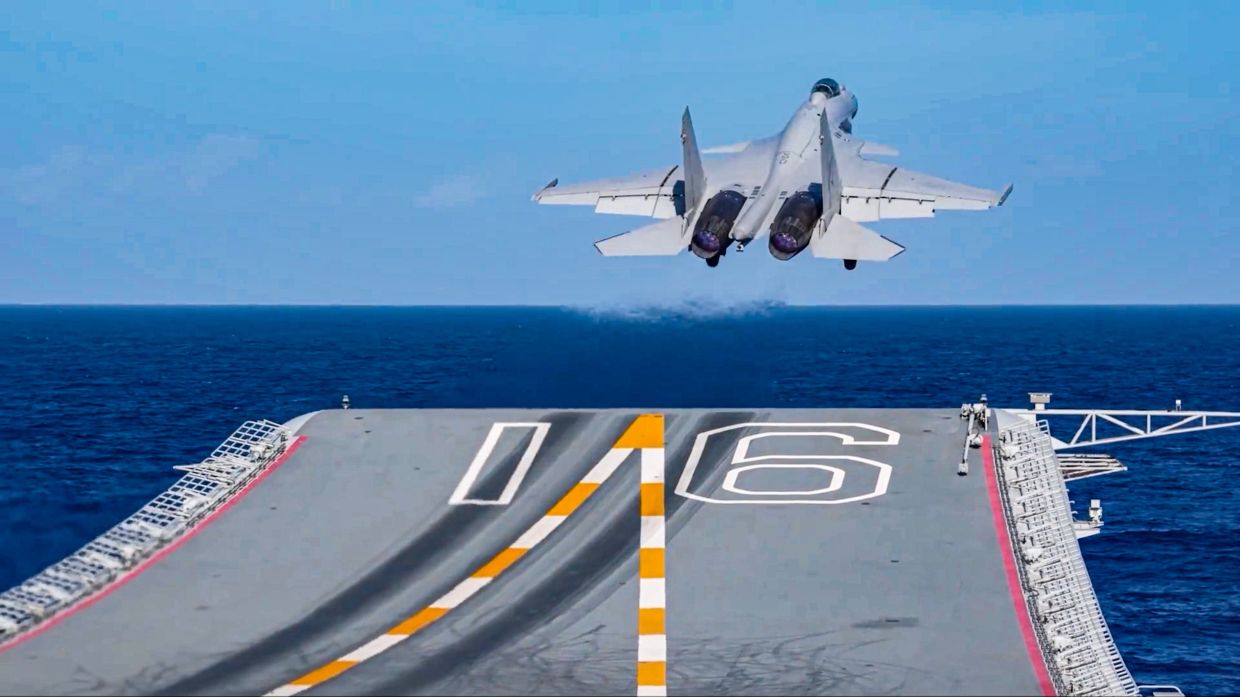
China's ambitious expansion of its aircraft carrier fleet is encountering a significant strategic constraint: vulnerability to submarine attacks. As Beijing's naval capabilities grow more formidable, military strategists both inside and outside China increasingly recognise that underwater threats could prove decisive in any conflict scenario involving the Taiwan Strait or broader Indo-Pacific confrontation. This emerging weakness has prompted substantial debate among defence analysts about whether carrier-centric naval strategies remain viable in an era when relatively quiet submarines equipped with advanced torpedoes can threaten even the most expensive warships.
A comprehensive analysis from Washington's Centre for Strategic and International Studies presents a multi-layered approach to constraining Chinese carrier operations, termed a "cost-imposition" strategy. This framework encompasses coordinated deployment of land-based strike networks, satellite-guided long-range air operations, cyber and electromagnetic warfare capabilities, and coordinated drone swarms. Among these five operational concepts, however, submarine-based interdiction emerges as particularly potent because it exploits a documented gap in China's underwater detection and tracking infrastructure. The People's Liberation Army Navy operates within a geographical constraint that amplifies this vulnerability: its carriers must transit through or operate within defined maritime corridors where hostile submarine forces can concentrate their assets and establish ambush positions.
Geographic realities fundamentally shape this strategic calculus. The western Pacific, South China Sea, and waters approaching Taiwan funnel naval traffic through relatively constrained shipping lanes and strategic chokepoints. Any carrier group operating in these regions must navigate zones where adversary submarines can lie in wait. Beyond these primary operational areas, carriers could theoretically project power through long-range strike aircraft supported by satellite surveillance and targeting systems, while coordinated cyber attacks could disrupt communications and sensor networks. Yet the submarine threat persists as the most difficult to counter because detection across vast ocean areas remains technologically challenging and operationally demanding.
Christopher Sharman, director of the China Maritime Studies Institute at the US Naval War College, acknowledges that China's undersea vulnerability "remains significant today," though he notes this is "not a static weakness." The PLAN has invested substantially in improving its understanding of underwater operating conditions and enhancing submarine detection capabilities. However, Sharman identifies a persistent disadvantage: China's meteorological and oceanographic knowledge lags significantly behind American naval capabilities. This comparative blindness regarding underwater environmental conditions impedes both submarine operations and anti-submarine warfare beyond the first island chain, where ocean conditions become more complex and surveillance becomes exponentially more difficult.
Beijing recognises these shortcomings and has initiated comprehensive programmes to close the gap. The Transparent Ocean initiative, conceived over a decade ago, aims to establish an integrated network of satellites, research vessels, oceanic buoys, autonomous underwater gliders, and seabed sensor arrays monitoring strategically vital waters including the western Pacific, South China Sea, and Indian Ocean. Chinese officials have explicitly connected this programme to national security imperatives. The Ocean University of China, which originated the concept, reports establishing hundreds of deep-sea observation systems while expanding monitoring networks from continental Southeast Asian waters into the broader Pacific. This infrastructure would theoretically provide the environmental awareness necessary for effective submarine operations and anti-submarine detection.
Simultaneously, the PLAN has substantially expanded its anti-submarine warfare arsenal. Maritime research institutes have documented growth in fixed-wing maritime patrol aircraft and Type 927 ocean-surveillance ships equipped with sophisticated towed-array sonar systems. Aircraft and helicopter sensors have undergone modernisation to enhance submarine detection. Despite these investments, defence analysts believe the PLAN confronts challenges extending beyond carrier protection. Undersea warfare has become central to broader Chinese naval strategy, particularly for achieving sea control within the first island chain during wartime and for complicating potential third-party intervention in Taiwan contingencies.
Sharmans assessment emphasises that effective undersea operations represent a necessary component of PLAN strategy for countering American naval superiority and dissuading potential allies from intervention. Beijing's historical claims over Taiwan and refusal to renounce forceful reunification create strategic imperatives for underwater dominance. Chinese military strategists have sometimes characterised coastal depths as a "wide-open door" through which adversaries can penetrate, reflecting genuine concern about detection and control deficiencies. Timothy Heath, heading defence research firm Perceptum, underscores that anti-submarine warfare challenges persist partly because American submarines rank among the world's quietest vessels, making detection extraordinarily difficult. Japanese naval intervention in any Taiwan conflict would substantially complicate carrier operations, as Tokyo could deploy anti-ship capabilities against Chinese vessels operating near Japanese territorial waters.
This strategic reality creates operational dilemmas for Chinese carrier deployment. While carriers might theoretically provide air cover for naval forces attempting to prevent third-party intervention in western Pacific theatres, Heath cautions that deploying carriers so far from Chinese shores would expose them to multiple targeting vectors. Given the range of land-based intermediate-range ballistic missiles under Chinese control, these systems offer more cost-effective means of threatening distant American naval assets than risking expensive carriers in vulnerable forward positions. The strategic calculation increasingly suggests that carrier deployment must remain relatively proximate to Chinese coastlines where land-based air support and coastal defence systems can provide protection, fundamentally constraining their operational range and strategic utility.
American defence strategists have incorporated these assessments into procurement recommendations. The CSIS report's authors argue that Chinese carrier vulnerabilities should shape American military investment priorities, particularly regarding torpedo development, undersea drone capabilities, and coordinated missile production with regional allies including Japan and Australia. Enhanced undersea capabilities and distributed maritime defence networks could impose prohibitive costs on Chinese carrier operations, potentially rendering traditional carrier-centric naval strategies obsolete in Indo-Pacific scenarios. For Southeast Asian countries observing this strategic competition, submarine capabilities may determine whether regional maritime stability can be maintained and whether established principles of international law in contested waters can be upheld. The submarine vulnerability afflicting China's carrier ambitions represents not merely a technical shortcoming but a fundamental constraint on Beijing's capacity to project sustained naval power across the Indo-Pacific region.

