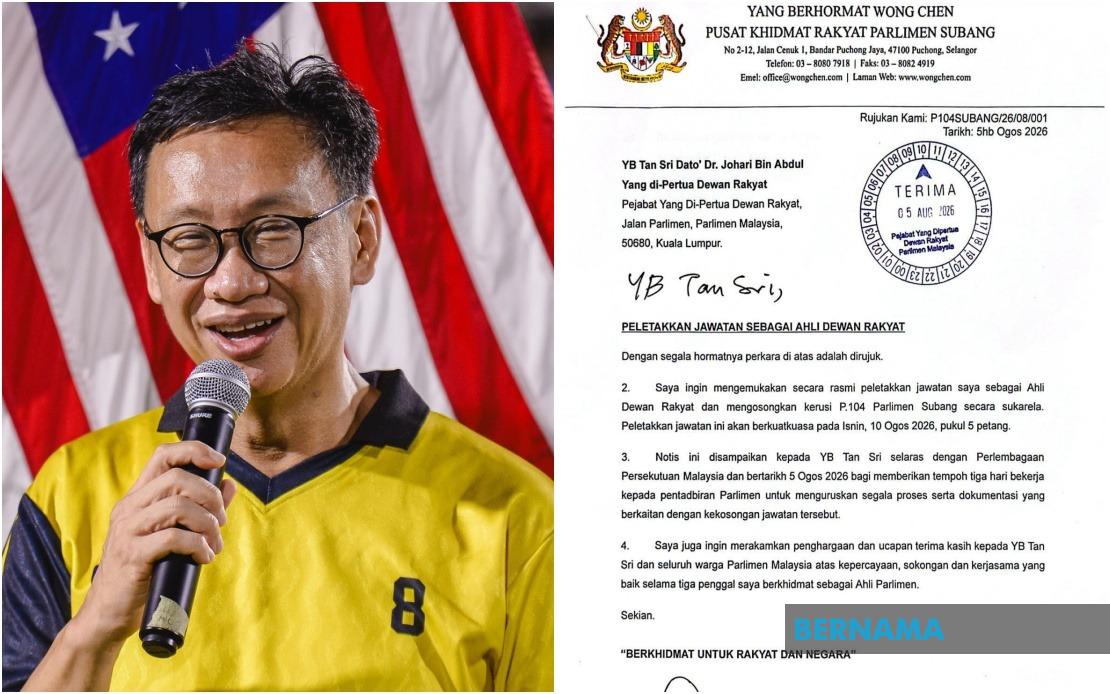
Wong Chen, the long-serving Member of Parliament for Subang, has officially ended his tenure in the Dewan Rakyat with a resignation that became effective at 5:00 pm today. The decision marks the conclusion of a parliamentary career spanning three consecutive terms representing one of the Klang Valley's key constituencies. His formal resignation letter, dated August 5 and addressed to Dewan Rakyat Speaker Tan Sri Johari Abdul, was submitted well in advance to facilitate an orderly transition of parliamentary representation.
The deliberate timing of Wong Chen's announcement and the advance notice provided to Parliament administration underscores a commitment to institutional protocol. By submitting his resignation letter five days prior to its effective date, he allowed the legislative branch adequate opportunity to manage the administrative and procedural requirements associated with the vacancy. This approach reflects an understanding of the logistical complexities involved in maintaining parliamentary operations and preparing for the eventual by-election that will determine Subang's next representative.
In outlining his decision through a Facebook post, Wong Chen expressed formal appreciation to the Speaker and Parliament's institutional staff, acknowledging their collaboration throughout his three terms. The public articulation of his gratitude extended to recognising the support systems that had enabled his legislative work. Such acknowledgment is customary among departing parliamentarians but carries particular significance when terminating a relationship spanning multiple electoral cycles, suggesting continuity in the institution even as individual members depart.
The removal of his ministerial honorific title from public-facing materials represents a practical conclusion to his formal status. Beginning next month, all billboards, signboards, and official correspondence previously bearing the honorific "Yang Berhormat" will be revised to reflect his civilian status. This administrative step, while procedural in nature, symbolises the formal severance of his parliamentary identity and the transition to private life following his extended public service.
Wong Chen's announcement of a dedicated press conference scheduled for 11:00 am the following day suggests that his resignation decision warrants detailed explanation to media and stakeholders. Such deliberate communication is typical when a sitting MP exits office mid-term, particularly in constituencies where the MP has maintained significant public visibility and engagement. The timing and format of this announcement may provide broader context regarding motivations behind his departure, which could include personal considerations, career transitions, health factors, or other circumstances typically outlined during such public addresses.
Subang's parliamentary representation carries particular importance within Malaysia's political landscape. Located in the densely populated Selangor region encompassing both urban and suburban communities, the constituency has historically attracted candidates from major political coalitions and independent contenders alike. Wong Chen's three-term tenure suggests he successfully navigated multiple election cycles and maintained voter confidence across different electoral periods, positioning Subang as a constituency of competitive political interest.
The mechanics of filling the vacant seat will necessarily follow constitutional procedures outlined in the Federal Constitution, which Wong Chen's resignation letter explicitly invoked. Once the Speaker formally acknowledges the vacancy, the Election Commission will coordinate with state authorities to schedule a by-election within the prescribed timeframe. This process typically generates heightened political activity as various parties assess opportunities to contest the seat and appeal to Subang's diverse electorate.
From a parliamentary perspective, Wong Chen's departure reduces the total number of sitting MPs and may affect political calculations around coalition numbers and committee compositions. Depending on his original party affiliation and the composition of current government coalitions, his exit could carry implications for legislative dynamics, particularly if parliament operates with narrow majoritarian margins. The timing of mid-term resignations occasionally carries strategic considerations beyond personal circumstances.
For Malaysian voters and political observers, Wong Chen's decision represents a transition point in Subang's representation. His departure after three terms suggests he completed multiple electoral cycles and potentially accumulated significant parliamentary experience and constituent knowledge. The nature of his exit—voluntary and administratively orderly—contrasts with other forms of parliamentary seat changes that may arise from electoral defeat or other circumstances.
The forthcoming by-election will provide Subang constituents an opportunity to reassess their parliamentary representation and evaluate candidates offering competing visions for the constituency's future development. The campaign period typically generates local discourse regarding infrastructure, economic opportunities, education, and community services—issues central to suburban constituencies' political concerns. How various contenders address Subang's specific challenges and opportunities will likely determine the eventual election outcome.
Wong Chen's three-term parliamentary service concludes a chapter in Subang's recent political history. His successor will inherit an active constituency with demonstrated voter engagement and established expectations regarding MP accessibility and constituent service. The transition from his tenure to new representation will be closely observed given the constituency's political significance within Selangor's broader electoral dynamics and Malaysia's competitive political environment.

