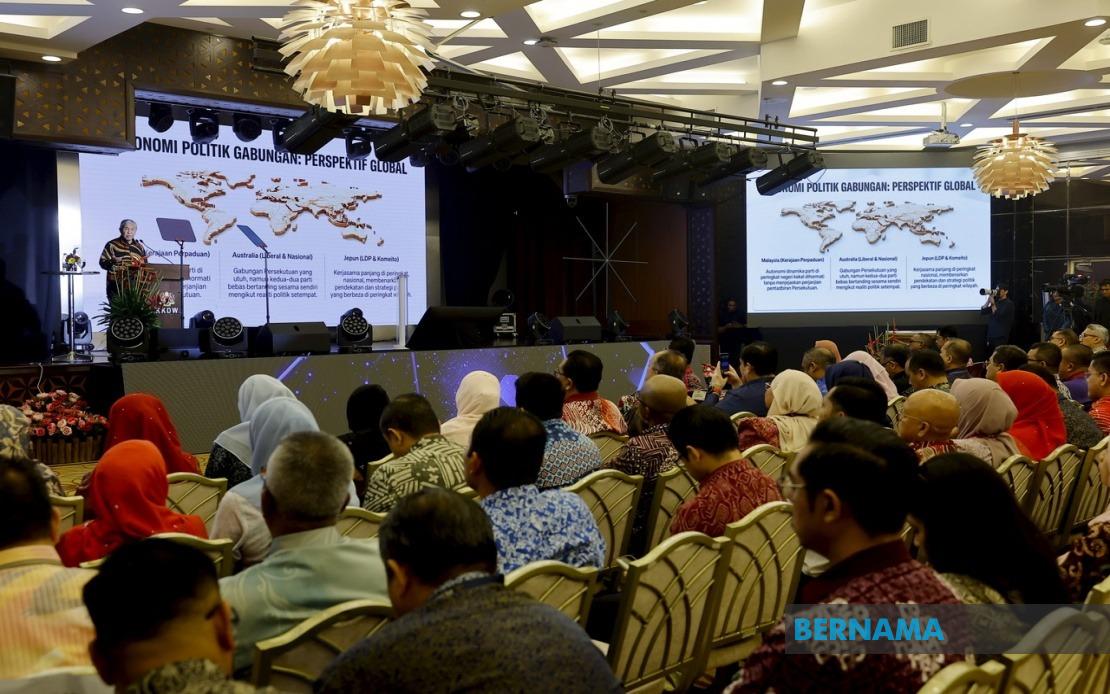
Deputy Prime Minister Datuk Seri Dr Ahmad Zahid Hamidi moved to reassure the nation on Tuesday that rivalries playing out in state politics pose no threat to federal governance, insisting the Unity Government's foundational compact will withstand such localized turbulence. Speaking at the Rural and Regional Development Ministry's monthly assembly in Putrajaya, the Barisan Nasional chairman articulated a clear distinction between competition at the state level and the institutional stability required to run the country effectively from the capital.
The timing of Ahmad Zahid's remarks reflects an attempt to contain any spillover concerns following recent state elections, particularly the contests in Johor and Negeri Sembilan, where political fortunes have shifted and coalition dynamics have come under scrutiny. By explicitly addressing these developments, the Deputy Prime Minister signalled that the federal administration is neither surprised nor destabilized by the outcomes, positioning the central government as operating according to a separate, more durable framework than the episodic nature of state-level contests.
Central to Ahmad Zahid's assurance is the principle of political autonomy within coalition governance. He characterized the relationship between member parties as one permitting individual political strategies and identity preservation, provided parties honour the overarching agreement that brought the Unity Government into being. This formulation seeks to reconcile the apparent tension between coalition unity at the federal level and competitive behaviour at state and local levels, acknowledging that Malaysian political life has long accommodated such multiplicity without complete institutional collapse.
The Deputy Prime Minister stressed that as long as Parliament remains intact and undissolved, the machinery of government will function without interruption. This procedural commitment underscores that the legitimacy and operational capacity of the federal administration does not depend on uniform political outcomes across all jurisdictions, but rather on the sustained agreement of coalition partners to support the government in Parliament. The dissolution of Parliament marks the legal threshold for resetting the arrangement, and until that occurs, governance responsibilities will proceed unaltered.
Ahmad Zahid's framing also addresses a deeper anxiety within Malaysian politics: whether state-level victories by certain parties might embolden them to extract concessions, withdraw support, or shift alignment at the federal level. By articulating that political principles and party identity need not be sacrificed for coalition membership, he attempts to reduce the perceived cost of participation and the incentive to abandon the arrangement. This messaging is particularly relevant for coalition members who may face domestic pressure to distinguish themselves politically but who also benefit from continued federal participation.
The principle of political autonomy within a coalition government, as outlined by Ahmad Zahid, reflects a pragmatic understanding of how Malaysia's plural political system actually functions. Rather than demand complete subordination of state to federal interests, the framework permits parties to contest locally, win state offices, and exercise influence in their respective domains while maintaining federal commitments. Such flexibility, in theory, reduces the brittleness that might arise from overly rigid centralization, allowing coalition partners breathing room to satisfy their electoral bases.
However, this model carries inherent risks that the Deputy Prime Minister's statement does not fully address. State-level victories, particularly by non-coalition parties, could over time shift the composition of state assemblies in ways that constrain federal policy implementation or create jurisdictional conflicts. Additionally, repeated electoral setbacks for certain coalition members might eventually erode their patience with an arrangement that privileges federal unity over state advancement, creating latent pressure for realignment that could manifest when Parliament faces eventual dissolution.
For Malaysian observers, Ahmad Zahid's message represents a bid to normalize the idea of differentiated outcomes across electoral tiers. The Unity Government has now weathered several state elections since its formation, and the Deputy Prime Minister's statement serves to institutionalize the expectation that such contests need not trigger existential crises at the federal level. This separation of federal and state fortunes, if maintained, could provide genuine stability to governance by preventing every local electoral swing from being read as a referendum on Putrajaya's mandate.
The implications for Southeast Asia's broader political landscape are noteworthy. Malaysia's coalition model, with its allowance for internal diversity and state-level autonomy, offers a template different from more centralized or majoritarian systems. Should Ahmad Zahid's framing prove durable in practice, it could demonstrate that coalition governments can function effectively despite internal competition, a lesson relevant to other regional democracies navigating multi-party politics and federal arrangements.
Looking ahead, the test of Ahmad Zahid's assurances will come through subsequent electoral cycles and any policy disputes between coalition partners. The statement's credibility depends on whether the federal government can indeed deliver on development programmes and maintain administrative continuity regardless of state-level changes. Should the next state elections produce significantly different outcomes, or should coalitional partners face mounting pressure from their own supporters to prioritize state interests, the robustness of the arrangement underpinning federal stability will face more serious questioning than the Deputy Prime Minister's current reassurance suggests.

