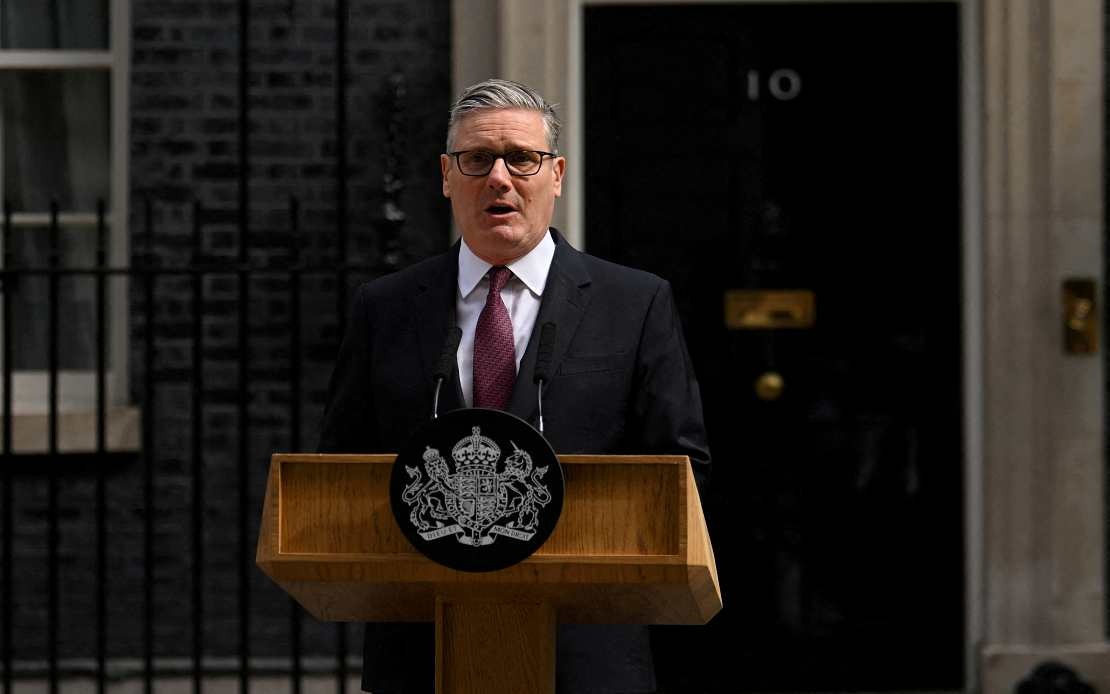
Keir Starmer concluded his tenure as British prime minister on Monday with a valedictory speech at Downing Street, where he reflected on his political journey and the state of the nation he is leaving behind. The outgoing premier, flanked by his wife Victoria Starmer and surrounded by colleagues and supporters, spoke of his accomplishments and expressed confidence in Britain's trajectory as he prepared to formally offer his resignation to King Charles. The announcement marks a significant transition in British politics and sets the stage for Andy Burnham to assume the top post.
In his remarks, Starmer underscored the distance Labour has travelled since its catastrophic defeat in 2019, when the party suffered one of its worst electoral performances in decades. Over the course of six and a half years, he systematically rebuilt the party from its foundations, repositioning it ideologically and organisationally to mount a credible challenge to the Conservative government. His narrative emphasised the scale of the transformation he initiated, framing it as essential groundwork that culminated in Labour's decisive victory in the 2024 general election.
The prime minister characterised his time in office as a profound privilege, suggesting that the nation had emerged from his stewardship in materially better condition than when he assumed the role. Starmer claimed that Britain was now "stronger and fairer," language that encapsulated Labour's core campaign messaging around economic stability and social equity. By invoking these themes during his departure, he sought to establish a positive narrative around his administration's legacy, even as political circumstances forced his hand.
For Malaysian observers and Southeast Asian political analysts, Starmer's departure carries relevance beyond Westminster theatrics. The transition exemplifies how modern democracies manage leadership changes within governing parties without triggering electoral upheaval—a contrast to some regional contexts where internal political shifts generate instability. The orderly nature of the transition, with a designated successor already positioned to assume power, demonstrates institutional continuity that underpins stable governance.
Andy Burnham's elevation to the premiership represents the next chapter in Labour's evolution under Starmer's foundational work. Burnham, who has served in various senior party roles and maintained a public profile as a senior figure within the government, inherits a party apparatus that Starmer has spent years refining. The handover from Starmer to Burnham suggests a degree of party cohesion around succession planning, mitigating potential internal discord that sometimes accompanies leadership transitions.
Starmer's decision to emphasise his party's 2024 election victory during his final speech underscores the legitimacy he derives from that democratic mandate. The landslide result gave Labour a substantial parliamentary majority and provided Starmer with a mandate to implement his policy agenda. Even as he steps down, he frames his tenure within the context of that electoral triumph, suggesting that the party's broader project remains intact despite his personal departure.
The timing and circumstances of Starmer's resignation merit consideration in the context of British political cycles and broader governance challenges. His assertion that "my work is done" signals either completion of a defined objective or a strategic assessment that ongoing circumstances warrant fresh leadership. For Burnham and Labour, the challenge will involve sustaining the electoral coalition that delivered their 2024 victory while navigating the inevitable complexities of governing in an economically constrained environment.
From a regional perspective, British leadership transitions have downstream effects on foreign policy and international partnerships. Burnham's administration will inherit relationships and commitments established during Starmer's tenure, including interactions with Asian nations and multilateral forums. How the new prime minister recalibrates or continues existing diplomatic postures will have implications for British engagement with Southeast Asia and the broader Indo-Pacific region.
Starmer's final speech also served a ceremonial function within British constitutional practice, formalising the transition of power through established protocols. His visit to King Charles to tender his resignation represents the culmination of these constitutional niceties, transforming a political change into a formal governmental act. This ritualistic dimension underscores the stability mechanisms embedded within British governance structures.
The contrast between Labour's position in 2019—marked by electoral devastation and internal turmoil—and its 2024 landslide victory validates Starmer's strategy of painstaking party reformation. His tenure, however long or short, had already achieved the core objective of rehabilitating Labour's electoral prospects. Whether Burnham can consolidate and extend that achievement will occupy British politics in the coming years, with broader implications for how centre-left parties navigate contemporary governance challenges in developed democracies.

