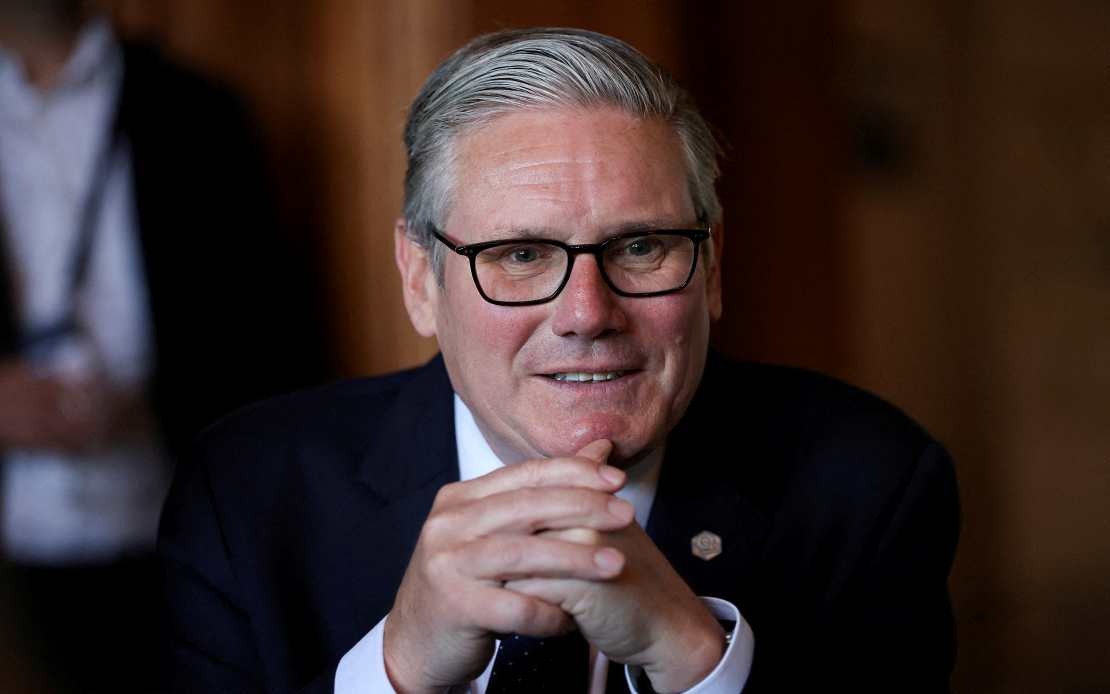
British Prime Minister Keir Starmer appears positioned to make a significant announcement within hours, with preparations underway at Downing Street that point toward an imminent statement. The staging of public address equipment signals an official pronouncement of considerable importance, marking a pivotal moment in Westminster politics that carries implications across the Commonwealth and affects Britain's standing on the international stage.
Reports emanating from multiple news sources on Sunday suggested that Starmer's departure from office may be imminent. International media outlets, citing statements attributed to US President Donald Trump, relayed claims that the British leader intends to step down from his position. The nature of these reports, originating from diverse geographical and political vantage points, underscores the extraordinary circumstances surrounding the British government at present and the degree to which this domestic matter has captured global attention.
The BBC's reporting added significant weight to speculation about the prime minister's timeline, indicating that Starmer could lay out a departure schedule as soon as Monday. This reporting came as the internal atmosphere within government underwent a marked shift, with previously reliable support bases beginning to fracture. The convergence of reporting from established news organisations suggested that developments were moving swiftly toward a resolution, rather than remaining in a prolonged state of uncertainty.
Government insiders, speaking to news organisations on condition of anonymity, indicated that Starmer had begun contemplating not an abrupt exit but rather a structured transition. Multiple officials within ministerial circles now anticipate that their prime minister will publicly articulate a timetable for his eventual departure. Such an announcement would represent a managed conclusion to his premiership rather than a chaotic forced removal, allowing the government machinery to begin preparing for succession arrangements and minimising further institutional disruption.
The underlying causes of this political crisis centre on substantial policy failures that have eroded Starmer's political capital. Immigration represents one critical flashpoint; his government's handling of immigration policy has drawn criticism from multiple quarters, with observers suggesting that neither the severity of enforcement nor the coherence of long-term strategy has satisfied the electorate's concerns. This vulnerability has left the government exposed to political challenge at a moment when decisive leadership might otherwise stabilise his position.
Energy policy constitutes a second major domain in which the government's performance has fallen short of public expectations. Britain faces substantial challenges in transitioning its energy infrastructure whilst maintaining affordability and security of supply. The government's approach to these intersecting challenges has evidently failed to command confidence among sufficient numbers of lawmakers and party members, contributing to the deterioration of support that now threatens Starmer's tenure.
For Malaysian and Southeast Asian observers, this unfolding British political drama carries relevance beyond Westminster gossip. The United Kingdom maintains significant diplomatic, trade, and security relationships throughout the region, and leadership transitions at the highest level in London inevitably affect the architecture of these relationships. A government in transition or lacking full institutional stability may prove less reliable as a diplomatic or strategic partner during a period when regional stability remains contested and great power competition shapes the environment.
The potential departure of Starmer would represent a remarkable reversal of fortune for Labour after the party won a substantial electoral mandate only months earlier. This trajectory from overwhelming victory to severe crisis illustrates the volatility of contemporary politics, where governing majorities can fragment rapidly when policy execution fails to match electoral promises. The speed of this deterioration suggests that deeper institutional or party management challenges may exist within Labour, issues that a change of leadership alone may struggle to resolve.
Further complicating matters is the involvement of international figures in commentary on British domestic politics. The attribution of statements regarding Starmer's intentions to US President Trump introduces an external dimension to what remains fundamentally a British constitutional matter. This internationalisation of what should be a UK political process underscores how closely observed the British government remains by global leaders and how its difficulties generate international attention and speculation.
The coming hours and days will prove consequential not merely for Starmer personally but for the stability and direction of British governance. If Starmer does indeed announce a resignation timeline, the question becomes whether such a managed transition can prevent further institutional damage or whether the underlying causes of discontent will continue to destabilise his government regardless of his ultimate departure date. The Labour Party must simultaneously contemplate the mechanics of choosing a successor whilst attempting to maintain governance capacity and public confidence during an extended lame-duck period.
Regionally, Southeast Asian governments and observers will monitor this situation with interest, particularly regarding the implications for Britain's continued engagement with Asian security architecture and trade relationships. A Britain consumed by domestic political turmoil may find itself less present and influential in regional affairs at precisely the moment when stable, predictable partnerships matter most.