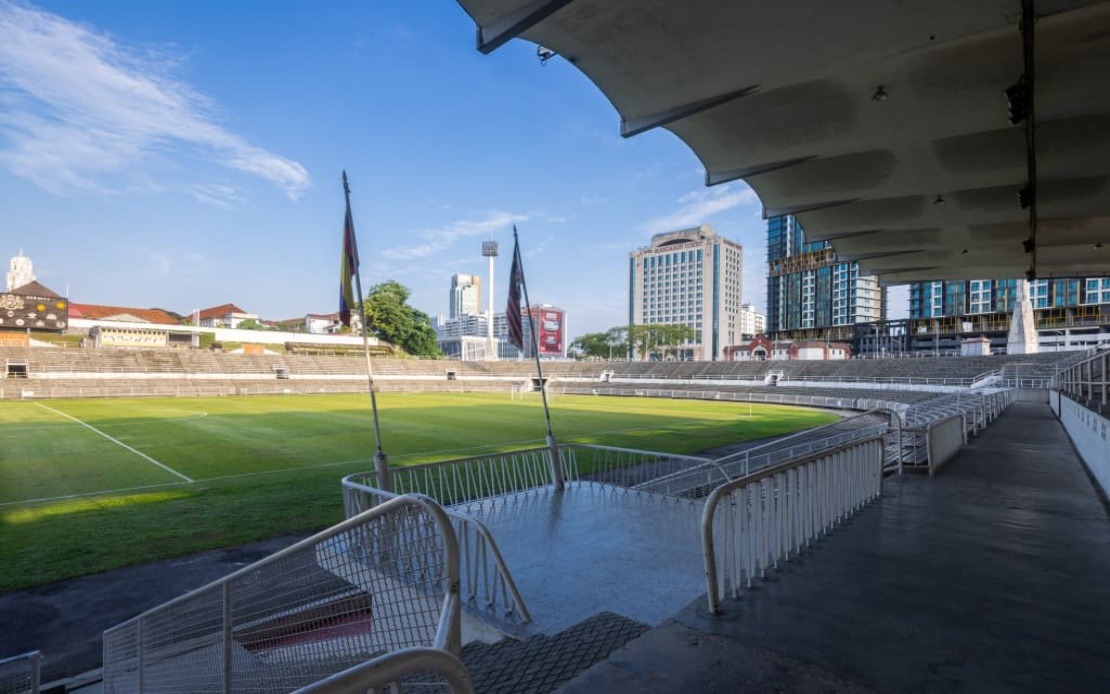
Stadium Merdeka stands as more than just a sports facility in Kuala Lumpur's evolving landscape. Positioned against the modern silhouette of Merdeka 118, this heritage venue remains a tangible link to one of Malaysia's most pivotal moments—the proclamation of Malaya's independence on August 31, 1957. Nearly seven decades later, the stadium persists as a repository of national memory, its walls echoing the historic declaration that launched a sovereign nation onto the world stage.
Construction of the venue was accomplished with remarkable efficiency and foresight. Built over the course of a single year with an outlay of approximately RM2.3 million, Stadium Merdeka became the chosen setting for Tunku Abdul Rahman Putra Al-Haj, the first Prime Minister, to deliver his seven resounding proclamations of "Merdeka!" alongside the inaugural rendition of the national anthem. This moment represented not merely a political transition, but the formal termination of colonial rule and the commencement of an independent federation.
Prof Dr Sarjit Singh Gill, a social anthropology expert from Universiti Putra Malaysia and Chairman of the National Council of Professors' National Unity Cluster, underscores the stadium's significance beyond its sporting function. He characterizes the venue as embodying Malaysia's identity, dignity and historical legacy—a monument whose value transcends the boundaries of athletic competition. The 1957 proclamation marked a watershed in Southeast Asian history, reshaping the geopolitical landscape and establishing a model for peaceful decolonization that would influence the region's trajectory for decades to come.
The venue's historical importance deepened six years after independence. In 1963, Stadium Merdeka witnessed the proclamation establishing the Malaysian Federation, extending the nation's sovereignty to encompass Sabah and Sarawak while Singapore briefly participated in the union before its separation. This dual historical significance—anchoring two pivotal moments in the nation's constitutional evolution—distinguishes Stadium Merdeka among Malaysia's cultural institutions and deepens its relevance to contemporary understanding of how the nation assumed its modern configuration.
The stadium's survival represents a triumph of heritage preservation over commercial pressures. During the late 1990s, the venue faced genuine threats of redevelopment as Kuala Lumpur's real estate values escalated. However, public advocacy and governmental foresight prevented demolition. Permodalan Nasional Berhad assumed custodianship of the site in 2000, assuming responsibility for maintaining this irreplaceable cultural asset. This transition signalled a commitment to conservation principles that would guide subsequent restoration efforts and establish the stadium's institutional future.
Datak Dr Izwan Ibrahim, Chief Executive Officer of PNB Merdeka Ventures Sdn Bhd, articulates a conservation philosophy centered on authenticity and accessibility. Rather than transforming the stadium into a sterile museum, the management approach emphasizes keeping the venue's narratives alive and available to contemporary Malaysians. He characterizes Stadium Merdeka as representing not merely historical commemoration, but embodying the aspirations and determination that fundamentally shaped the nation's modern character. This perspective positions the venue as dynamic rather than archival—a living space where historical significance intersects with present-day community engagement.
Restoration work proceeded according to rigorous historical documentation. Original Public Works Department construction blueprints guided conservation efforts, ensuring fidelity to the original structural design. Later modifications, including added upper seating sections, were methodically removed to restore the stadium's intended twenty-thousand-seat capacity. Specific architectural elements—the distinctive scoreboard, facilities infrastructure, decorative mosaic tilework, and the characteristically cantilevered roof structure—underwent meticulous rehabilitation to recover their original condition and aesthetic integrity.
The venue has evolved considerably from its original function as the exclusive host of National Day ceremonies. Contemporary Stadium Merdeka operates as an accessible public landmark, featuring a refurbished athletic track available to community members and regularly hosting cultural programming. Earlier this year, the Bazram Merdeka bazaar, a Ramadan market event, drew over two hundred fifty thousand visitors, demonstrating the stadium's capacity to facilitate meaningful community interaction and commerce. This multifunctional approach ensures the venue remains economically viable and socially relevant while maintaining its historical character.
International recognition has further validated the stadium's heritage importance. In 2008, Stadium Merdeka received the UNESCO Asia-Pacific Heritage Award, reflecting international acknowledgment of its architectural and historical significance. The Malaysian government subsequently designated the venue as a National Heritage site in 2009, providing formal legal protection and elevating its status within the nation's cultural patrimony. These designations underscore that Stadium Merdeka transcends local or regional significance to merit recognition within a broader global context of historically important sites.
Management priorities increasingly emphasize intergenerational engagement, particularly attracting younger Malaysians who did not experience independence directly. Izwan Ibrahim recognizes that 1957 exists for younger generations primarily through educational curricula and family narratives. Experiencing the physical location where independence was proclaimed represents a fundamentally different form of historical consciousness. By encouraging school visits, organizing youth-oriented activities, and facilitating younger visitors' participation in stadium-based events, management cultivates direct personal connections to Malaysia's founding narrative. This experiential learning approach transforms abstract historical knowledge into embodied memory, potentially deepening young Malaysians' relationship to national identity.
Long-serving staff member Alias Daud, who invested thirty-five years in PNB's service with the final decade devoted entirely to stadium stewardship, personalizes the institutional commitment to preservation. His account of experiencing profound pride and responsibility when walking through Stadium Merdeka's gates reflects how heritage conservation engages human emotion and personal meaning-making. Daud's observations that visitors from diverse backgrounds arrive with varied stories and memories illuminate how the stadium functions as a gathering place where disparate Malaysian communities intersect with shared national history. His contentment derives not from administrative duty, but from witnessing successive generations engaging with the venue and appreciating its significance.
The experience of visitors during Malaysia's National Day month particularly reveals the stadium's contemporary resonance. Government departments, educational institutions, and university groups visit to absorb historical context and generate commemorative content, indicating that Stadium Merdeka retains its function as a focal point for official and grassroots celebration of national identity. Many visitors express surprise upon learning that independence was proclaimed at this specific location, suggesting that experiential encounter with the site generates historical understanding that passive textbook learning cannot replicate. Younger visitors especially appear responsive to understanding their nation's origins within the physical and architectural environment where those origins were formally declared.
As Kuala Lumpur's skyline continues its vertical expansion, Stadium Merdeka's persistence maintains historical continuity and temporal perspective. The juxtaposition of heritage architecture against soaring contemporary towers creates a visual narrative about Malaysia's relationship to time and progress. The stadium's endurance symbolizes commitment to remembrance amid rapid modernization, ensuring that the nation's founding moment remains tangible and accessible rather than relegated to archival abstraction. Stadium Merdeka thus stands as Malaysia's promise to future generations that the spirit of Merdeka—the independence, determination, and collective aspiration animating the nation's birth—will remain materially present and experientially available for generations yet to emerge.

