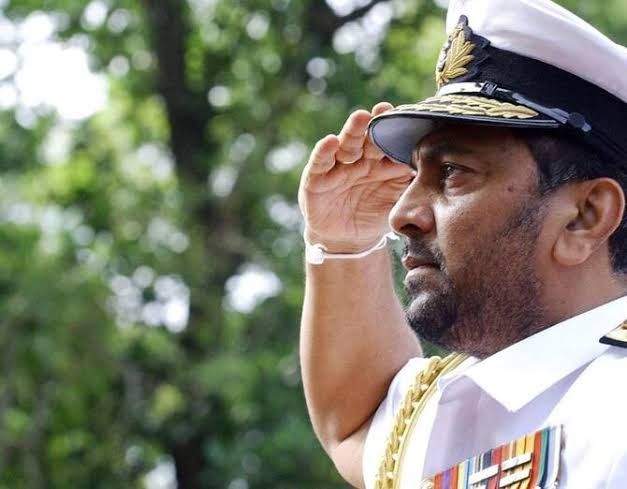
Sri Lanka's anti-corruption authorities have arrested a retired senior military officer in connection with a sprawling scandal centring on the Rajapaksa family's exercise of political privilege. Admiral of the Fleet Wasantha Karannagoda, 73, was taken into custody by the Bribery Commission on Friday to face allegations of corruption stemming from his involvement in the improper naval recruitment of Yoshitha Rajapaksa, the son of former president Mahinda Rajapaksa, without the required professional qualifications in 2006.
Karannagoda served as commander of the Sri Lankan navy during a pivotal moment in the island nation's history, overseeing the military apparatus as the country's three-decade conflict with Tamil separatists drew to a close in 2009. His career trajectory saw him elevated to the ceremonial rank of Admiral of the Fleet in 2019, though he has held no operational military position since his retirement. The arrest represents a significant moment in Sri Lanka's reckoning with the Rajapaksa era, a period when members of the family accumulated substantial influence over state institutions and military appointments.
The immediate trigger for Karannagoda's detention concerns the 2006 enlistment of Yoshitha Rajapaksa into the navy, a transaction that appears to have circumvented standard recruitment protocols. Yoshitha, now 38 years old, was granted entry to the military service despite lacking the qualifications typically required for such positions. Beyond the initial recruitment irregularity, investigations have revealed that the younger Rajapaksa subsequently benefited from overseas military training at Britannia Royal Naval College in Dartmouth, Britain, with evidence suggesting that public funds covered his tuition. This secondary arrangement has prompted separate criminal charges against him, and he is presently free on bail awaiting trial.
The Bribery Commission's formal statement directly implicates Karannagoda in the scheme, declaring that he "has committed the offence of corruption in the recruitment and training of Yoshitha Rajapaksa." This characterisation frames the admiral's actions as a deliberate abuse of his official authority to facilitate preferential treatment for a well-connected family member. The charges carry particular weight given Karannagoda's prominent standing within military and governmental hierarchies during the period in question.
Karannagoda's legal troubles extend well beyond the nepotism allegations. He has faced longstanding accusations of war crimes and grave human rights violations dating to the final phases of the civil conflict, when military operations against Tamil militant groups intensified. In March 2025, Britain imposed sanctions against him specifically citing serious human rights abuses and allegations of extrajudicial killings. Additionally, he confronts charges related to a conspiracy to murder eleven young men whose deaths occurred between 2008 and 2009, a period when state security forces operated with considerable impunity.
These graver accusations had previously been shelved in October 2021, a period when Gotabaya Rajapaksa, Mahinda's younger brother, occupied the presidency. The decision to drop charges at that juncture reflected the political climate under Rajapaksa family control, when institutional mechanisms appeared designed to shield associates from accountability. However, following the election of President Anura Kumara Dissanayake in September 2024, prosecutorial momentum shifted markedly. Dissanayake campaigned explicitly on pledges to investigate and prosecute corruption and unresolved major crimes, a platform that appealed to voters fatigued by years of perceived impunity within elite circles.
The revival of charges against Karannagoda exemplifies a broader legal offensive targeting the Rajapaksa family and their inner circle. Since Dissanayake's assumption of office, multiple cases that had languished or been discontinued under previous administrations have been resurrected and pursued with apparent vigour. These prosecutions touch upon diverse matters ranging from financial crimes to abuses of power, and collectively signal a determination to address grievances accumulated over the family's decades of political dominance.
Yoshitha Rajapaksa's own legal entanglement illustrates the web of complications ensnaring the Rajapaksa family. Beyond the naval training allegation, he confronts criminal prosecution concerning the sources of wealth used to purchase property during his father's tenure as president from 2005 to 2015. When questioned by investigators, Yoshitha's explanation proved unconvincing: he claimed that funds derived from the sale of gemstones gifted by a maternal aunt, yet his relative could provide no coherent account of how she had originally acquired the valuable stones. This circular and implausible narrative merely deepened suspicions of illicit financial conduct.
The vulnerability of the broader Rajapaksa network has intensified with developments affecting Gotabaya Rajapaksa, the former president and Mahinda's brother. Authorities recently imposed a prohibition on his international travel following revelations regarding his alleged connections to the 2019 Easter Sunday bombings, a coordinated series of attacks that claimed 279 lives. The restrictions on Gotabaya's movement prevent him from fleeing Sri Lanka while investigations proceed, effectively tightening the legal noose around senior family figures.
These cascading arrests and investigations reflect a fundamental realignment of Sri Lanka's approach to prosecutorial accountability. For years, the Rajapaksa family operated within an environment where political leverage could arrest legal proceedings or ensure lenient outcomes. The change of government has disrupted this protective architecture, exposing family members and close associates to judicial scrutiny previously forestalled. For observers across Southeast Asia, the unfolding events in Sri Lanka demonstrate both the fragility of elite protection systems and the potential for institutional reform when political conditions shift.
The implications for regional governance remain significant. Sri Lanka's struggle to address corruption and human rights abuses committed during authoritarian periods mirrors challenges facing other countries in the region grappling with transitional justice. The Dissanayake administration's willingness to pursue former leaders and military figures sends a message about the evolving standards for accountability, though questions persist regarding whether such prosecutions will proceed impartially or become instrumentalised for partisan political advantage. The outcomes of these high-profile cases will likely influence how other Southeast Asian democracies approach similar reckoning with their own troubled pasts.

