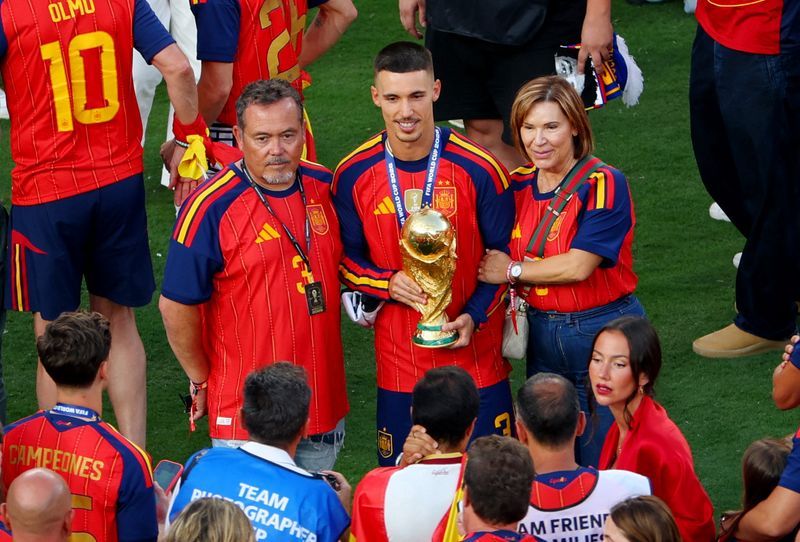
Spain secured the World Cup on Sunday with a 1-0 victory over Argentina, a result that proved far more than a simple triumph in sport. The match served as a declaration of footballing identity, demonstrating how a team built on controlled possession and collective purpose could outlast a more traditionally combative opponent. Playing at East Rutherford, New Jersey, Spain moved past the conventional narrative of dramatic, explosive glory to deliver something more distinctive: the steady domination of a side utterly committed to its own philosophy, regardless of external pressure or mounting fatigue.
The Spanish approach throughout the tournament reflected a deliberate rejection of chaos in favour of methodical control. Across the ninety minutes and beyond, Spain maintained possession exceeding 65 per cent while constructing twice as many completed passes as their Argentine counterparts. Rather than seeking quick breakthroughs, Luis de la Fuente's team methodically constructed opportunities through precise ball movement and positional discipline. Argentina managed only a single off-target attempt deep into extra time, a stark illustration of how completely Spain had seized control of the contest's rhythm and flow.
What distinguished this Spanish side extended beyond statistical dominance. The team's willingness to trust substitutes with decisive moments revealed something fundamental about its culture. When Nico Williams and Ferran Torres combined to produce the winning goal from the bench, they became the third pairing of replacement players to score crucial knockout-stage objectives for Spain. This pattern underscored a team philosophy where no individual transcended the collective system, where even players entering late in matches had internalised the tactical language and positional responsibilities demanded by their coaches.
Yet the path to victory exposed a persistent vulnerability that even championship-winning performances cannot entirely erase. Spain's creation of twelve shots on target contrasted sharply with their ability to convert opportunities into goals, a deficit traceable to the absence of a traditional centre forward operating in the classical mould. The team compensated through collective efficiencies and tactical flexibility, but the absence of a consistent goal-pouring finisher remained visible, albeit not ultimately decisive.
The tournament awards distribution reflected this collective identity rather than individual brilliance. Rodri earned the Most Valuable Player designation, while Pau Cubarsi received Best Young Player honours and Unai Simon garnered recognition as Best Goalkeeper. Only the Golden Boot eluded Spanish hands, awarded to France's Kylian Mbappe. This distribution of accolades mirrored Spain's tactical philosophy: success flowed from system rather than from singular performances. Across eight tournament matches, fourteen goals were distributed among eight different scorers, a variance that prevented any one player from dominating the narrative.
The achievement extended beyond immediate competition, constructing what may become a defining era in Spanish international football. This victory extended Spain's unbeaten sequence to thirty-eight consecutive matches, surpassing Italy's previous benchmark and establishing a foundation of consistency stretching back three years. The accomplishment underscored dominance within the international football landscape and suggested momentum that transcended momentary achievement.
For Luis de la Fuente personally, the triumph validated an unconventional path to football's highest honour. Once dismissed by Spanish media with the epithet "Luis de la Who" during his extended tenure developing youth talent within the Spanish Football Association's academy structures, he had transformed patient apprenticeship into championship vindication. His appointment had carried scepticism from observers accustomed to more celebrated managerial pedigrees, yet his systematic approach and meticulous team building ultimately prevailed.
Beyond tactical considerations, the Spanish victory carried profound implications for national identity. The squad composition reflected the country's internal diversity with remarkable clarity. The team brought together players from distinct regions: Mikel Oyarzabal and Mikel Merino from the Basque Country, Borja Iglesias representing Galicia, Ferran Torres from Valencia, Rodri from Madrid, Fabian Ruiz and Gavi from Andalusia, and Pedri from the Canary Islands. Catalonia contributed nine players including Pau Cubarsi and Marc Cucurella. Meanwhile, Lamine Yamal and Nico Williams embodied Spain's evolving relationship with immigration, representing a demographic transformation reshaping Spanish society across recent decades.
Historically, Spain has derived cultural complexity from its constituent regions, each possessing distinct linguistic traditions, historical trajectories, and regional pride. These differences have occasionally strained national cohesion, creating political tensions and identity disputes that footballing success cannot permanently resolve. Yet momentarily, during the World Cup final, these regional distinctions ceased functioning as divisive obstacles. Instead, players carrying disparate regional backgrounds united toward common purpose, their differences converging into cooperative strength.
The tournament triumph demonstrated something that domestic politics frequently struggles to achieve: creating shared national identity transcending regional particularism. On Sunday evening, Spanish television screens unified the country in celebration, temporarily suspending the grievances and competing narratives that characterise Spanish political discourse. Whether this moment would produce lasting effects remained uncertain, but the symbolic power of diverse regions cooperating through football proved undeniable.
For Southeast Asian observers and Malaysian readers particularly, Spain's approach offered instructive parallels. Regional diversity combined with effective institutional frameworks can generate strength rather than fragmentation. The Spanish model demonstrated how systematic development, institutional consistency, and clear philosophical identity could accommodate regional variation while maintaining organisational coherence. In contexts where regional considerations carry significant political weight, Spain's footballing success suggested pathways through which collective identity might emerge without erasing legitimate regional distinctions.
The dominance displayed throughout Spain's eight-match tournament run established this team among football's most accomplished sides. The combination of championship success, statistical superiority, unbeaten streak extension, and philosophical coherence positioned them as potentially definitive standard-setters for international football during coming years. Whether they maintain this supremacy remains unknowable, but the immediate accomplishment stands unambiguous.

