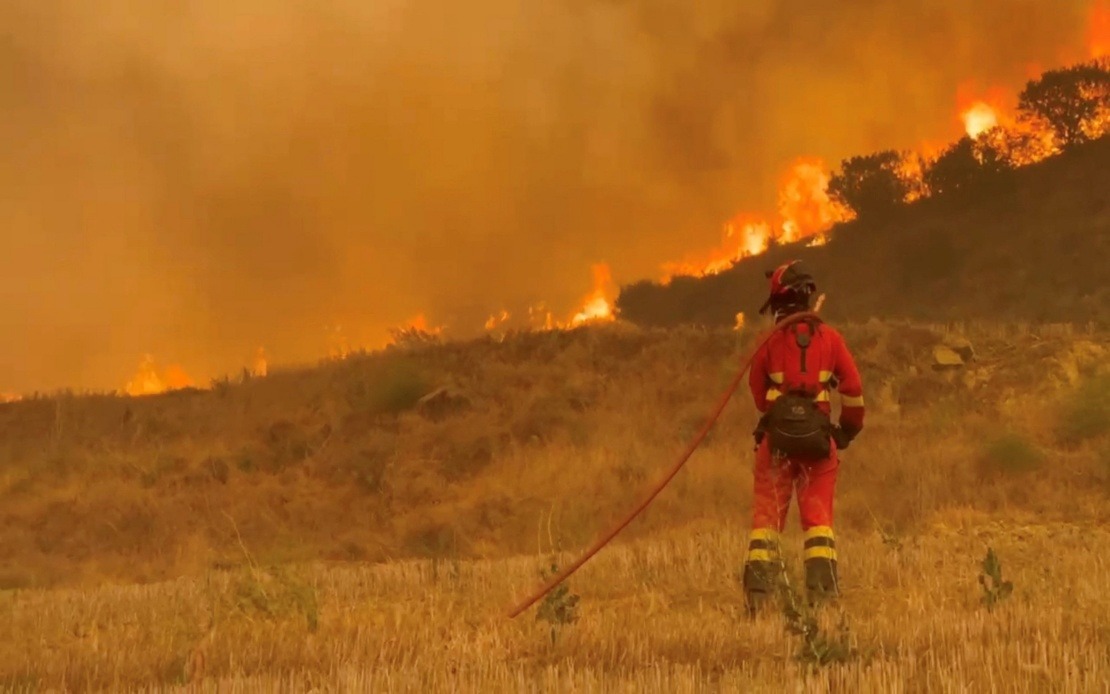
Spain faces one of its most severe wildfire challenges this year as a massive blaze continues to rage across the northeastern province of Zaragoza, consuming approximately 12,000 hectares of land and forcing the emergency evacuation of more than 1,100 residents across multiple communities. The fire, which originated on Wednesday in the Cinco Villas region, has demonstrated remarkable ferocity and persistence, spreading rapidly through the night into Friday with what authorities describe as "significant" progression despite intensive suppression efforts.
The geographical scale of the disaster underscores the severity of the situation. The wildfire has expanded across a perimeter extending some 60 kilometres, necessitating the closure of several major roads and prompting widespread lockdown measures throughout the affected zone. The evacuation has affected five municipalities entirely within Zaragoza province, whilst authorities have also ordered the displacement of residents from one municipality in the adjoining region of Navarre, indicating how far the fire's influence extends beyond its point of origin.
Responding to the emergency, Spanish authorities have mobilized substantial resources to combat the advancing flames. On Thursday alone, approximately 400 ground personnel alongside 19 aircraft were deployed to engage the fire directly. Overnight operations shifted focus toward defensive measures, with firefighting teams concentrating their efforts on protecting residential areas in Uncastillo, a strategic shift that reflects the immediate threat posed to civilian populations as the fire spread unpredictably through the region.
The situation remains fluid and unpredictable. Despite restoration of electricity to all affected towns—a critical step toward stabilizing conditions for evacuated residents—the Cinco Villas region continues operating under lockdown with two major roads remaining impassable. The fire's classification as "quite active" suggests that containment remains elusive and that additional resources may be required in coming days as the situation develops.
This catastrophic fire in Zaragoza is not an isolated incident within Spain during this period. Simultaneously, authorities have been managing multiple fire emergencies across the Iberian peninsula. A second significant wildfire near La Mierla in the northern province of Guadalajara has consumed approximately 900 hectares, prompting similar evacuation protocols and community lockdowns. That blaze's persistence prompted the regional government to formally request assistance from Spain's Military Emergency Unit, which dispatched approximately 100 personnel to augment civilian firefighting operations. Additionally, a third wildfire located near Lozoyuela to the north of Madrid remains an active concern, though it has shown relatively more favorable containment trends compared to its larger counterparts.
The confluence of environmental and meteorological factors has created particularly hazardous conditions for fire propagation across Spain. Exceptionally high temperatures, powerful wind patterns sweeping across the region, and critically low humidity levels have combined to provide ideal conditions for rapid fire spread. Paradoxically, abundant vegetation resulting from abundant rainfall during the spring months has supplied an overabundance of fuel for the flames, transforming what might typically be a manageable situation into a conflagration.
For Malaysian and Southeast Asian observers, the Spanish wildfire crisis offers sobering lessons about climate vulnerability and environmental management. The combination of climatic extremes—intense heat coupled with drought-like conditions—mirrors challenges increasingly faced across Southeast Asia, particularly during extended dry seasons when forests throughout Indonesia, Malaysia, and neighboring nations become susceptible to catastrophic blazes. The 2015 Southeast Asian haze crisis, which devastated air quality across the region and caused substantial economic losses, remains a cautionary historical parallel.
Experts analyzing Spain's current emergency point toward broader systemic factors amplifying wildfire risk. Climate change's role in intensifying temperature extremes and creating more volatile weather patterns is increasingly recognized as a primary driver of megafire phenomena worldwide. Simultaneously, the systematic abandonment of rural agricultural areas across southern Europe has resulted in landscape degradation and uncontrolled vegetation accumulation, both of which substantially increase fire hazard. This combination of climate forcing and land-use transformation creates what fire scientists term a "perfect storm" for catastrophic wildfires.
The legal dimension of the crisis adds another layer of complexity. Civil Guard authorities have arrested a male suspect in connection with the Madrid-region fire, suggesting that human agency—whether accidental or intentional—remains a significant factor in ignition events. The regional government's decision to participate as a civil party in legal proceedings indicates serious investigation into fire origins, reflecting Spain's commitment to holding parties accountable where human negligence or criminality contributes to environmental disaster.
Looking forward, Spain's experience underscores the necessity for integrated approaches to wildfire management encompassing prevention, preparedness, and response. For Malaysia and other Southeast Asian nations increasingly affected by transboundary haze and regional fire emergencies, Spain's current challenges and emergency response mechanisms provide valuable reference points. Investment in modern firefighting capabilities, cross-border coordination mechanisms, land management practices that reduce fuel accumulation, and climate adaptation strategies emerge as essential components of resilient environmental governance in an era of intensifying climatic extremes.

