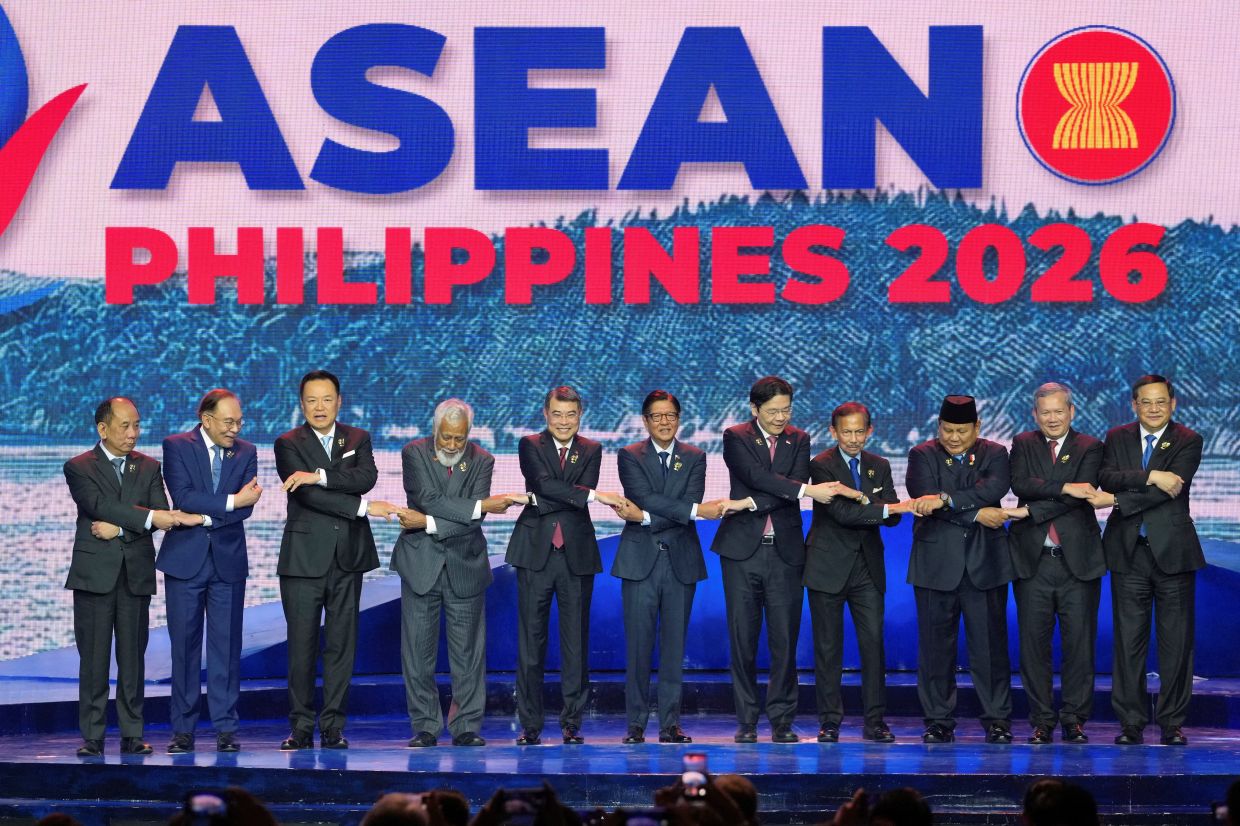
Southeast Asia's diplomatic establishment will converge on Manila this week for annual ministerial talks that have assumed heightened urgency as multiple regional and global crises demand urgent attention. The three-day gathering, anchored by the Association of Southeast Asian Nations and chaired by the Philippines, will draw foreign ministers from across the region alongside major powers including the United States, China, Russia and the European Union. The timing proves significant: each attendee arrives carrying distinct priorities and concerns that threaten to complicate consensus-building on issues directly affecting the 680-million-strong region.
The escalating military confrontation between the United States and Iran looms large over the agenda. Southeast Asian diplomats plan to issue a collective statement expressing deep concern about renewed hostilities that have reverberated across the Middle East, with calls for both Washington and Tehran to de-escalate and return to diplomatic channels. For the region, this deterioration carries immediate economic implications. The Strait of Hormuz, through which roughly one-fifth of global oil supplies flow annually, has again become a flashpoint for disruption. When similar tensions surfaced in March, Philippine President Ferdinand Marcos Jr. declared a national energy emergency to shield his country from fuel shortages and price volatility, a precautionary measure that underscores Southeast Asia's profound vulnerability to Middle East instability. The region's energy security depends heavily on stable supply flows from the Gulf, making any prolonged conflict a direct threat to economic momentum across multiple national economies.
Washington's military focus on the Middle East has simultaneously raised concerns among Southeast Asian strategic thinkers about potential American attention deficit regarding Asia-Pacific affairs. The Trump administration's stated commitment to deterring Chinese aggression in the South China Sea and against Taiwan requires sustained engagement, yet persistent Middle East entanglement threatens to fragment American diplomatic and military resources. U.S. Secretary of State Marco Rubio's attendance at the Manila talks represents Washington's deliberate attempt to reassure regional partners that the United States remains strategically committed to maintaining a "free and open Indo-Pacific" despite competing global pressures. The visit signals that the new American administration recognises the need for sustained presence in Southeast Asia as a counterweight to China's increasingly assertive regional posture.
Rubio's presence also creates opportunity for dialogue with Chinese Foreign Minister Wang Yi, though neither official has formally committed to bilateral meetings. Before departing Washington, Rubio acknowledged the potential for talks while emphasising the importance of sustained communication between major powers despite fundamental disagreements. Both nations recognise that mutual isolation serves neither their interests nor those of the wider region, a pragmatic acknowledgment that transcends contemporary political tensions. The Americans will also use the Manila platform to strengthen the Quad bloc—comprising the United States, India, Japan and Australia—a strategic arrangement Beijing consistently criticises as containment by another name. This multilateral coordination reflects Washington's broader effort to institutionalise regional partnerships that complicate Chinese hegemonic aspirations.
Myanmars civil conflict presents perhaps the most complex challenge facing ASEAN's collective diplomacy. Since the military's 2021 coup against democratically elected leader Aung San Suu Kyi, the country has descended into sustained bloodletting that has claimed more than 8,100 lives while leaving nearly 22,500 detained, according to the Assistance Association for Political Prisoners. A five-point peace consensus adopted by ASEAN leaders in 2021 has proven virtually worthless, undermined primarily by the Naypyidaw military administration's consistent non-compliance with ceasefire provisions and dialogue commitments. The bloc responded by excluding Myanmar's leadership from high-level meetings, a symbolic but ultimately ineffective sanction that has failed to compel behavioural change.
Recent diplomatic attempts signal potential shifting strategy. Philippine Foreign Secretary Theresa Lazaro, serving as ASEAN's special envoy, met Myanmar's Foreign Minister Tin Maung Swe in Bangkok this month—the first such encounter in five years. The meeting represented a calculated decision to maintain diplomatic channels with Naypyidaw despite the military regime's continued intransigence. Subsequent consultations between ASEAN representatives and ethnic armed organisations operating within Myanmar demonstrated effort to engage diverse stakeholders rather than excluding all Burmese interlocutors wholesale. However, international human rights organisations have denounced these overtures as capitulation, arguing that rewarding the generals through renewed engagement abandons earlier principled positions without extracting meaningful concessions on violence reduction or prisoner releases. Lazaro has defended the approach as "resolute diplomacy" necessary for any viable peace pathway, though sceptics question whether dialogue without leverage can meaningfully alter military calculations in Naypyidaw.
The South China Sea territorial disputes remain perpetually vexatious, with China and four ASEAN members—the Philippines, Vietnam, Malaysia and Brunei, alongside Taiwan—claiming overlapping maritime zones. Recent years have witnessed dramatically increased confrontations between Chinese coast guard vessels and Philippine maritime forces, transforming what might otherwise remain diplomatic abstraction into real-world flashpoint incidents. ASEAN foreign ministers will use the Manila talks to review progress on negotiating a "code of conduct" with Beijing that theoretically aims to prevent maritime disputes from escalating into armed conflict. The initiative represents decades-long effort to establish binding rules preventing accidents from triggering wider warfare, yet negotiations proceed glacially as China resists provisions that would meaningfully constrain its operational freedom. For the Philippines particularly, which has faced repeated aggressive incidents in the disputed waters, the code's effectiveness remains disappointingly marginal.
Washington's historical role as security guarantor for the region adds another dimension to South China Sea calculations. American naval operations asserting freedom of navigation rights through contested waters provide implicit security assurance to Philippines and other littoral nations whose individual maritime capabilities cannot match China's expanding coast guard and naval resources. Rubio's reassurances regarding American commitment to the region therefore carry strategic weight beyond diplomatic rhetoric. The Trump administration's publicly stated willingness to help Taiwan resist Chinese pressure requires corresponding attention to wider Southeast Asian security concerns, as the region represents both contested terrain and crucial gateway to broader Indo-Pacific strategic competition.
Russia's participation through Foreign Minister Sergey Lavrov introduces additional complexity to Manila's diplomatic calculus. Moscow maintains significant interests in Southeast Asian markets and resources while positioning itself as alternative partner for nations seeking to escape exclusive American or Chinese alignment. Ukrainian Foreign Minister Andrii Sybiha has received invitation to a Friday ceremony commemorating ASEAN's 1976 non-aggression treaty but will not participate in substantive talks, reflecting regional reluctance to transform ASEAN forums into venues for great power competition over Ukraine policy. This careful distinction demonstrates Southeast Asian diplomatic sophistication: the region seeks to maintain dialogue channels with major powers while resisting pressure to choose permanent sides in superpower confrontations that remain geographically peripheral to core regional interests.
The European Union's attendance similarly reflects broader European recognition that Indo-Pacific stability affects global prosperity and security. The continent's economic interests in Southeast Asian supply chains and markets have grown substantially, making regional stability a legitimate European concern rather than purely Asian matter. The Manila talks therefore represent genuinely multilateral engagement where global powers confront regional actors asserting their distinct interests and constraints rather than simply implementing external directives.
For Malaysia and other Southeast Asian governments, the week's discussions will clarify whether regional institutions retain capacity to shape outcomes in contested domains or have been relegated to endorsing arrangements negotiated between major powers. The ASEAN consensus principle, traditionally designed to protect smaller nations' sovereignty, faces increasing strain when powerful members like the Philippines face direct Chinese pressure while others maintain more accommodative approaches. How Manila's presidency navigates these fractious relationships will determine whether ASEAN emerges from the talks strengthened or further fractured by divisions that major powers will inevitably exploit. The outcome will reveal whether Southeast Asia can maintain strategic agency or faces relegation to arena where great powers compete rather than where regional voices meaningfully shape outcomes.

