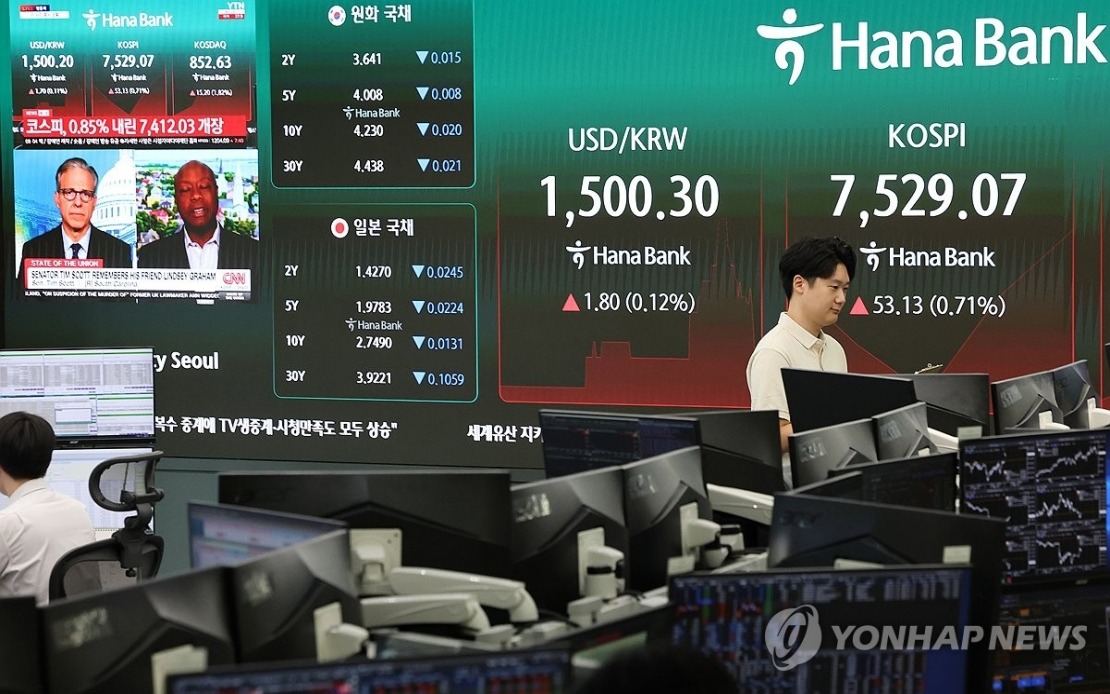
The Korea Exchange moved swiftly to contain market volatility on Monday when it triggered an automatic trading halt affecting the nation's primary equity benchmark, the Korea Composite Stock Price Index, in response to severe selling pressure driven by deteriorating regional security conditions. The marketwide circuit breaker was activated at approximately 1:28 p.m. local time, freezing all KOSPI-listed share trading for twenty minutes after the index had declined more than eight percentage points from the previous trading session's closing level.
The sharp market deterioration reflected mounting investor apprehension following fresh military exchanges between the United States and Iran centred on control of the strategically vital Strait of Hormuz. These renewed geopolitical hostilities sent shockwaves through regional trading floors, prompting institutional and retail investors alike to reduce exposure to equities perceived as vulnerable to international instability. The cascade of sell orders overwhelmed buy-side interest, creating the conditions necessary for the automated circuit breaker mechanism to engage.
Circuit breakers represent a critical safeguard embedded within modern equity markets, designed to pause trading temporarily when price movements exceed predetermined thresholds. By halting transactions for a defined interval, these mechanisms create psychological space for market participants to reassess positions and consider implications of unfolding events without succumbing entirely to panic-driven liquidation. South Korea's bourse has demonstrated particular reliance on this tool during volatile periods, reflecting both the sensitivity of its technology-heavy index composition to global economic and security conditions and the prevalence of algorithmic trading strategies that can amplify directional moves.
The Monday activation marked the seventh instance this year that the Korea Exchange has felt compelled to implement circuit breaker protocols, suggesting that 2024 has proven unusually turbulent by historical standards. This frequency underscores the degree to which external shocks—whether originating from geopolitical friction, macroeconomic data surprises, or policy shifts—have destabilized established market patterns. Each activation carries broader implications for investor confidence, as repeated halts can undermine faith in market stability and discourage medium to long-term capital deployment.
For Malaysian and Southeast Asian investors, developments in South Korean equity markets warrant careful attention given the region's deeply interconnected financial networks and overlapping exposure to technology sector dynamics. South Korea represents a major hub for semiconductor manufacturing, battery production, and digital services—sectors in which Malaysian companies maintain significant supply chain relationships and competitive positioning. Volatility affecting Korean equity valuations can create spillover effects through corporate earnings, supply chain reordering, and shifts in regional capital flows.
The Strait of Hormuz tensions carry particular resonance throughout Southeast Asia, where energy imports and maritime commerce constitute lifeblood economic activities for multiple nations. Malaysia, as both an energy producer and a nation dependent on sea-lane security for trade, faces direct consequences from any escalation affecting chokepoint waterways. Disruption to petroleum flows or shipping insurance costs could propagate through regional economies, affecting inflation trajectories, currency valuations, and corporate profitability across the ASEAN community.
Investors operating across Asian equities must contend with the reality that geopolitical risk premiums now constitute permanent features of market pricing. The frequency with which circuit breakers engage in developed markets like South Korea suggests that volatility thresholds previously considered extreme have become normalized. This structural shift reflects both genuine elevations in underlying geopolitical tension and the mechanical amplification effects created by algorithmic trading systems that can rapidly translate breaking news into aggressive market positioning.
The broader implication for regional markets involves recognizing that synchronization across equity bourses has intensified substantially. When major indices like KOSPI experience severe disruptions, secondary effects ripple through regional peers as portfolio managers simultaneously reassess allocations across multiple geographies. Malaysian investors maintaining positions in South Korean securities or derivatives contracts linked to Korean indices would have experienced direct portfolio impacts from Monday's decline and trading halt, creating urgent pressure to rebalance exposures.
Looking forward, market participants must monitor whether US-Iran tensions stabilize at current elevated levels or escalate further, as any military incidents affecting shipping through the Strait of Hormuz would trigger additional volatility waves. The precedent established by seven circuit breaker activations in 2024 suggests that South Korean exchanges may face additional trading halts should geopolitical flashpoints ignite further. For Malaysian investors and policymakers, maintaining awareness of Korean market structure and geopolitical risk factors remains essential for navigating Southeast Asian financial markets effectively during this persistently unstable period.

