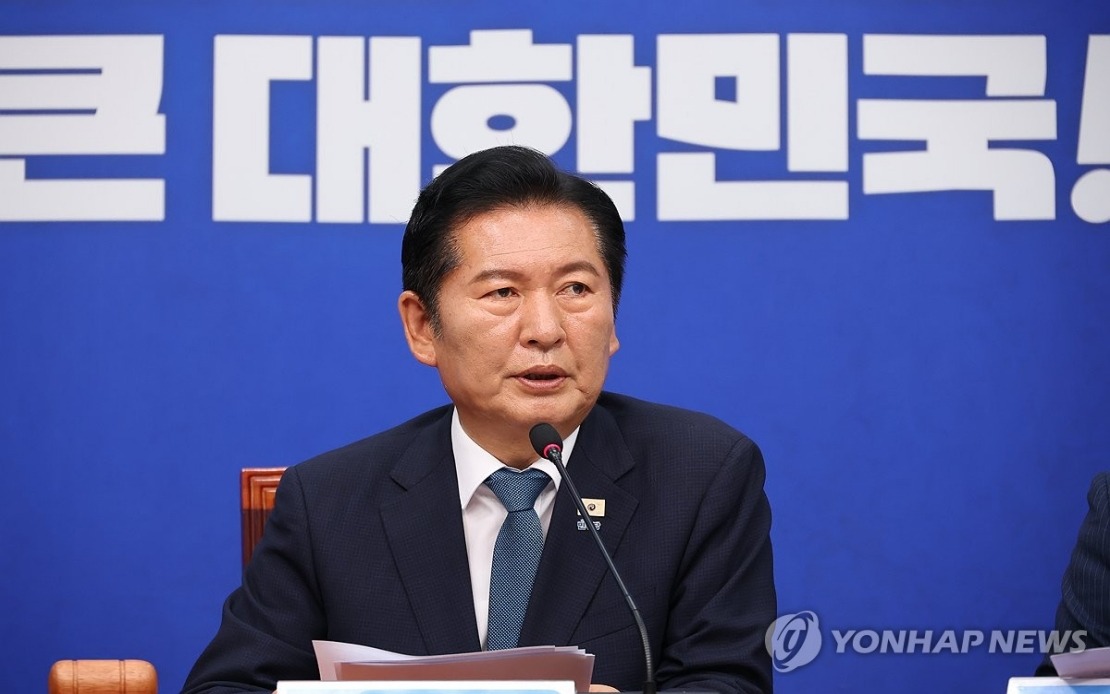
South Korean lawmaker Jung Chung-rae has stepped down as chairman of the ruling Democratic Party, a resignation that observers widely interpret as a calculated prelude to his campaign for re-election at the party's national convention scheduled for August 17. The move, announced during a meeting of the party's supreme council at the National Assembly on Wednesday, sets the stage for what is shaping up as a contested battle for control of one of the country's two major political forces during a sensitive period for President Lee Jae Myung's administration.
Jung's departure from the chairman's post comes after weeks of internal scrutiny and criticism from allies of President Lee who have questioned his leadership approach. In his statement to party elders, Jung characterised his tenure as one marked by personal sacrifice and unwavering commitment, noting that he had "spent many sleepless nights looking back" on his political journey and performance in the role. His language suggested an attempt to position himself as a dedicated servant of both the party and the sitting president, a careful framing that underscores the delicate factional dynamics within South Korea's political establishment.
The core issue driving the resignation appears rooted in competing visions for party direction. Jung has faced mounting criticism from pro-Lee factions within the Democratic Party who contend that his leadership style prioritises the interests of his own political base rather than operating in lockstep with the presidential administration. These tensions have created an unusual situation where the party chairman must navigate between maintaining his own political identity and demonstrating loyalty to the sitting president—a balancing act that ultimately proved unsustainable in his formal role.
In his remarks to the party's supreme council, Jung emphasised his dedication to ensuring that the ruling party, the government, and the presidential office functioned as a cohesive unit under Lee's direction. However, this very emphasis inadvertently highlights the fractures beneath the surface. His comment that he "carried out duties without complaint" despite facing "resistance from within and outside the party" suggests an acknowledgment of the internal discord that has plagued the Democratic Party in recent months. Such public recognition of party infighting, even when framed positively, signals weakness at precisely the moment when the ruling coalition should project unity.
With Jung's resignation, Democratic Party floor leader Han Byung-do assumes the role of acting chairman, a transitional arrangement that ensures continuity until the August convention settles the question of permanent leadership. This interim period, spanning roughly six weeks, will prove crucial for establishing the terms of competition and allowing the various camps within the party to organise their campaigns. Typically in Korean politics, an acting leader maintains a neutral posture, though the individual's institutional authority and background can subtly influence which candidates gain momentum.
The upcoming convention is shaping up as a three-way contest among Jung, Prime Minister Kim Min-seok, and former Democratic Party leader Song Young-gil. Kim represents the clearest proxy for President Lee's preferred direction, given his status as a trusted ally and sitting government official. His candidacy effectively positions the contest as a referendum on whether the party should more closely align with the presidential office or maintain greater institutional independence. Song, as a former party leader with his own political base, brings experience and relative autonomy, potentially appealing to those seeking a check on concentrated executive power within the ruling coalition.
Song Young-gil's reported communication with President Lee regarding his intention to enter the race signals that even ostensibly independent candidates must navigate the preferences of the sitting chief executive. According to Democratic Party lawmaker Park Jie-won, Song has also raised the possibility of unifying his candidacy with Kim, suggesting a potential coalition strategy that could consolidate support behind a single anti-Jung candidate. Such manoeuvres indicate that Korean political parties remain highly personalised organisations where factional alignments shift based on calculations of power and influence rather than ideological differences.
For Malaysian and Southeast Asian observers, this internal struggle within South Korea's ruling party offers instructive parallels regarding the challenges facing multiparty democracies in the region. Like many Asian democracies, South Korea's parties often struggle to balance centralised executive authority against institutional autonomy and internal pluralism. The Democratic Party's tensions mirror dynamics seen in ruling coalitions across Southeast Asia, where sitting presidents and prime ministers frequently face pressure from party structures that demand acknowledgment of their independent bases and concerns.
The August convention outcome will likely shape South Korea's political trajectory through the remainder of President Lee's term. A Jung victory would signal that the Democratic Party retains significant autonomy from the executive office, potentially emboldening it to pursue more independent policies on contentious issues. Conversely, a Kim victory would underscore the subordination of party machinery to presidential will, consolidating executive control but potentially alienating party members who value institutional independence. Song's potential success would represent a middle path, providing the president with a cooperative ally while respecting the party's institutional identity.
The broader significance of this succession battle extends beyond immediate factional concerns. South Korea has witnessed recurring cycles of political polarisation, prosecutorial overreach, and presidential vindictiveness in its recent history. Party structures that function with some autonomy from sitting presidents can theoretically provide checks on executive excess, while simultaneously creating governance inefficiencies. The Democratic Party's internal negotiations this summer will, in subtle ways, determine whether the ruling coalition moves toward greater integration or preserves meaningful institutional separation.
As the convention approaches, all three candidates will compete to frame their candidacy as the path to party unity and effective governance. Each will need to simultaneously appeal to hardline party loyalists while demonstrating sufficient presidential loyalty to avoid Lee's active opposition. This delicate positioning reflects a deeper reality of South Korean politics: party leaders operate within parameters largely defined by the sitting president's preferences, even when they are supposed to represent institutional independence. Jung's resignation, rather than settling the question of party direction, merely marks the beginning of a competition conducted under rules that the presidential office ultimately shapes.