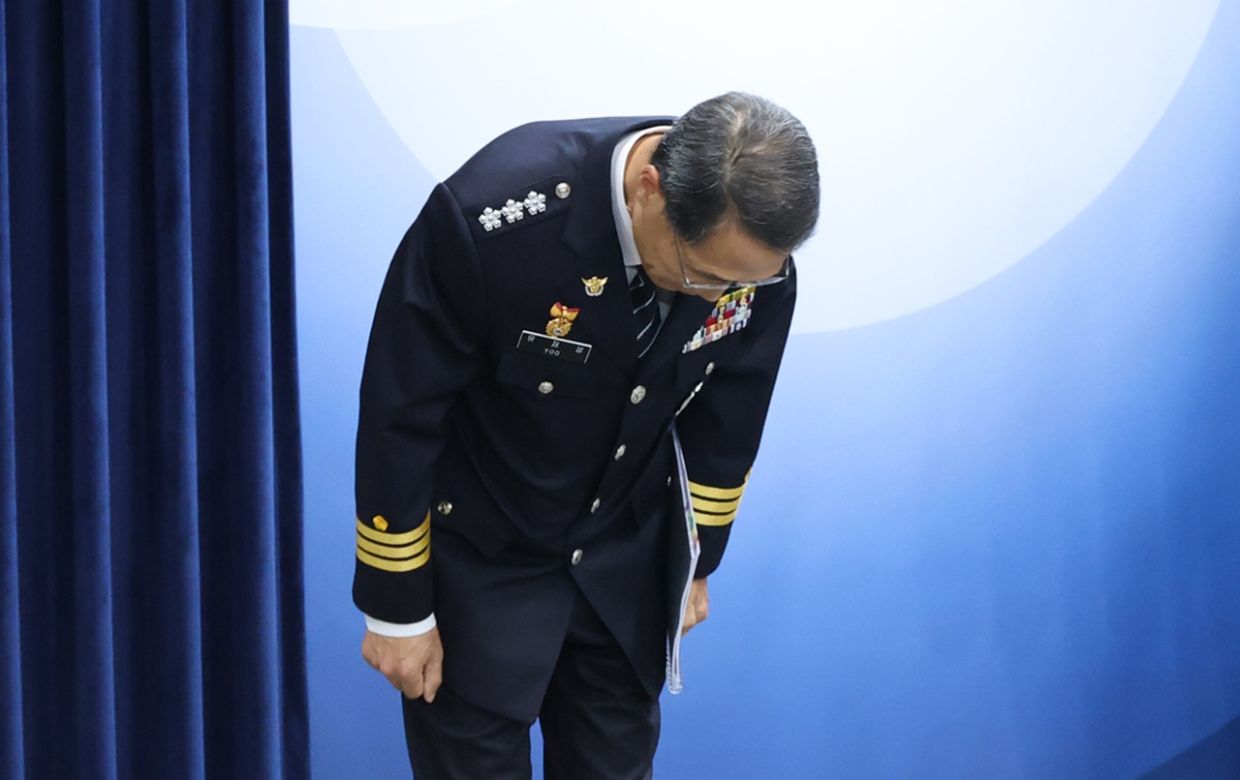
South Korea's police leadership is facing mounting pressure to restore institutional credibility following revelations of investigative failures and alleged improper connections within the force. Acting National Police Agency Commissioner General Yoo Jae-sung declared on Monday that the organisation would undergo fundamental restructuring, acknowledging that the case involving suspect Jang Yoon-gi—arrested for the alleged murder of a teenage girl in Gwangju in May—represents a critical moment for the agency's future. Speaking at a formal briefing in Seoul, Yoo framed the scandal not merely as an isolated incident but as an opportunity to demonstrate whether South Korea's police can genuinely reform their internal culture and investigative methodology.
The controversy centres on serious allegations of institutional compromise. Investigators are accused of leaking sensitive case information to Jang Yoon-gi's father, himself a police officer, while simultaneously failing to properly preserve and secure crucial evidence that would have advanced the investigation. Such breaches represent not technical oversights but fundamental violations of investigative integrity, raising uncomfortable questions about whether familial and professional networks within the police hierarchy can impede justice for ordinary citizens, particularly vulnerable ones like the teenage victim in this instance.
Yoo's public commitment to reform comes as South Korean public opinion has turned sharply critical, with citizens questioning whether the police can be trusted to investigate their own members impartially. The commissioner's assertion that police would pursue their duties "without clinging to position" appeared designed to signal that no senior official would resist accountability measures for self-preservation. This rhetorical move reflects awareness that external pressure and reputational damage now outweigh internal resistance to change within the institutional hierarchy.
The proposed reform framework encompasses multiple coordinated initiatives designed to address systemic vulnerabilities. By the end of July, the agency plans to establish an investigative reform task force with seven to ten members, deliberately structured so that outside experts constitute more than half the panel. This external majority is strategically important—it prevents the police from framing reforms solely through an institutional lens and subjects proposed changes to independent scrutiny. The task force will examine personnel systems to eliminate inappropriate relationships between officers and local communities, while simultaneously strengthening protections for socially disadvantaged individuals whose cases may be deprioritised within current investigative frameworks.
Paralleling these administrative changes, a new internal affairs investigation unit operating under the National Office of Investigation will begin functioning imminently. Unlike traditional police disciplinary mechanisms, this unit will investigate serious crimes allegedly committed by personnel at all ranks without hierarchical protection. For a police force historically resistant to horizontal accountability, this represents a significant departure from conventional practice, as senior officers previously operated with greater insulation from scrutiny.
The most ambitious reform proposal involves establishing a substantial civilian oversight body under the Korean National Police Commission, comprising approximately one hundred civilian investigators tasked with examining alleged human rights violations and investigative misconduct. Yoo emphasised that this body's effectiveness depends not on its mere existence but on its capacity to translate findings into concrete personnel and disciplinary recommendations. This emphasis is politically significant—it acknowledges that civilian oversight only matters if institutional consequences actually follow investigation conclusions, otherwise remaining performative. The commissioner indicated that enabling legislation has already been submitted to the National Assembly, and police will articulate their institutional perspective during parliamentary deliberations.
The reform package also addresses the contentious issue of police rotation policies, where officers are transferred across districts to prevent entrenched local networks that potentially compromise impartial investigations. Currently, only superintendent-level officers undergo mandatory nationwide rotations, with limited application at lower ranks. Yoo indicated that expanding this system could generate logistical difficulties, particularly regarding provision of official residences for transferred officers. The financial implications are substantial—extending housing allowances to lower ranks would require significant budget increases and potentially trigger equity concerns if applied inconsistently. Rather than implementing rotation across all ranks immediately, the police will pilot measures that address pressing concerns while gathering feedback from frontline officers whose operational capacity directly depends on working conditions.
The commissioner's acknowledgment that comprehensive rotation implementation faces practical obstacles represents a rare moment of institutional candour about the constraints limiting police reform. While South Korean administrations frequently announce ambitious restructuring programmes, sustained opposition from affected personnel often produces diluted outcomes. Yoo's transparent discussion of logistical barriers suggests either genuine recognition that sustainable reform requires officer cooperation, or strategic acknowledgment of resistance that will eventually limit implementation scope.
Regarding Jang Yoon-gi's father specifically, Yoo announced that the police would defer concluding their internal inspection until the special investigation team completes its findings. This sequencing decision reflects prudent institutional practice—allowing the primary investigation to conclude before determining how extensively the father's alleged misconduct warrants disciplinary measures prevents investigations appearing coordinated or politically influenced. The decision also preserves prosecutorial independence by ensuring police internal affairs processes do not preempt judicial proceedings.
For Southeast Asian observers, South Korea's police reform trajectory carries instructive implications. Many regional democracies encounter similar challenges where professional networks, family connections, and hierarchical structures potentially compromise investigative impartiality, particularly in cases where suspects possess institutional access or family ties to security personnel. The degree to which South Korea's proposed external oversight mechanisms and civilian investigative bodies prove effective in genuinely constraining police discretion will offer important precedent for regional governance debates about balancing professional autonomy with institutional accountability.
The broader political context matters substantially here. Demonstrating visible progress on police reform addresses public frustration while potentially constraining opposition narratives about government-security force collusion. Yet institutional change rarely occurs through announcement alone—implementation requires sustained political will, adequate funding, and genuine officer participation. The test of these reforms will emerge not in their announcement but through whether civilian investigators actually exercise real power, whether internal affairs investigations produce genuine disciplinary consequences for implicated officers regardless of rank, and whether rotation systems ultimately prevent the localised networks that enabled the alleged misconduct in Jang Yoon-gi's case.

