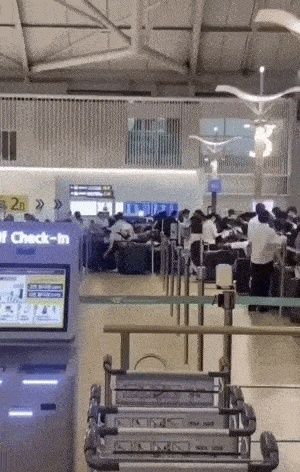
South Korea's principal international hub, Incheon Airport, is moving to upgrade its physical infrastructure and security protocols following a surge in disruptive behaviour from passengers identified as daigou—small-scale cross-border traders who purchase discounted duty-free merchandise in bulk for resale across Asian markets. The decision comes after multiple incidents in which these traders have circumvented formal queuing systems at airline check-in counters, sometimes causing injury to airport personnel attempting to maintain order. Airport management has begun evaluating the installation of reinforced plastic dividers to complement existing retractable barriers, creating a more robust maze-like queuing structure that would make it physically more challenging for passengers to cut across designated pathways.
The problem gained wider public attention following the circulation of video footage recorded on July 2, which captured scenes of apparent chaos in Terminal 1's third-floor departure hall. The footage showed dozens of travellers surging toward check-in desks serving China-bound flights, visibly pushing luggage trolleys across the zigzag barrier arrangement rather than waiting their turn in orderly lines. The viral nature of the incident highlighted a growing tension between the airport's capacity and the behaviour of a specific passenger demographic, prompting media outlets and airport authorities to examine the underlying causes more closely.
According to reporting from Yonhap News Agency, five such disruptive incidents were documented during July alone, suggesting a concentrated period of disruption rather than isolated occurrences. The passengers involved were almost certainly daigou operators, individuals who exploit regulatory arbitrage opportunities and price differentials between Asian markets to generate profit. These traders typically purchase tax-free cosmetics, handbags, electronics, and luxury goods at South Korean airports and department stores, then transport them in large quantities to China, where they sell through online platforms or retail networks at markups that reflect local demand and import restrictions. The business model has become increasingly common as e-commerce and social media have made cross-border commerce more accessible.
The physical consequences of these incidents extended beyond mere inconvenience. Multiple airline employees sustained injuries while attempting to guide passengers back into proper queuing formation, raising occupational safety concerns that extended the issue beyond simple passenger management into the realm of worker protection. Airport staff, typically equipped with minimal training for confrontational situations, found themselves at risk when attempting to enforce queuing discipline against determined crowds motivated by time pressure and commercial interests. This dimension of the problem—the vulnerability of service workers caught between competing pressures—has become an important consideration in how airport authorities approach solutions.
Incheon Airport's management has attributed some of the increased congestion and subsequent boarding pressure to operational decisions by airlines serving major routes to China. Several carriers have expanded capacity on key services by deploying larger aircraft, effectively adding roughly 100 additional seats on certain flights. This expansion reflects strong commercial demand but simultaneously intensifies the pressure experienced by passengers trying to secure early boarding, particularly those carrying large quantities of goods. The larger aircraft mean longer boarding procedures and tighter turnarounds, compounding the time-sensitive nature of international travel and creating conditions where certain passengers might feel justified in bypassing queues to avoid missing departure windows.
While the situation appeared to escalate in July, airport officials have noted signs of temporary improvement following enforcement actions taken by Chinese authorities. Tighter regulatory scrutiny and increased inspections targeting daigou traders within China itself have reportedly reduced the numbers of such traders departing from South Korea during subsequent weeks. This cross-border enforcement cooperation, though not explicitly coordinated between governments as far as public statements indicate, has created natural pressure that reduced the magnitude of the problem without requiring Incheon Airport to implement more drastic measures.
Nevertheless, Incheon Airport has not treated this respite as cause for complacency. Management has directed increased surveillance and inspections throughout departure halls to maintain order and vigilance. Staff have received guidance on how to recognize and respond to similar incidents should they recur, treating the July incidents not as an anomalous blip but as a potential recurring challenge. The airport's contingency planning reflects awareness that the commercial incentives driving daigou activity remain powerful and structural, unlikely to vanish permanently simply because enforcement temporarily reduced numbers.
The broader implications for Southeast Asian airports merit consideration, given the significance of Chinese tourist and trader traffic across the region. While Incheon Airport's specific challenge stems from the prevalence of daigou operations using South Korea as a sourcing hub, similar dynamics could potentially emerge at other regional aviation hubs with significant duty-free retail offerings and strong connectivity to Chinese markets. The incident illustrates tensions inherent in modern aviation security and passenger management—balancing the needs of legitimate travellers, protecting workers, and addressing the behaviour of passengers whose economic motivations may override conventional norms of public conduct.
The proposed plastic partition solutions represent a deliberately low-tech, non-confrontational approach to a behavioural challenge. Rather than increasing security personnel or implementing more aggressive enforcement, the airport is attempting to engineer compliance through environmental design—making it physically cumbersome to bypass the system. This approach avoids potential safety risks associated with more confrontational interventions while still addressing the core problem of queue-jumping. However, its effectiveness will ultimately depend on whether structural barriers can outmatch determined behaviour motivated by significant financial stakes.

