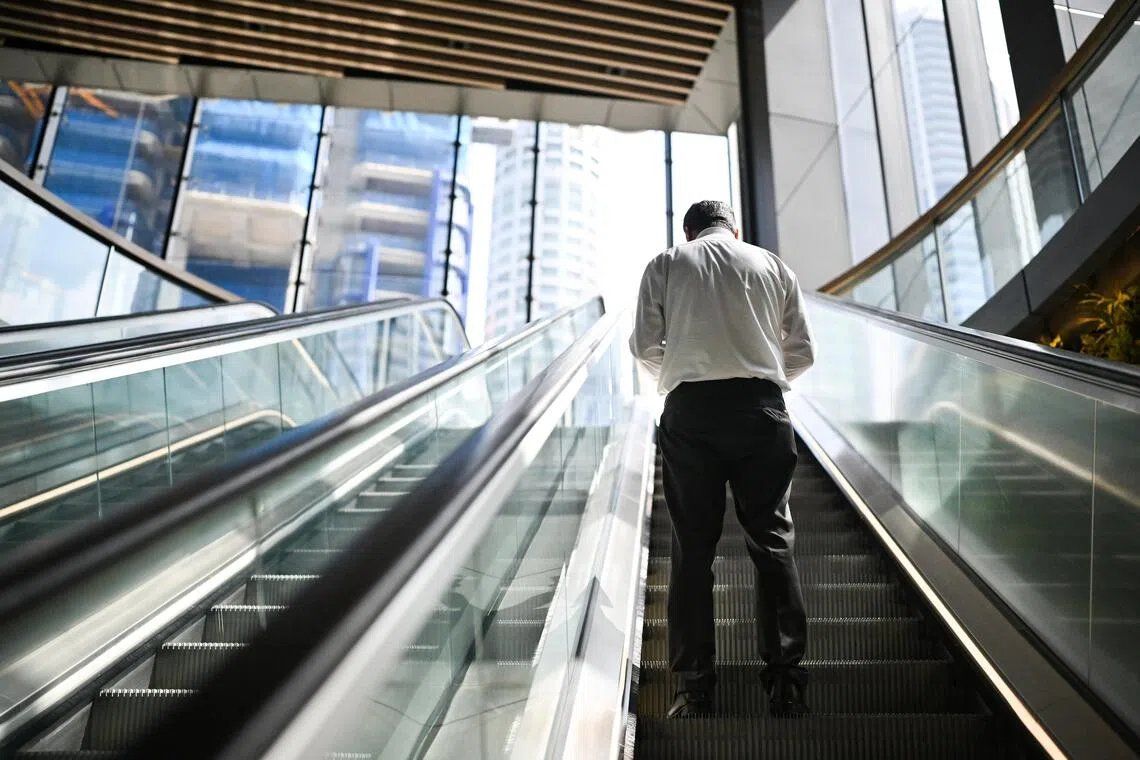
South Korea faces an unexpectedly polarizing question that has divided commuters for decades: should escalator riders stand on one side or occupy both lines? A nationwide government survey of 1,000 adults across seven major cities revealed a striking near-perfect split, with 50.1 per cent preferring to stand on a single side and leave the other open for those in a hurry, while 49.9 per cent argued that passengers should remain stationary across both available lines. This razor-thin margin has thrust what might seem like a trivial commuting habit into the realm of serious public policy debate, prompting officials to convene a major forum and reconsider decades of shifting guidance on the matter.
The intensity of disagreement became evident at a government-sponsored forum held in Seoul on August 29, where approximately 200 citizens, transport experts, and officials spent hours examining whether escalators operate more safely and efficiently when everyone stands still or when one lane remains designated for walkers. Rather than settling on a simple answer, the discussion revealed the underlying complexity of the issue. Jang Gye-ryeon, a public administration researcher at the Korea Institute of Industrial Relations, articulated the fundamental challenge: determining whose efficiency matters most and under what circumstances. The question forces South Korea to grapple with competing priorities—individual convenience versus collective capacity, personal safety versus equipment longevity, and urban design versus behavioural expectations.
The efficiency argument cuts both ways depending on perspective. For an individual rushing through a transit station, the ability to walk up or down an escalator can shave valuable seconds off travel time. However, when examining aggregate passenger throughput across an entire system, the calculus shifts dramatically. Research cited at the forum included a notable experiment conducted at a crowded British railway station, where passenger capacity increased by approximately 25 to 30 per cent when commuters occupied both sides rather than leaving one open for walkers. A smaller-scale test at Guri Station near Seoul in South Korea produced comparable results, with 190 people using the escalator during a test period when both sides were occupied, compared with only 164 when the one-side-standing practice was in effect. These findings suggest that from a systems perspective, two-line standing moves more people through congested stations. Researchers acknowledged, however, that the limited scope of their experiments warranted caution in drawing definitive conclusions applicable across all scenarios.
Safety considerations add another critical dimension to the debate, shifting focus from speed to physical risk. Sensor-based testing revealed that the biomechanical impact of walking downward on an escalator generates forces equivalent to approximately 2.01 times a person's body weight, while walking upward produces about 1.54 times body weight. According to Heo Yun-seop, a professor specializing in lift engineering at Korea Lift College, these repeated impacts from movement combined with uneven stress from one-sided standing can accumulate mechanical wear on escalator components. While he cautioned that evidence does not yet directly link one-sided standing to equipment breakdowns, the potential for accelerated wear and increased maintenance costs represents a genuine concern for urban transit operators and municipal budgets.
South Korea's own history with escalator etiquette reveals the difficulty of imposing uniform standards across a diverse population. During the late 1990s, authorities began actively promoting one-side standing as a deliberate policy, and this practice became entrenched nationwide by 2002, coinciding with the FIFA World Cup held in the country. The explicit goal was to create space for individuals in a hurry and accommodate transit demand. However, as concerns mounted regarding accident rates and equipment maintenance expenses, the government reversed course, campaigning from 2009 to 2014 to encourage two-line standing instead. This about-face left commuters confused and accustomed to conflicting messaging. Since 2015, rather than prescribing which configuration to use, officials have adopted a neutral stance, instead emphasizing three fundamental safety principles: holding the handrail, avoiding walking or running, and remaining within designated safety zones. This hands-off approach reflects official uncertainty rather than clarity, potentially contributing to the current deadlock.
Accident statistics provide an objective foundation for revisiting the issue with renewed urgency. Between 1993 and 2025, recorded escalator accidents in South Korea indicate that user behaviour accounts for 72.3 per cent of incidents, a staggering proportion that underscores how human decisions fundamentally shape safety outcomes. Furthermore, passengers aged 60 and older were involved in 53.3 per cent of all accidents, highlighting vulnerability among elderly commuters who may struggle with balance on moving escalators or face difficulty walking while the step itself moves. These demographic patterns carry particular significance for an aging South Korean society where the elderly population continues expanding. Any policy choice must account for how different age groups experience escalators, yet the one-side-standing model inherently privileges younger, more agile commuters while potentially disadvantaging seniors.
The August 29 forum demonstrated that extended deliberation can shift public opinion, albeit modestly and in unexpected directions. Before the discussion, survey participants showed stronger preference for two-line standing, with 45.9 per cent favouring this approach compared with just 13.4 per cent supporting one-side standing. After hours of expert presentations and citizen debate, support for one-side standing climbed to 29.9 per cent, while backing for two-line standing declined to 31.4 per cent. Rather than consolidating around either position, however, the largest bloc of participants—38.1 per cent—concluded that the answer depends on location, crowd density, and time of day. This outcome suggests that rigid, one-size-fits-all policies may be inappropriate and that context-sensitive approaches merit serious consideration.
The implications of South Korea's escalator dilemma extend beyond commuter convenience, touching on fundamental questions about how governments balance individual freedoms against collective welfare, how evidence guides policy when research yields ambiguous conclusions, and how urban design accommodates diverse populations with varying physical capabilities. For Malaysia and other Southeast Asian nations experiencing rapid urbanization and rising elderly populations, South Korea's wrestling with this issue offers instructive lessons. Cities across the region are expanding metro systems, shopping malls, and transit hubs where escalator usage will grow substantially. The debate also reflects broader tensions in modern cities between optimizing for individual consumer choice and ensuring equitable, safe systems that serve entire populations.
Interior Minister Yun Ho-jung announced that the government would incorporate insights from the forum into future escalator safety measures, though she did not specify whether this would mean returning to active promotion of one standard, implementing location-specific policies, or continuing neutral guidance. South Korea's experience demonstrates that even seemingly straightforward behavioural questions become contentious when evidence reveals trade-offs between competing goods, when different population groups experience consequences differently, and when decades of conflicting messaging have left the public confused and divided. The near-perfect 50-50 split in the original survey may ultimately prove most significant not as a simple measurement of current preference, but as a mirror reflecting genuine disagreement about values and priorities that resist easy resolution through expert opinion alone.

