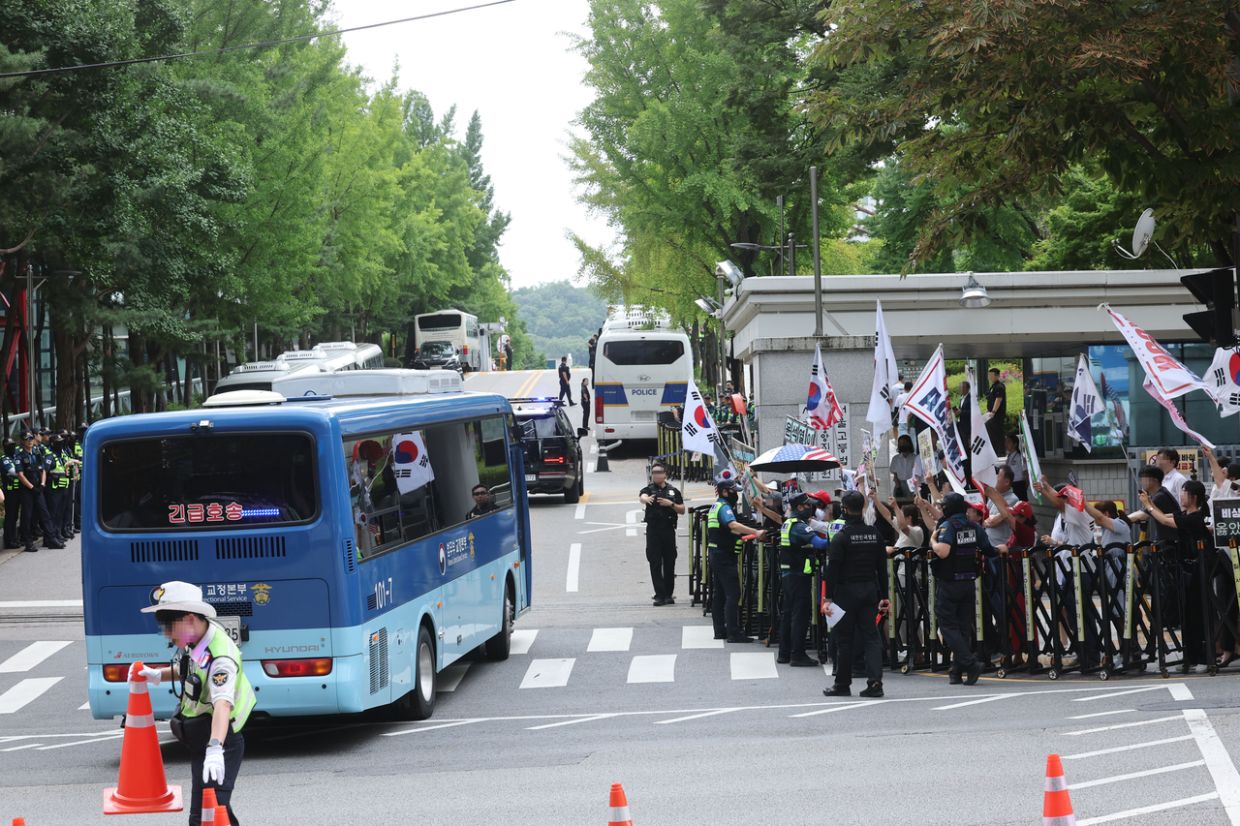
Former President Yoon Suk Yeol of South Korea received a two-year prison sentence on Monday after the Seoul Central District Court determined he had unlawfully accepted political polling services during his election campaign. The conviction marks a significant development in South Korea's ongoing struggle with campaign finance violations and political corruption at the highest levels of government. The case underscores the vulnerabilities in democratic systems even in mature democracies when safeguards designed to protect electoral integrity are circumvented by powerful political figures.
The court established that Yoon had benefited from 14 surveys worth a combined 27.92 million won provided without charge by political broker Myung Tae-kyun. This arrangement violated the Political Funds Act, which sets strict parameters for how political candidates and their campaigns may acquire goods and services. The Seoul Central District Court determined that the polling services constituted undisclosed in-kind contributions that fell outside the legal framework governing campaign financing. The value placed on these services became central to establishing the violation, as prosecutors and the court had to quantify the unlawful benefit Yoon's campaign received.
Judge Lee Jin-gwan emphasized in his ruling that opinion surveys hold tremendous power in shaping electoral outcomes. The presiding judge noted that because polls influence voter behaviour and their perceived accuracy forms a critical pillar of democratic legitimacy, any circumvention of transparency rules regarding such services strikes at the heart of fair elections. The judge articulated concern that when political actors obtain polling data through undisclosed arrangements, the resulting distortions in public perception threaten the entire electoral system. This reasoning reflects international jurisprudence recognising that electoral fairness depends on equal access to information and transparent campaign practices.
The prosecution had originally alleged that Yoon, working in coordination with his wife former first lady Kim Keon Hee, had received 58 surveys valued at over 270 million won between June 2021 and March 2022. The court's findings, however, narrowed the conviction to 14 surveys. The disparity between the prosecution's allegations and the court's findings illustrates the evidentiary challenges in such cases, where establishing the precise scope and value of illegal transactions requires meticulous documentation. Nevertheless, the conviction on 14 counts provided sufficient basis for the sentencing.
Central to the court's reasoning was the structure of the arrangement between the three parties. The judges found that Kim had authorised Myung to control when polls would be conducted, what questions would be asked, how results would be gathered, and whether findings would be made public. Yoon, the court determined, possessed knowledge of this arrangement and tacitly consented to it. This implicit agreement among Yoon, Kim, and Myung constituted a violation even without explicit discussion, according to the court's interpretation of the Political Funds Act. The decision expands understanding of how campaign finance violations can occur through silent understandings rather than overt conspiracies.
The court also identified a quid pro quo element within the arrangement. Yoon allegedly promised that former lawmaker Kim Young-sun would receive the ruling People Power Party's nomination in exchange for Myung's provision of the surveys. Following Yoon's election as president, he allegedly leveraged his influence through Chang Je-won, his then-chief of staff, to ensure the party's nomination process favoured Kim Young-sun. While prosecutors had emphasized this reciprocal arrangement, the court noted that proving the quid pro quo was unnecessary to establish a Political Funds Act violation. This legal determination means that even without demonstrating explicit exchange of favours, the undisclosed provision of valuable services constitutes a standalone crime.
Myung Tae-kyun, the political broker at the centre of the affair, received an 18-month prison sentence and was immediately remanded into custody. His more lenient sentence compared to Yoon's reflects his role as a service provider rather than as a high-ranking official. Nevertheless, his conviction confirms that brokers facilitating illegal campaign finance arrangements face serious legal consequences. The relatively short difference between Myung's and Yoon's sentences suggests the court weighted Yoon's superior position and decision-making authority heavily in determining appropriate punishment.
The conviction of Yoon stands in stark contrast to the separate proceedings against his wife Kim Keon Hee, who was acquitted at both trial and appellate levels of related Political Funds Act charges stemming from the same polling arrangements. Judge Lee explained that the circumstances in Kim's case and Yoon's case could not be regarded as identical. In Kim's case, lower courts had determined that prosecutors failed to establish she received quantifiable financial benefit from the polls or that the services were explicitly provided in return for Kim Young-sun's nomination. This divergence in outcomes for the former president and former first lady, despite their involvement in the same core transaction, highlights inconsistencies in how courts apply campaign finance standards.
The Supreme Court is scheduled to deliver its final decision in Kim Keon Hee's case on Thursday, which may clarify whether her acquittals will stand or whether higher judicial review will reverse the lower courts' findings. Should the Supreme Court overturn her acquittals, it would suggest that the standard of proof for campaign finance violations applies equally to all participants regardless of position. Alternatively, affirming her acquittals would reinforce the notion that the burden of proving financial benefit and quid pro quo arrangements differs based on individual circumstances. For Malaysian observers and Southeast Asian democracies grappling with similar campaign finance challenges, the Yoon case demonstrates both the capacity of judicial systems to hold senior officials accountable and the persistent difficulties in consistently applying electoral rules.
Yoon's imprisonment carries profound implications for South Korean politics as the nation continues to process the fallout from his tumultuous presidency. His December 2024 impeachment sparked intense political division, and his ongoing legal troubles now extend beyond impeachment to criminal conviction. The case reinforces that even presidents enjoy no immunity from campaign finance scrutiny once they leave office. For Southeast Asia, where campaign finance transparency remains inconsistently enforced across the region, the Yoon conviction offers both encouragement and caution—encouragement that courts can act against powerful figures, caution that legal systems must maintain rigorous and consistent standards to preserve public trust in democratic institutions.

