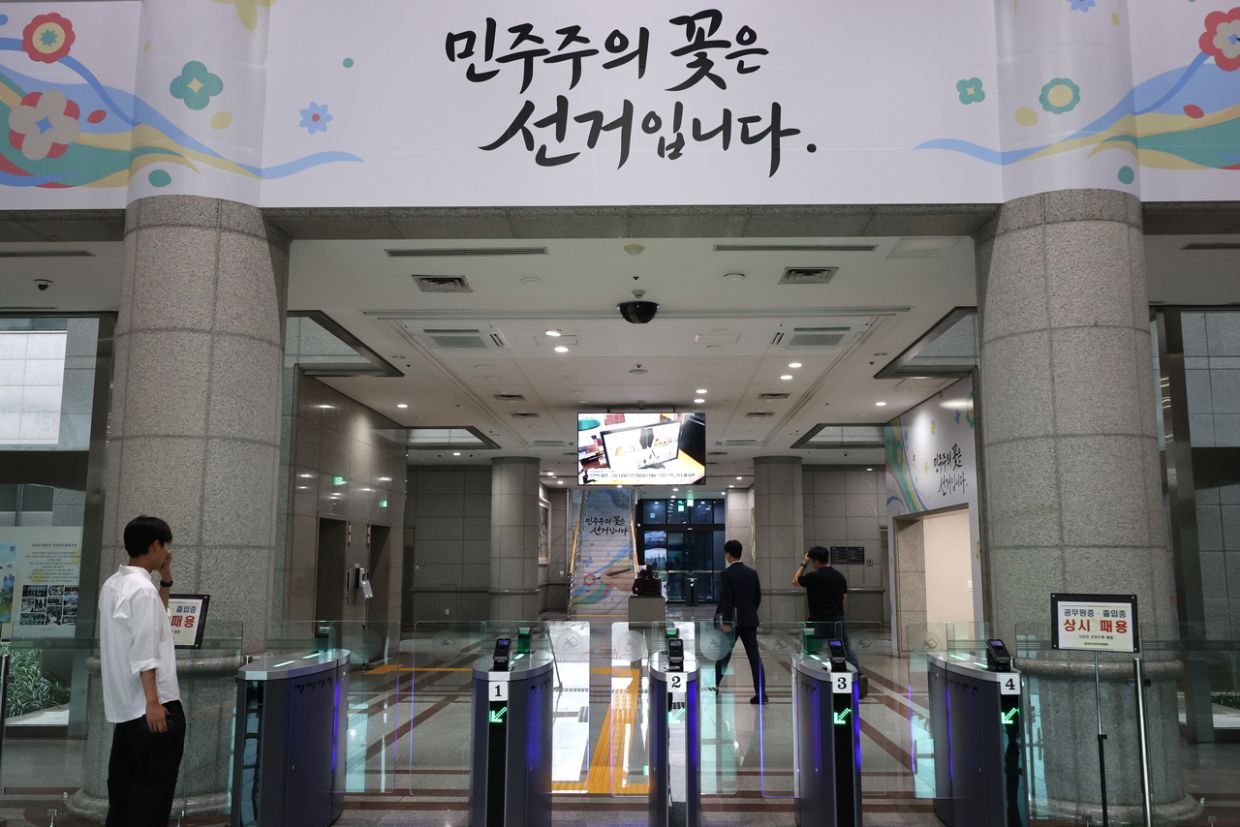
South Korean investigators descended on the National Election Commission's headquarters in Gwacheon, just outside Seoul, executing a search warrant as part of a sprawling investigation into allegations that officials deliberately altered computer records to conceal systemic failures during the nation's June 3 local elections. The joint task force, comprising prosecutors and police officers working in tandem, seized materials and documents as evidence mounted that staff members at the election watchdog had engaged in data falsification to mask errors in voter roll statistics.
The operation represents an escalation in scrutiny of an institution designed to safeguard the integrity of South Korea's democratic process. The NEC, responsible for administering elections and maintaining public confidence in electoral mechanics, now stands accused of internal malfeasance at the very moment when transparency and accountability are essential to maintaining voter trust. The timing of the raid underscores how electoral administration failures can swiftly erode institutional credibility, particularly in a society where election integrity carries profound political weight.
Election day on June 3 witnessed a significant operational crisis when multiple polling stations reported insufficient ballots for all registered voters. Citizens who arrived to cast their votes encountered queues that exhausted available paper ballots before all eligible voters could participate. Some voters ultimately left polling stations without exercising their franchise, an outcome that strikes at the heart of democratic participation. The shortages were neither isolated incidents nor minor administrative hiccups—they occurred across numerous voting locations, suggesting either systemic planning failures or negligent resource allocation by election authorities.
Legal sources familiar with the investigation have indicated that staff members within the NEC altered statistical information stored in the election commission's computer networks. Rather than transparently documenting the scale of the problem, these officials manipulated figures to downplay discrepancies between expected and actual voter numbers. Such data manipulation would represent a deliberate effort to obscure what appears to have been a preventable crisis, raising questions about whether inadequate ballot production reflected incompetence, budget constraints, or something more deliberately concealed.
For Malaysian observers, South Korea's election commission crisis offers sobering lessons about institutional vulnerability. While Southeast Asian election bodies have faced periodic criticism, the NEC case demonstrates that even supposedly insulated, professional electoral institutions operating in established democracies can experience comprehensive failures compounded by internal attempts at concealment. The willingness of staffers to manipulate data rather than escalate concerns through proper channels suggests organizational cultures where accountability mechanisms may have weakened or where political pressure influenced institutional behaviour.
The investigation's scope extends beyond simple accounting errors or statistical oversights. Prosecutors appear focused on establishing whether the data manipulation was coordinated or rogue action, whether superior officials knew of the alterations, and whether budget decisions or deliberate negligence produced the initial ballot shortage. These distinctions matter enormously for determining appropriate consequences and preventing recurrence. An institution tampering with its own records fundamentally compromises its legitimacy regardless of whether underlying failures were intentional or accidental.
South Korea's experience also highlights tension inherent in election administration across democratic systems. Election commissions occupy an awkward institutional position, simultaneously needing political support to function while maintaining independence from political interference. When commissioners or staff face pressure—whether explicit or implicit—to downplay electoral failures, institutional integrity collapses. The alleged data manipulation suggests that someone within the NEC hierarchy either authorized or tacitly accepted falsifying records, a choice that compounds the original failure rather than remedying it.
The broader implications for South Korean politics centre on whether this scandal will trigger structural reforms in election administration. Mere personnel discipline without institutional overhaul risks leaving underlying vulnerabilities intact. Voter confidence, once damaged, requires not just investigation and punishment of wrongdoers but demonstrable systemic improvements. This includes adequate ballot production planning, transparent contingency protocols when shortages occur, and accountability mechanisms preventing cover-ups.
Regionally, the case serves as a cautionary reminder that election integrity depends ultimately on institutional cultures that prioritize transparency and accountability over self-protection. Democratic systems worldwide have discovered that electoral bodies require not just formal independence but strong internal ethical frameworks, adequate whistleblower protections, and clear reporting obligations when problems emerge. South Korea's NEC now faces the challenging task of restoring public confidence following investigations that have exposed internal failures and apparent dishonesty among its own staff.
For Malaysian stakeholders observing this unfolding situation, the Korean case underscores importance of investing in election administration infrastructure before crises occur. Ballot production, voter registration management, and polling station logistics demand adequate resources, contingency planning, and personnel trained to prioritize procedural integrity over concealment. The ultimate test of any election commission's legitimacy lies not in performing flawlessly but in responding honestly when performance inevitably falls short.

