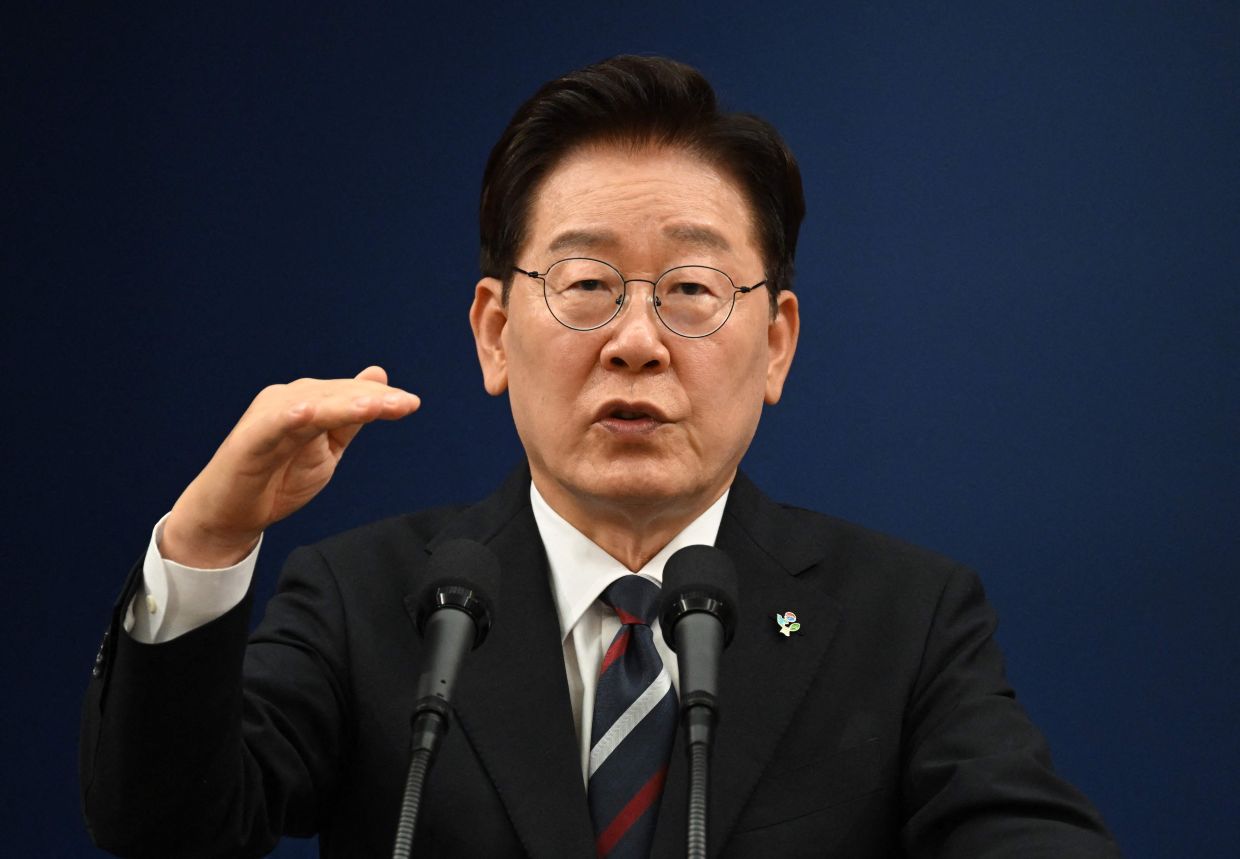
South Korean President Lee Jae Myung faces a significant political setback as his approval rating has slumped below the 50 per cent threshold for the first time since assuming office on June 4, 2025. According to a nationwide poll by respected local research firm Realmeter released on June 22, only 46.7 per cent of respondents now view his presidency favourably, representing a decline of 4.8 percentage points in a single week. The crossover into negative territory—where disapproval reached 49.7 per cent—signals a critical juncture for a newly elected leader and suggests that early honeymoon support has evaporated far more rapidly than historical precedent would predict.
The trajectory of Lee's approval ratings reveals an accelerating descent rather than gradual erosion. In early May, his administration commanded the support of roughly 60.5 per cent of South Koreans, a solid foundation for any new president. Within the span of six weeks, that cushion deteriorated markedly, passing through 59.3 per cent and 59.1 per cent before dropping to 55.2 per cent and finally collapsing to the current level. This dramatic slide distinguishes Lee's early tenure from those of his recent predecessors, though not necessarily in his favour. Former President Yoon Suk Yeol experienced a similar disapproval crossover, but it took him six weeks rather than Lee's five consecutive weeks of decline. Park Geun-hye and Moon Jae-in saw their approval ratings surpassed by negative assessments only after 16 and 19 months respectively, making Lee's predicament exceptional in its swiftness.
The primary culprit behind the approval collapse centres on the bungled administration of South Korea's June 3 local elections, an event that exposed significant systemic vulnerabilities in electoral management. Ballot shortages in certain voting districts created chaos and undermined public confidence in the fundamental mechanics of democratic participation. Rather than a single discrete failure, however, the election fiasco has metastasized into broader questions about governmental competence and administrative oversight. This resonates particularly in a country where elections carry profound symbolic weight as expressions of democratic will, and where mismanagement strikes at the legitimacy of the electoral process itself. Realmeter analysts attributed the collapse to "growing demands for accountability following the election management fiasco," indicating that the public expects not merely acknowledgment but substantive response to systemic breakdowns.
Compounding the electoral crisis is turmoil within Lee's own Democratic Party of Korea, which faces an internal leadership struggle ahead of an August 17 convention to select a new party chair. Factional tensions have spilled into public view, with various factions advancing competing visions for the party's direction and demanding accountability from senior figures. These internal divisions erode the appearance of unified governance and suggest that Lee cannot command full loyalty even within his own political base. The conjunction of external administrative failure and internal party fragmentation creates a particularly toxic environment for maintaining public confidence. Rather than presenting a coherent government capable of navigating challenges, Lee's administration appears buffeted by forces beyond its control—a perception death to any new presidency.
Geographic analysis of the poll data reveals a troubling pattern of support collapse across previously reliable constituencies. In conservative strongholds such as Daegu and North Gyeongsang Province, Lee's approval plummeted 9.9 percentage points to just 34.6 per cent, suggesting that traditional conservative voters feel abandoned or betrayed by his handling of the election crisis. The Greater Seoul metropolitan area, encompassing Incheon, Gyeonggi Province, and Seoul itself, shows similar deterioration, with approval ratings dropping 7.6 percentage points in each satellite region. This metropolitan decline is particularly significant, as these densely populated areas contain swing voters and moderates whose support is essential for any president seeking to transcend narrow factional backing. The fact that approval in Seoul stands at only 39.8 per cent—roughly 7 percentage points below the national average—suggests deepening urban alienation from Lee's administration.
Demographic fissures likewise undermine Lee's political foundation. Among moderate voters, who often determine election outcomes in pluralistic systems, approval fell 4.9 percentage points to 47.5 per cent. This erosion among centrists is particularly consequential, as moderates tend to swing based on competence assessments rather than partisan loyalty. Support among liberals, typically the Democratic Party's core constituency, declined 3.2 percentage points to 80.4 per cent, indicating that even the party's ideological base is losing enthusiasm. Only among conservatives did approval remain relatively stable, dropping a mere 0.7 percentage point to 19.8 per cent—but from such a low baseline that stability offers little comfort. These ideological rifts suggest that Lee's problems transcend partisan boundaries and reflect genuine public concern about governmental effectiveness.
Realmeter identified asset market disparities as an additional factor eroding support among moderate voters and Seoul metropolitan residents. Rising inequality in real estate and financial markets, a perennial concern in South Korea's development-driven economy, appears to be crystallizing into political discontent. While Lee's European trip reportedly received positive coverage and the benchmark Kospi index broke through the 9,000-point milestone—traditional markers of economic optimism—these positive factors have proven insufficient to offset ballot shortages and party infighting. The gap between market indices and lived experience of ordinary households, particularly among those concerned about housing affordability and intergenerational economic mobility, creates cognitive dissonance that undermines confidence in official narratives of economic success.
The survey's methodology involved 2,517 voters aged 18 and above across the nation between June 15 and 19, employing automated response systems designed to minimize interviewer bias. A separate poll among 1,001 voters conducted on June 18 and 19 examined party preference dynamics, revealing that while the conservative People Power Party maintained a narrow lead over the Democratic Party at 42.3 per cent versus 40.1 per cent, this gap has narrowed substantially. The Democratic Party gained 2.1 percentage points week-over-week while the People Power Party lost 2 percentage points, suggesting that the electoral mismanagement crisis, while formally a Democratic Party matter, has created broader institutional damage to public faith in governance across party lines.
Younger voters show particular disillusionment, with the People Power Party's approval among those in their twenties plummeting 10.5 percentage points to 48.6 per cent and among those in their thirties declining 5.1 percentage points to 47.4 per cent. This generational exodus reflects a pattern common across developed democracies where younger cohorts punish incumbent parties for perceived failures of governance and economic opportunity. South Korea's aging demographic structure means that continued alienation of voters in their twenties and thirties could create enduring structural challenges for conservative politics. The Democratic Party, by contrast, appears to have stabilized its base through an emphasis on party unity and cooperation with the government on electoral reform investigations, suggesting that crisis management through institutional mechanisms can provide some political shelter.
The presidential office issued a measured statement acknowledging the poll results "humbly" and pledging greater attention to public concerns and expectations. Cheong Wa Dae framed the approval decline as reflecting public assessment of "both economic conditions and the overall conduct of state affairs," a formulation that accepts the judgment without admitting specific administrative failure. This defensive posture suggests internal recognition that the crisis requires substantive response rather than mere public relations adjustment. The administration's challenge lies in translating rhetorical humility into concrete actions that address both the electoral management fiasco and the party infighting that continue to dominate political coverage.
For regional observers, particularly Malaysian policymakers concerned with governance standards and democratic institutions, South Korea's experience offers cautionary lessons about the speed with which public confidence can erode when fundamental administrative systems fail. The ballot shortage crisis, though specific to South Korea's electoral context, exemplifies how technical failures in state capacity can rapidly delegitimize even newly elected governments. In Southeast Asian contexts where electoral integrity remains contested in some jurisdictions and where factional politics within ruling parties often surfaces, Lee's predicament demonstrates that even wealthy democracies with strong institutions must vigilantly maintain the technical and organizational infrastructure that sustains public faith in democratic processes. The subsequent weeks will reveal whether Lee can arrest the decline through policy action or whether the approval trajectory continues its downward arc.