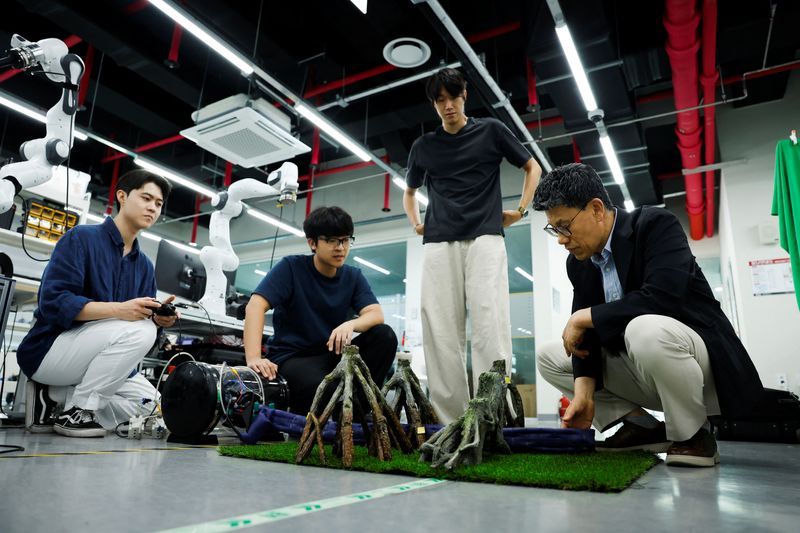
Scientists collaborating between South Korea's KAIST university and Stanford University have demonstrated a breakthrough in wearable robotics: clothing equipped with artificial vines that can autonomously dress the wearer without requiring hands or external help. The innovation, unveiled in Daejeon, promises significant practical applications across healthcare, manufacturing, and emergency response sectors where rapid, independent dressing proves critical.
At the heart of this technology lies a deceptively simple yet elegant mechanism. Soft, flexible structures resembling climbing vines are embedded throughout garments and activated by compressed air pressure. When pressurised, these pneumatic appendages guide fabric across the wearer's body in a climbing motion, much like actual ivy ascending a wall, gradually enveloping the person in protective clothing. The process requires approximately ten seconds to fully suit someone in complete protective gear, a dramatic improvement over traditional manual dressing methods.
Kim Nam Gyun, the lead researcher and postdoctoral fellow at KAIST, conceived the concept during an everyday experience. While cycling in unexpected rainfall, he recognised the inconvenience of stopping to don protective clothing, sparking the question: could garments equip themselves? This observation catalysed years of engineering work that ultimately produced a system capable of independent operation even as the wearer moves.
The mechanical sophistication distinguishing this approach from previous attempts lies in its elegant simplicity. Rather than employing complex computational algorithms or requiring wearers to remain stationary during dressing, the robotic vines function through biomimetic design inspired by natural climbing plants. The system works by progressively inverting clothing as it moves upward along the body's contours, maintaining stability on curved surfaces regardless of wearer movement. This represents a significant departure from robotics approaches that typically demand precise environmental control and minimal variation.
Professor Ryu Jee-Hwan of KAIST's civil and environmental engineering department explains the core innovation underlying the design. The vine robot advances by extending from its tip rather than displacing its entire body, enabling stable navigation along complex curved topographies. This growth-like mechanism permits the system to navigate narrow spaces, adapt to environmental variations, and function effectively across different surface conditions—whether slippery, adhesive, or inclined—without requiring environmental modification or specialised calibration.
The immediate practical applications extend well beyond novelty demonstrations. For elderly populations and individuals with physical disabilities, the technology eliminates dependence on caregivers for basic dressing tasks, thereby enhancing dignity and independence. However, the developers envision more specialised deployments that justify significant investment in this technology. Semiconductor manufacturing cleanrooms represent one critical application area, where contamination prevention demands rapid donning of protective suits while maintaining sterile protocols. Emergency first responders similarly require expeditious protective equipment deployment without fumbling or external assistance, particularly in hazardous environments where traditional dressing methods prove impractical.
Within the Southeast Asian context, rapid industrialisation has expanded semiconductor manufacturing and related high-tech sectors significantly. Countries including Malaysia, which hosts major semiconductor fabrication and assembly operations, would particularly benefit from technologies streamlining cleanroom protocols. Enhanced efficiency in protective equipment deployment directly translates to increased productivity, reduced contamination incidents, and improved worker safety—compelling factors for regional technology adoption.
Ryu's broader observation about technological development trajectories carries strategic significance. Amid widespread fascination with artificial intelligence and software innovations, mechanical engineering contributions often receive insufficient attention and investment. This robotic dressing system exemplifies how mechanical design principles, informed by natural biomechanics, can achieve sophisticated functionality without requiring elaborate computational systems. Such balance between mechanical and digital innovation reflects mature technological thinking increasingly necessary as sectors seek reliable, efficient solutions without over-dependence on software complexity.
The research methodology and findings underwent rigorous peer review before publication in IEEE Robotics and Automation Letters, establishing credibility within the scientific community and suggesting the technology has surpassed preliminary conceptual phases. This formal validation indicates the system represents genuine engineering advancement rather than speculative prototype work, encouraging serious consideration from industry stakeholders evaluating protective equipment innovations.
The collaborative framework between South Korean and American researchers reflects broader patterns of international scientific cooperation on robotics development. KAIST's strength in mechanical innovation complemented Stanford's expertise in applied robotics research, producing outcomes exceeding what either institution might achieve independently. Such partnerships increasingly characterise cutting-edge technology development, particularly within East and Southeast Asia where regional collaboration increasingly supplements Western-centric research networks.
Looking forward, commercialisation pathways remain uncertain but encouraging. Semiconductor manufacturers, hospital systems managing patient mobility, and emergency services organisations represent potential early adopters. The technology's scalability across different garment types and body dimensions requires further investigation, but the fundamental principles appear transferable. Malaysian firms engaged in semiconductor assembly, healthcare provision, or emergency response infrastructure would logically monitor this technology's development trajectory closely, as near-term accessibility appears realistic within existing manufacturing and supply chain frameworks.

