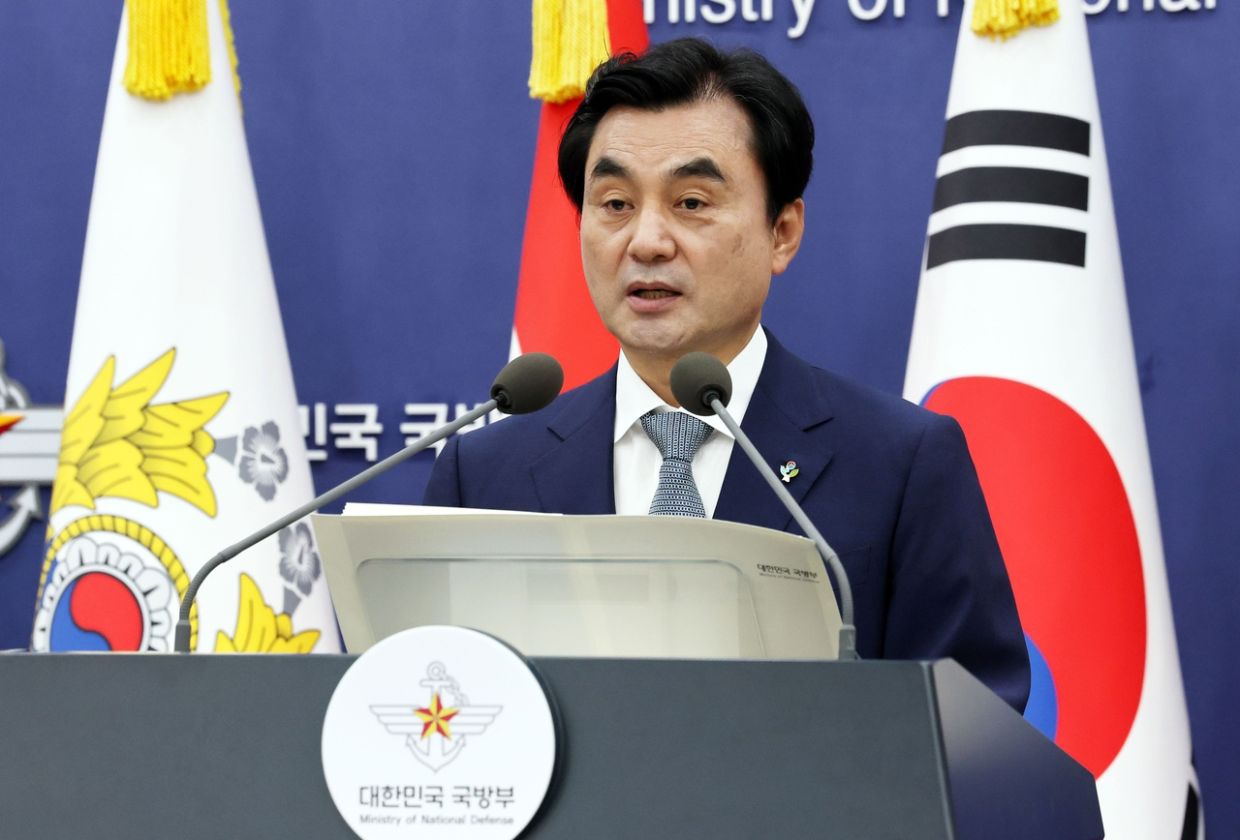
South Korea is embarking on a comprehensive transformation of its unmanned aerial systems, committing to procure more than 20,000 low-cost drones while expediting the deployment of its domestically developed K-Lucas loitering munitions. Defence Minister Ahn Gyu-back announced the sweeping initiative on Friday, describing it as a fundamental shift in how Seoul approaches modern warfare in an era increasingly defined by budget-friendly drone technology and autonomous systems.
The strategic pivot reflects global military developments witnessed over recent years, particularly the prominent role unmanned systems have played in the Russia-Ukraine conflict and recent confrontations in the Middle East. These real-world applications have demonstrated that technological sophistication alone no longer guarantees military advantage when adversaries can deploy large numbers of inexpensive, expendable drones to overwhelm traditional defences. For Seoul, the implications are particularly acute given North Korea's demonstrated interest in expanding its own uncrewed aerial capabilities, which threaten not only military installations but also critical civilian infrastructure across the peninsula.
The K-Lucas programme represents a key pillar of this modernisation effort. Described as a Korean-style long-range loitering munition, the system is intended to deliver strategic strike capabilities during future conflicts. By prioritising this domestically developed platform, Seoul signals its commitment to reducing reliance on foreign defence technologies whilst simultaneously building indigenous defence industries. The acceleration of K-Lucas deployment timelines indicates that military planners view these capabilities as increasingly urgent rather than merely aspirational.
Beyond loitering munitions, the procurement strategy encompasses diverse categories of expendable unmanned platforms. Short-range reconnaissance drones will provide battlefield intelligence, whilst small loitering munitions will serve as distributed strike assets. The target of acquiring over 20,000 such systems by 2030 underscores the scale of this transformation—a timeframe suggesting Seoul expects operational requirements for these capabilities to intensify within the coming years. Frontline areas adjacent to the inter-Korean border will see the earliest deployment of counter-drone systems and small aircraft defence apparatus starting next year.
The ministry's vision extends far beyond current hardware. Deputy Minister for National Defence Policy Kim Hong-cheol articulated the fundamental challenge driving this shift: traditional military procurement processes, designed for lengthy evaluation and certification cycles, cannot accommodate the breakneck pace of drone technology advancement. To address this constraint, the Defence Ministry intends to pursue legislative reforms that would permit commercially available systems to undergo military testing and accelerated fielding through streamlined certification procedures. This approach could significantly compress the lag between technological innovation and operational deployment.
Directed-energy weapons feature prominently in Seoul's longer-term planning. Laser systems and high-power microwave installations represent the next generation of counter-drone defences, offering capabilities fundamentally distinct from kinetic interceptors. Concurrently, low-cost interceptor drones will form part of a layered defence architecture, enabling Seoul to counter inexpensive drone threats without expending expensive conventional air-defence systems. This multi-layered approach acknowledges economic realities—matching expensive systems against expendable threats creates unsustainable cost ratios that no military budget can sustain indefinitely.
A particularly ambitious aspect of the strategy involves developing artificial intelligence-powered drone swarms, technology that promises to multiply operational effectiveness by enabling large formations of unmanned systems to coordinate autonomously. Such capabilities would represent a fundamental escalation in unmanned warfare, potentially enabling smaller military forces to generate disproportionate combat power through algorithmic coordination and distributed decision-making.
The Defence Ministry's human capital investment parallels its hardware modernisation. The military aims to train 500,000 personnel as drone operators, conceptualising unmanned systems as a second personal weapon equivalent to firearms for individual service members. This democratisation of drone capabilities across the entire force would represent an unprecedented expansion of operational reach, though it simultaneously poses significant challenges regarding training quality, doctrine development, and rules of engagement.
Organisational restructuring accompanies this strategic reorientation. The existing Drone Operations Command will transform into the National Defence Drone Headquarters, fundamentally shifting from operational execution to policy and capability development roles. Operational planning and command authority will devolve to the Army, Navy, Air Force and Marine Corps, permitting each service branch to develop doctrine and tactics suited to its specific mission sets. The Army might emphasise ground support and reconnaissance, whilst the Navy could prioritise anti-ship and maritime surveillance applications. This decentralisation represents a deliberate move away from centralised drone command structures toward service-specific integration.
This reorganisation resolves months of institutional controversy. The previous Drone Operations Command faced scrutiny following allegations that personnel conducted drone incursions into North Korean airspace in October 2024, purportedly as part of efforts to manufacture justifications for martial law declaration in December 2024. Investigations also revealed allegations of evidence destruction, including deletion of flight logs and disposal of equipment. Rather than disband the organisation entirely, military leadership determined that drones' escalating importance in modern warfare necessitated retaining a central coordinating body, albeit stripped of operational authority.
For Southeast Asian observers, South Korea's rapid militarisation of unmanned systems carries significant regional implications. As a leading defence technology manufacturer with substantial export orientation, Seoul's innovations typically proliferate throughout the Indo-Pacific within years. The K-Lucas programme and mass-production approaches for low-cost drones could influence procurement decisions across the region, potentially accelerating the adoption of autonomous systems among regional militaries. Additionally, the successful integration of drone swarms and directed-energy weapons could establish technological benchmarks that neighbouring militaries view as necessary to maintain strategic parity.
The broader geopolitical context matters considerably. North Korea's parallel expansion of unmanned capabilities suggests an asymmetrical arms race unfolding on the peninsula, with both sides racing to deploy systems faster than adversaries can develop countermeasures. South Korea's acceleration of timelines reflects assessments that security challenges are intensifying rather than stabilising. The simultaneous pursuit of legislative reforms to expedite procurement suggests military planners believe bureaucratic constraints represent the primary obstacle to matching identified threats.
President Lee Jae Myung's scheduled meeting on fostering security innovation companies complements this defence modernisation agenda, signalling that Seoul views the upcoming decade as pivotal for establishing industrial dominance in drone and autonomous systems manufacturing. Investment in domestic capabilities promises both military advantages and economic dividends, positioning South Korean companies to compete globally in the rapidly expanding unmanned systems market.

