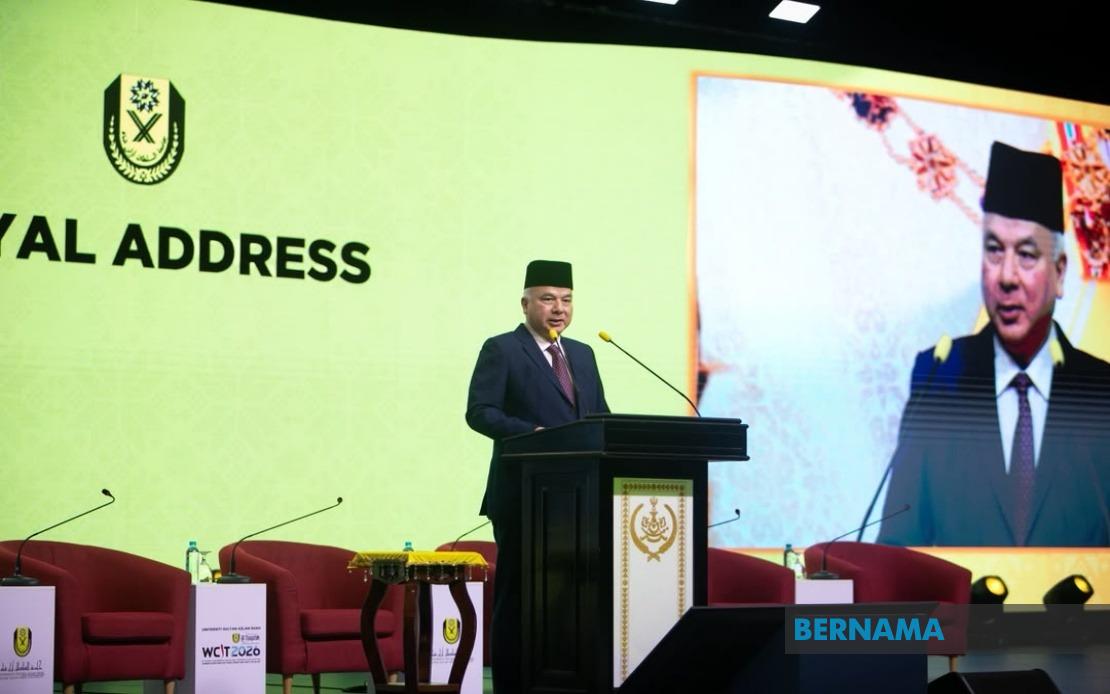
At the 8th World Conference on Islamic Thought and Civilisation in Ipoh, Sultan Nazrin Shah of Perak articulated a vision of national security that extends far beyond conventional defence mechanisms. While acknowledging that border protection, cybersecurity, and counter-extremism efforts remain necessary components of statecraft, the Sultan contended that the most enduring safeguard against instability is the fabric of social cohesion woven through shared belonging among all citizens. This framing represents a deliberate inversion of traditional security hierarchies that prioritise military capacity and technological advantage, placing instead the psychological and social contract at the foundation of national resilience.
The Sultan's intervention comes at a moment when Malaysia, like much of the Muslim-majority world, faces mounting pressures to fragment along religious and ethnic lines. His Royal Highness explicitly warned against the cynical exploitation of faith narratives for narrow political advantage, condemning the manipulation of religious sentiment to justify division and exclusion rather than the inclusive vision that Islamic teachings fundamentally espouse. This critique carries particular weight in the Malaysian context, where periodic communal tensions and political rhetoric invoking religious identity have tested social stability. By positioning such manipulation as incompatible with genuine Islamic principles, Sultan Nazrin provides religious and moral authority to counter-narratives that resist polarisation.
The philosophical core of Sultan Nazrin's argument rests on a distinction between security achieved through coercion and security rooted in authentic participation. He emphasised that national integrity cannot be separated from genuine security; a state may fortify itself against external enemies whilst collapsing from internal injustice and corruption. This inversion of conventional threat assessment suggests that the greatest danger to Malaysia's stability is not necessarily foreign military power but rather the erosion of institutional legitimacy and the withdrawal of consent among communities that feel excluded from economic opportunity, political voice, or fair representation in law. Such conditions create the psychological ground in which extremism, organised crime, and social fragmentation take root.
Central to Sultan Nazrin's thesis is the concept of genuine stakes in national success. For citizens to regard themselves as having an authentic share in their country's future, they must perceive themselves reflected fairly across multiple dimensions: in the legal frameworks that govern them, in the economic structures that generate opportunity, in educational institutions that shape aspirations, and in the leadership compositions that make decisions. Uniformity imposed through suppression does not create this sense of belonging; rather, it breeds resentment and alienation. The Sultan's framework suggests that Malaysia's stability depends less on perfect agreement than on a confident belief among all major communities that the system operates with fundamental fairness and that dissent can be expressed without existential threat to one's position or identity.
Sultan Nazrin also addressed the related challenge of human capital development in an era of accelerating technological disruption. He argued that investment in education must be comprehensive and intellectually ambitious, encompassing not only scientific and mathematical prowess but equal attention to the humanities, arts, and moral reasoning. This holistic approach reflects concern that narrow, vocational education produces workers adapted only to immediate labour market demands and vulnerable to obsolescence as automation reshapes employment patterns. The Sultan underscored that technical and vocational pathways deserve parity of esteem with academic trajectories, a principle that Malaysian policymakers have rhetorically endorsed but often failed to implement with equivalent resource allocation.
A particularly incisive dimension of the Sultan's address concerns the mismatch between educational methods developed for industrial economies and the cognitive demands of an artificial intelligence-driven era. He contended that rote memorisation and standardised testing, which served reasonably well when information was scarce and gatekept, are poorly adapted to a world where knowledge retrieval is instantaneous and nearly costless. What distinguishes human capability in such an environment is precisely what machines cannot replicate: critical thinking, ethical reasoning, creative problem-solving, and adaptive capacity. These capacities, the Sultan suggested, align naturally with authentic Islamic education that integrates both revealed knowledge and rational inquiry, avoiding false dichotomies between faith and reason.
For Malaysia specifically, Sultan Nazrin's emphasis on inclusive social cohesion carries profound implications for governance and interethnic relations. The country's constitutional framework rests on explicit pluralism: the recognition of Islam's special position coexists with guarantees of religious freedom and minority rights. Yet this delicate architecture faces persistent strain from political actors who frame zero-sum competition as inevitable and who leverage identity grievances instrumentally. By elevating social cohesion to primary importance, Sultan Nazrin implicitly reframes the political conversation away from competitive assertion of group claims and toward the construction of mutual interest and shared institutional legitimacy. This represents a sophisticated counter-narrative to identity politics that respects religious distinctiveness whilst rejecting its weaponisation.
The Sultan's warning against exploitation of religious sentiment for political ends also addresses a regional concern across Southeast Asia and the broader Muslim world. In an environment where extremist narratives proliferate across digital platforms and where political entrepreneurs routinely invoke religious authenticity to mobilise support, the explicit articulation that such manipulation contradicts genuine Islamic principles carries significance. By positioning inclusive belonging and equal citizenship as Islamic imperatives rather than as secular liberal principles imposed against religious resistance, Sultan Nazrin reframes the relationship between religious identity and pluralistic citizenship.
The presence of senior government figures, including Deputy Prime Minister Datuk Seri Fadillah Yusof, Perak Menteri Besar Datuk Seri Saarani Mohamad, and Higher Education Minister Datuk Seri Dr Zambry Abd Kadir, suggests that the Sultan's address reflects deliberate policy direction rather than merely personal reflection. The attendance of the Deputy Prime Minister and ministers responsible for both state-level governance and higher education signals institutional alignment with the vision of social cohesion as a primary security concern and education as foundational to national resilience.
The timing of these remarks at an international conference on Islamic thought also positions Malaysia as articulating a moderate, inclusive interpretation of Islamic principles in global forums where narratives of civilisational conflict and religious incompatibility with pluralism remain influential. By demonstrating that respected Islamic institutional actors advance visions of diversity, equal citizenship, and shared belonging as consistent with authentic faith, Sultan Nazrin contributes to intellectual resources available to policymakers and educators across Muslim-majority societies navigating similar challenges.
Moving forward, the principal test of Sultan Nazrin's framework lies in implementation. The intellectual case for prioritising social cohesion over security apparatus is compelling, but translating this into institutional practice demands sustained commitment across multiple policy domains: education curricula and resource allocation, economic policies that ensure meaningful opportunity for marginalised communities, legal reforms that enhance perceptions of fairness, and leadership messaging that consistently reinforces inclusive belonging. The Sultan's address provides a normative foundation and moral authority for such efforts, yet their success ultimately depends on political will and technical capacity across government, civil society, and the private sector.

