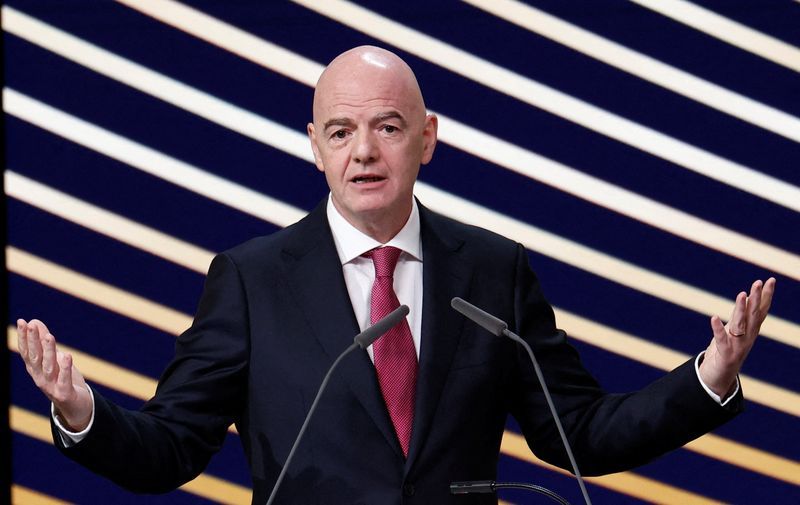
The political ground beneath FIFA President Gianni Infantino is shifting rapidly. After a decade steering the world's largest sporting body, he now faces perhaps his gravest challenge—one that reveals the peculiar arithmetic of international soccer governance. While major European and North American federations have turned against him, Infantino's path to political survival may ultimately run through smaller nations that have never qualified for a World Cup and depend almost entirely on FIFA's financial lifeline to sustain their football programmes.
The crisis erupted following Infantino's ill-fated proposal to introduce private equity partners into World Cup ownership, a move that triggered swift and harsh reactions from soccer's traditional establishment. In August 2024, the European confederation UEFA and the confederation covering North and Central America and the Caribbean, CONCACAF, both declared they had lost confidence in Infantino's leadership. Wales became the first national federation to formally withdraw its backing, signalling that even smaller European nations were abandoning the FIFA chief. UEFA subsequently indicated it was preparing potential legal action against Infantino regarding the proposal itself.
Yet the mechanics of FIFA's voting structure create an asymmetry that may work in the incumbent's favour. All 211 member associations possess equal voting power regardless of their economic or sporting clout. This means that while France, Spain, and England each cast one vote apiece, so do Bhutan, Vanuatu, and dozens of other emerging footballing nations. To trigger an extraordinary congress capable of removing Infantino before his scheduled 2025 election, opponents would need to secure written requests from at least 20 per cent of FIFA's membership—more than 42 associations. Such a congress would then need to happen within three months of that request being filed. Even if those thresholds were cleared, removing Infantino would require mustering a majority among all 211 members, a task that becomes exponentially harder when many voting nations depend on FIFA's patronage.
The financial architecture underpinning this dependency is substantial and deliberate. Throughout the current 2023-26 World Cup cycle, FIFA members have been able to claim up to $3 million each for soccer development projects—an increase of $1 million compared to the previous four-year period. For wealthy nations with established professional leagues and private investment in football, such sums represent marginal funding. But for smaller nations operating with skeletal football budgets, these grants constitute the primary lifeline keeping their sport afloat. Training facilities, coaching programmes, stadium construction, and even basic infrastructure for youth development often depend entirely on these FIFA allocations.
Vanuatu exemplifies how this system operates in practice. The South Pacific island nation, home to approximately 340,000 people and ranked 160th globally in FIFA standings, received a $4.15 million development grant from FIFA to construct a 6,500-seat stadium in the capital Port Vila, completed in 2022. Beyond the infrastructure investment, Infantino elevated Vanuatu's football association head, Lambert Maltock, to one of eight vice-presidential positions on FIFA's Executive Council—granting a representative from a tiny nation a seat at soccer's highest governing table. Brian Kaltak, Vanuatu's first professional player currently competing for Perth Glory in Australia's A-League, credited Infantino with transforming opportunities for developing nations, describing the FIFA president as someone who "gave a chance for our president to be part of FIFA" and worked systematically to grow the game across the Global South.
This pattern replicates across Africa, Asia, the Caribbean, and the Pacific archipelago. FIFA grants have financed pitches and gymnasia, funded coaching education programmes, and enabled national associations to participate meaningfully in international competitions. Without such resources, many smaller nations would struggle to field competitive teams or maintain functional football administrations. The funding model has created a constituency of nations with genuine material interest in Infantino's continued leadership—not because they endorse his policies in the abstract, but because his administration has delivered tangible investment their football systems urgently require.
The irony is transparent to observers of FIFA politics. The same funding mechanism that Infantino's critics argue reinforces an unhealthy system in which FIFA trades financial power for political loyalty may simultaneously be his most reliable defence against removal. Building the broad coalition necessary to unseat an incumbent requires converting nations that benefit from his patronage, a difficult proposition when those nations' football development depends on continued FIFA generosity. This creates a structural advantage for the sitting president that transcends personality or political philosophy.
The private equity proposal itself, whatever its merits as a business strategy, exposed a fundamental tension within FIFA's governance. Infantino had apparently envisioned using private sector capital to expand World Cup tournaments and generate additional revenue. But major confederations viewed this as both a governance violation and a threat to the tournament's integrity. Yet the very confederations making these arguments represent wealthy nations with established football infrastructure. To smaller nations, the proposal may have appeared less threatening and potentially even advantageous if new investment created additional tournament spots or development opportunities.
Infantino confirmed in April 2024 his intention to seek a fourth term at next year's FIFA Congress, seemingly confident despite the mounting pressure. Whether that confidence proves justified depends less on appeasing Barcelona, Manchester United, or the English Premier League than on retaining support from federations in Port Vila, across the Pacific Islands, in smaller African nations, and among emerging football powers still building their sporting infrastructure. The established soccer aristocracy may view this arrangement as everything wrong with FIFA governance. But from the perspective of nations like Vanuatu, where FIFA grants enabled stadium construction that would otherwise have been impossible, Infantino's patronage system represents genuine opportunity.
What emerges from this crisis is a sobering reality about international sports governance: voting structures designed to guarantee equality can inadvertently entrench power when that equality intersects with vast disparities in economic capacity. Whether Infantino ultimately survives will likely be determined not in the boardrooms of European football, but in calculation of which smaller nations can afford to sacrifice FIFA's development support in pursuit of a change of leadership. And that arithmetic, at present, appears to favour the embattled FIFA president.

