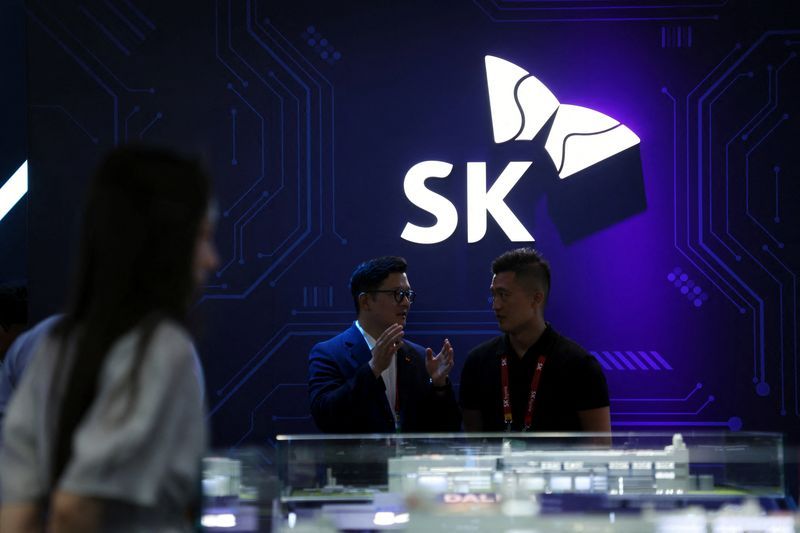
South Korea's SK Hynix unveiled an ambitious capital-raising strategy on Wednesday, announcing plans to float American Depositary Receipts on the Nasdaq exchange valued at up to 45.45 trillion won—approximately $29.43 billion—in what would represent the largest ADR offering in history. The move underscores the chipmaker's aggressive expansion plans at a moment when global demand for artificial intelligence processing capacity has created unprecedented opportunities for memory semiconductor manufacturers.
The secondary listing, scheduled for July 10, will involve the issuance of 17.79 million new shares, with the conversion ratio set at ten ADRs equalling one common share. SK Hynix emphasized that the final amount could shift following the bookbuilding process, a standard feature of equity offerings where lead managers gauge investor appetite and adjust pricing accordingly. This flexibility reflects market realities, though the company's confidence in securing substantial proceeds appears evident from the scale of its ambitions.
The capital injection will directly support SK Hynix's most critical growth initiatives. The company plans to construct a new chip manufacturing facility in Yongin, establish an advanced packaging fabrication plant in Cheongju, and acquire sophisticated production equipment including Extreme Ultraviolet Scanner technology—machinery essential for producing the cutting-edge semiconductors demanded by the artificial intelligence sector. These infrastructure investments position SK Hynix to dramatically increase its production capacity for high-bandwidth memory chips, a product category experiencing explosive growth as AI developers worldwide race to build more powerful systems.
The transaction represents a watershed moment for South Korean industry. If completed at the maximum indicated valuation, SK Hynix's ADR offering would eclipse the previous record established by Chinese e-commerce behemoth Alibaba, which raised $21.8 billion during its New York debut in 2014. This distinction carries symbolic weight beyond mere financial metrics, demonstrating the technological prowess and market confidence surrounding South Korea's semiconductor sector even as geopolitical tensions and trade uncertainties cloud the broader global economic landscape.
SK Hynix's emergence as a formidable player in the artificial intelligence supply chain has transformed its market standing with remarkable speed. The company supplies high-bandwidth memory chips to major technology firms including Nvidia, the dominant artificial intelligence processor manufacturer, and Alphabet's Google, positioning it as a critical link in the infrastructure supporting the global AI revolution. This supplier relationship has proven extraordinarily lucrative, as data centre operators and AI developers desperately seek additional chip capacity to meet surging computational demands.
The company's ascent has been reflected in shareholder value creation. SK Hynix achieved a historic milestone on Monday when it surpassed Samsung Electronics in market capitalisation, becoming South Korea's most valuable corporation. This represents a dramatic shift in the competitive hierarchy among the nation's technology giants, reflecting investors' assessment that SK Hynix's exposure to high-growth AI markets offers more compelling prospects than Samsung's more diversified but slower-growing business portfolio. The achievement underscores how technological positioning and exposure to transformative mega-trends can reshape corporate pecking orders within remarkably short timeframes.
The underwriting consortium brings substantial heft to the offering. BofA Securities, Citigroup Global Markets, Goldman Sachs, and JP Morgan Securities will jointly manage the transaction, assembling the cream of global investment banking to navigate what promises to be an intensely competitive process for share allocation. These institutions' involvement signals Wall Street's confidence in SK Hynix's growth narrative and the market's appetite for exposure to semiconductor companies benefiting from artificial intelligence commercialisation.
For Malaysian and Southeast Asian readers, SK Hynix's capital-raising initiative carries significant implications. The region has developed into a critical node within global semiconductor supply chains, with companies such as Malaysia's Penang-based manufacturers playing increasingly important roles in advanced packaging and assembly operations. SK Hynix's planned expansion of its own packaging capabilities in Cheongju potentially signals competition with existing regional manufacturers, yet simultaneously indicates the growing importance of packaging technology within the artificial intelligence economy, potentially creating new opportunities for regional suppliers to participate in advanced semiconductor services.
The timing of SK Hynix's listing reflects broader market dynamics favouring semiconductor manufacturers. Memory chip prices have stabilised and begun climbing as the artificial intelligence surge consumes inventory faster than manufacturers can produce it, reversing years of oversupply that devastated industry margins. By securing capital now, SK Hynix positions itself to capture disproportionate value from the AI cycle, as companies and governments worldwide compete to acquire the chips essential for training and deploying increasingly sophisticated artificial intelligence systems.
SK Hynix's strategic focus on high-bandwidth memory represents a deliberate differentiation from commodity memory markets. While conventional DRAM and NAND flash memory remain intensely competitive, the specialised memory required for artificial intelligence applications commands premium pricing and offers superior margin profiles. This focus explains why SK Hynix, despite being smaller than Samsung Electronics, has commanded higher valuations—investors reward companies positioned in high-growth segments rather than mature, commoditised markets.
The capital raise also demonstrates South Korea's continued technological prowess and its ability to mobilise international capital markets at scale. Despite persistent concerns about competition from Chinese manufacturers and geopolitical risks stemming from North Korea and great power tensions, South Korean semiconductor companies continue commanding investor confidence based on their technological capabilities and dominant market positions in critical segments. This voting of confidence through capital markets validates decades of South Korean investment in semiconductor research and development infrastructure.