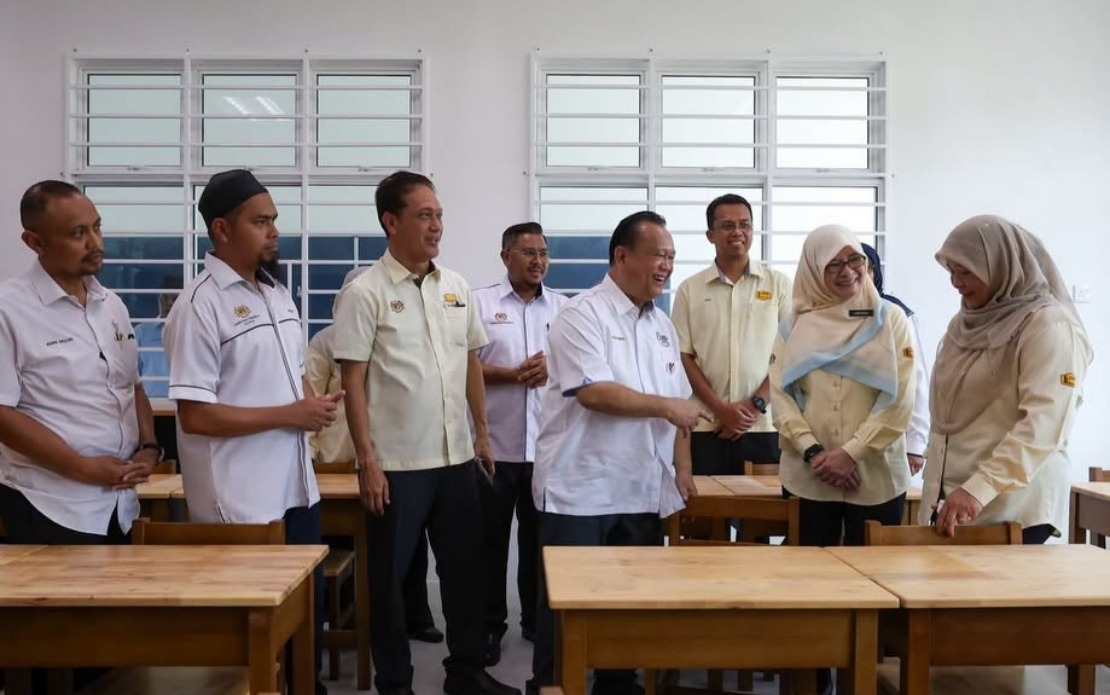
The reconstruction of SK FELDA Kota Gelanggi 1 in Jerantut has been completed significantly ahead of schedule, with Works Minister Datuk Seri Alexander Nanta Linggi hailing the achievement as a model for how government infrastructure projects should be executed. The RM7.998 million undertaking, which commenced on January 13 last year, reached full completion on June 26—nearly a year earlier than the originally projected deadline of May 2, 2027. This represents a delivery acceleration of more than 300 days without requiring any extension of time, a benchmark that officials are positioning as evidence of effective project management within the public sector.
The scope of reconstruction encompassed two distinct structures intended to modernise the school's physical infrastructure and expand its capacity to serve students with varying educational requirements. A new academic block was erected featuring three conventional classrooms alongside a dedicated science laboratory and health room, while a separate Special Education Integration Programme block was constructed with specialised facilities designed specifically for pupils with special educational needs. The dual-block approach reflects a broader policy emphasis on inclusive education within Malaysian schools, ensuring that students requiring additional support receive appropriate learning environments tailored to their circumstances.
The special education component holds particular significance for the school community, as the facilities directly serve 17 pupils identified as having special educational needs. By integrating a dedicated block within the main school campus rather than operating as a separate facility, the design promotes social cohesion and allows these students to participate in broader school activities whilst accessing specialised instruction. Minister Nanta drew attention to this benefit during the project handover ceremony, emphasising that the investment addresses a genuine gap in educational infrastructure within the Pahang region.
Nanta's public remarks underscored the successful completion not merely as a construction milestone but as validation of governmental competence in delivering complex infrastructure projects on time. He articulated that achieving such acceleration without incurring time extensions demonstrates discipline in project execution, cost management, and coordination between the Works Ministry, contractors, and local authorities. The absence of delays is particularly noteworthy given the complexity inherent in educational facility construction, which typically requires careful sequencing of works to minimise disruption to ongoing school operations.
Beyond the immediate project, Nanta indicated that SK FELDA Kota Gelanggi 1 represents part of a larger portfolio of rehabilitation initiatives across Pahang aimed at addressing deteriorating school buildings. Several additional projects focusing on dilapidated structures are currently in progress throughout the state. The Minister expressed optimism that these parallel undertakings might similarly achieve ahead-of-schedule completion, suggesting that the methodologies and operational frameworks applied to this project could be systematised across the broader Pahang school improvement programme.
During the handover ceremony, Nanta issued clear directives to construction contractors regarding their ongoing obligations beyond physical completion. He stressed that all defects identified during the mandatory defect liability period must be addressed with promptness and thoroughness, establishing accountability for workmanship quality and material durability. This emphasis reflects growing concerns within the public sector about ensuring that infrastructure projects not only complete on schedule but maintain functional integrity throughout their design life.
The Works Ministry has also tasked the Public Works Department with establishing robust post-handover monitoring protocols to safeguard the facility's long-term condition. These oversight mechanisms are intended to verify that all installed systems and structures remain operationally sound, meet established technical standards, and continue serving their intended educational purpose without degradation. Such monitoring represents a departure from historical practice whereby facilities were sometimes handed over with insufficient attention to ongoing maintenance, potentially compromising their utility within years of completion.
For Malaysian and Southeast Asian readers, this project illustrates how prioritising timely delivery of educational infrastructure can directly improve student outcomes and educational equity. The completion of two functional blocks enables the school to accommodate its entire student population, including those requiring specialised support, within properly resourced facilities. The acceleration also suggests that budget allocations for education, when managed efficiently, can yield more extensive outcomes than initially projected, effectively stretching limited public resources further.
The project's success carries implications for how future tenders and contracts for public infrastructure are structured. Evidence of accelerated delivery without quality compromises may encourage the Ministry to adopt similar contractual frameworks in forthcoming projects, potentially including performance incentives for early completion. However, this approach requires careful calibration to avoid creating pressure that compromises safety standards or worker welfare within construction sites.
For the broader Pahang region, the completion of SK FELDA Kota Gelanggi 1's reconstruction addresses a long-standing infrastructure challenge within a FELDA settlement area. The availability of modern learning facilities, particularly the specialised block for special education, positions the school to serve not only its immediate catchment but potentially as a reference facility for other FELDA schools facing comparable challenges. This demonstration effect may catalyse similar improvements elsewhere within the FELDA network throughout Malaysia.
The integration of special education facilities within mainstream school environments aligns with Malaysia's commitment to inclusive education, a principle enshrined in national education policy but not always reflected in physical infrastructure. By embedding the PPKI block within SK FELDA Kota Gelanggi 1's campus, the design actively supports social integration whilst providing the specialised resources that students with diverse needs require. This approach contrasts with institutional models that physically separate special education learners, potentially stigmatising them or limiting their exposure to peer interaction.
Moving forward, the accountability frameworks established for this project—including defect liability oversight and post-handover monitoring—merit replication across the education sector. If consistently applied, such protocols could significantly extend the functional lifespan of school buildings and reduce the cycle of repeated rehabilitation that has historically plagued Malaysian educational infrastructure. The challenge lies in ensuring that Public Works Department teams receive adequate resourcing to fulfil their monitoring mandates, a requirement that extends beyond the ceremonial handover phase into sustained operational engagement.

